
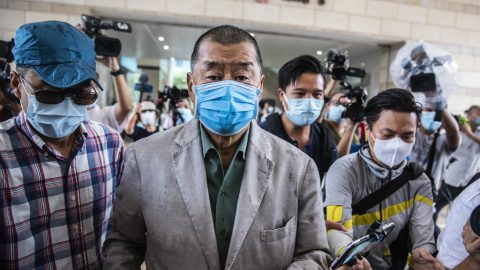
Jimmy Lai (黎智英), the media tycoon and pro-democracy campaigner, was sentenced Monday to 20 years in prison, marking the end of the high-profile trial that has come to symbolize China’s crackdown on free expression in Hong Kong.
A panel of three Beijing-vetted judges found Lai guilty last month of publishing seditious materials and colluding with foreign forces.
Lai, who made his fortune in the clothing business before founding the now-defunct newspaper Apple Daily in 1995, was the most prominent figure to be charged and convicted under China’s 2020 national security legislation, which has quashed dissent in the once-politically vibrant city.
The punishment could see Lai, 78, live out the rest of his life in prison.
“The harsh 20-year sentence against 78-year-old Jimmy Lai is effectively a death sentence,” Elaine Pearson, Asia director at Human Rights Watch, said in a statement posted on X. “A sentence of this magnitude is both cruel and profoundly unjust.”
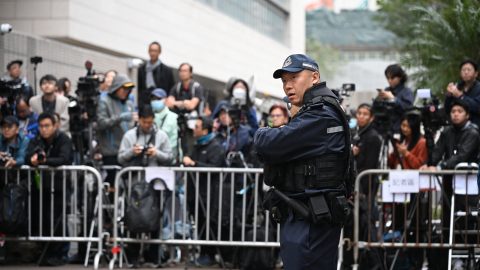
The verdict was announced just three minutes after Lai entered the courtroom. The sentence will be served concurrently with Lai’s 2022 sentence for fraud in a case over an office lease.
Lai’s supporters say his health has been steadily deteriorating behind bars since his initial arrest in December 2020. Lai’s daughter, Claire Lai (黎采), told the BBC in December that her father’s fingernails were falling off and his teeth were rotting.
Chinese authorities have repeatedly denied allegations of mistreatment.
During his trial, which began in December 2023 and concluded in September, Lai appeared physically diminished. In August, the trial was briefly postponed so that Lai, who suffers from diabetes, could be fitted with a portable heart monitor.
Claire Lai has warned that if China allows her father, who is Catholic, to die in prison, he would die a martyr, calling it “a stain that [the Chinese Communist Party] will never be able to erase.”
Beijing’s liaison office in Hong Kong said in December that Lai’s conviction was a “stern warning” to “anti-China” forces.
For Lai’s supporters, the trial itself has never seemed like the most promising avenue to win his freedom.
Since the government began charging people under the national security law in 2020, defendants have faced a near-100% conviction rate.
“He’s not going to see a fair trial,” Lai’s son Sebastien Lai (黎崇恩) said in August. “It’s an absolute kangoo trial.”
Caoilfhionn Gallagher, a human rights lawyer who has been leading an international campaign for Lai’s release, told The Nation in November that the repeated delays in Lai’s trial were a tactic aimed at slowing the momentum behind her campaign.
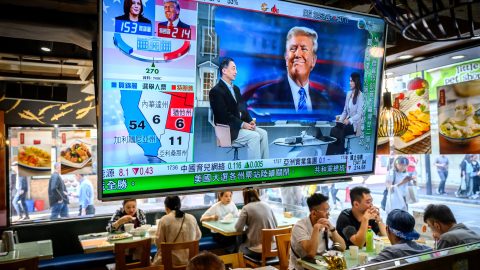
U.S. President Donald Trump, who has taken pride in his ability to free political prisoners abroad, has said that he would work to get Lai released.
Trump reportedly raised Lai’s case during his meeting with Xi Jinping (習近平) in South Korea in October, telling the Chinese leader that releasing him would be good for U.S.-China relations and positive for China’s reputation on the global stage.
“As long as the regime refuses to relinquish its authoritarian grip, more innocent people — more ‘Liu Xiaobos’ and ‘Jimmy Lais’ — will fall prey to the same oppressive system,” Taiwan’s ruling Democratic Progressive Party’s (DPP) said in a statement from its Department of China Affairs, referring to late Nobel Laureate and Chinese political prisoner Liu Xiaobo (劉曉波).
Taiwan’s Mainland Affairs Council, which handles relations with China, said in a statement that Lai’s case “once again proves that under the CCP’s so-called ‘One Country, Two Systems,’ the freedoms and rights promised to the people of Hong Kong under the Basic Law, exists in name only, with the judiciary reduced to a political tool for repression and vengeance.”
“This is not an isolated case in Hong Kong, but a sign that the CCP is accelerating its authoritarian outreach,” the council said, using the acronym for the Chinese Communist Party.
Supporters of Lai, who is a British citizen, have also called on the U.K. government to intervene on his behalf.
At a parliamentary hearing following U.K. Prime Minister Keir Starmer’s trip to China last month, Sebastien Lai expressed disappointment that the delegation had not done more to pressure Beijing.
“Time is running out for my father,” Sebastien Lai said. “Surely a man who defended freedom deserves a bit of it himself.”
This article was updated on February 9, 2026 to include statements from Taiwan’s Mainland Affairs Council and Democratic Progressive Party.




Leave a Reply