
Protesters against the proposed new Chinese embassy in London were left disappointed and concerned on Saturday after their pre-approved march route was altered by the Metropolitan Police just before the event. Many in attendance believed that the Chinese government may have influenced the decision, either directly or indirectly.
In speeches on the day, protest organizers said they had received an email the day before the demonstration confirming that a route that began at Royal Mint Court, where the proposed embassy would be located, and continued on over Tower Bridge, was acceptable to Metropolitan Police.
However, on the morning of the protest, police contacted organizers to say the route should be changed to one that only encircled the Royal Mint Court complex — and did not include Tower Bridge.
“Yesterday … the organizer of this protest received a really kind email saying they [the police] were fine with the proposed route of the demonstration … to cross the Tower Bridge and come back…” one of the organizers, Clara Cheung (張嘉莉), told a crowd of around 2,000 people.
“But after — I don’t know what kind of dream they had — but this morning, while everyone from the north is coming down … the Metropolitan Police actually sent out a message saying that ‘Oh, no, we are now actually objecting to this proposed route’ because of various factors — and they don’t actually want to clarify what factors there are,” she said.
On its X account, the Metropolitan Police said “Conditions have been imposed under the Public Order Act to prevent serious disruption.” But did not go further.
Attending the protest on Saturday, Domino Theory spoke to various protesters who believed that the unexplained late adjustments to the march route were caused by Chinese government influence.
One protester in his 40s said he had attended protests in the area around issues such as the civil war in Sudan, the treatment of Palestinians in Gaza and nurses’ pay, but he had never seen a route changed so late on. He felt it “must be” because of Chinese government interference.
Another protester in his 30s who was originally from China said he felt ongoing trade talks between the U.K. and China were likely to be a factor in the decision.
Another protester who had been a lawyer in Hong Kong said the police’s decision was an example of how closer ties between the U.K. and China could have a negative effect on freedom in the U.K.
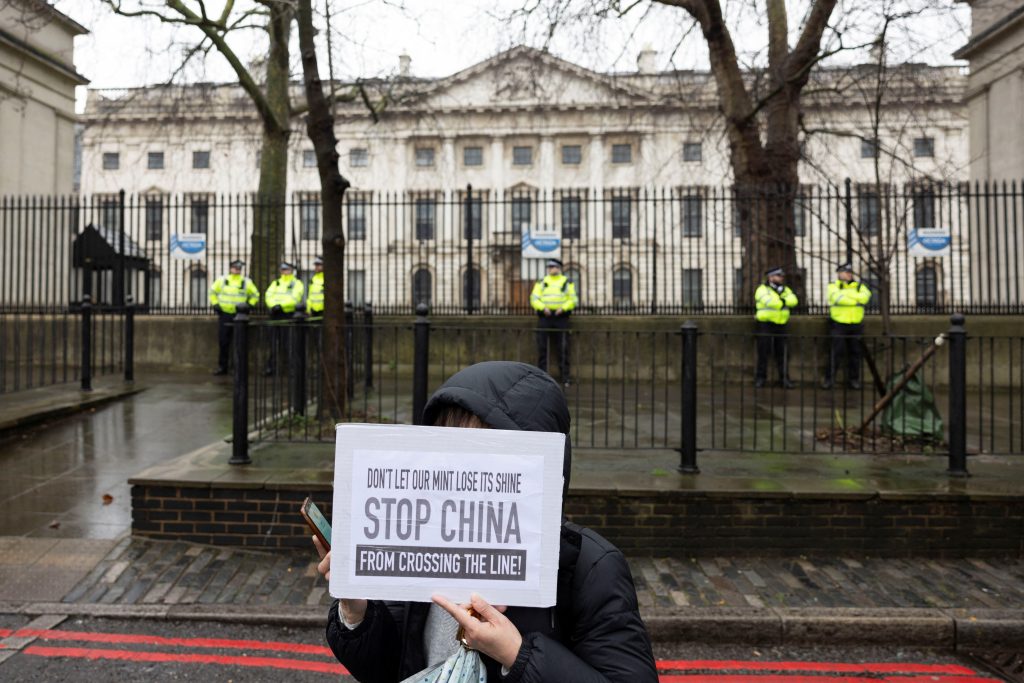
“We just want to walk and demonstrate and want to let more people know about this message. And this is really disappointing that they only want us to stand in this restricted area… while in some other protests with other ethnic groups… previously they were allowed to cross exactly this bridge, the Tower Bridge,” Cheung told the crowd.
The proposed Chinese embassy is controversial because protesters believe it could be used as a base for increased surveillance of Hong Kongers and dissidents in the U.K.
The decision over its development has already changed multiple times. The Chinese government originally purchased the site in 2018. But in 2022, the local Tower Hamlets Council refused permission for the development to be transformed into an embassy. Then, in October 2024, the new Labour government took over responsibility for the decision. Secretary of State for Housing Angela Rayner is expected to make a final decision on the future of the site this month.
Should it be built, some reports suggest it would become the largest embassy in Europe.
In advance of a final decision, the Metropolitan Police warned last week that protests of more than 500 people outside the embassy would impede traffic and “require additional police resources.” The force had previously objected to the development itself, but it withdrew that objection in January.
Update (May 12): The Metropolitan Police’s press office told Domino Theory the change of route “was an operational decision and not due to any contact with either Government. Was put in place to prevent disruption as we said in our X post.”






Leave a Reply