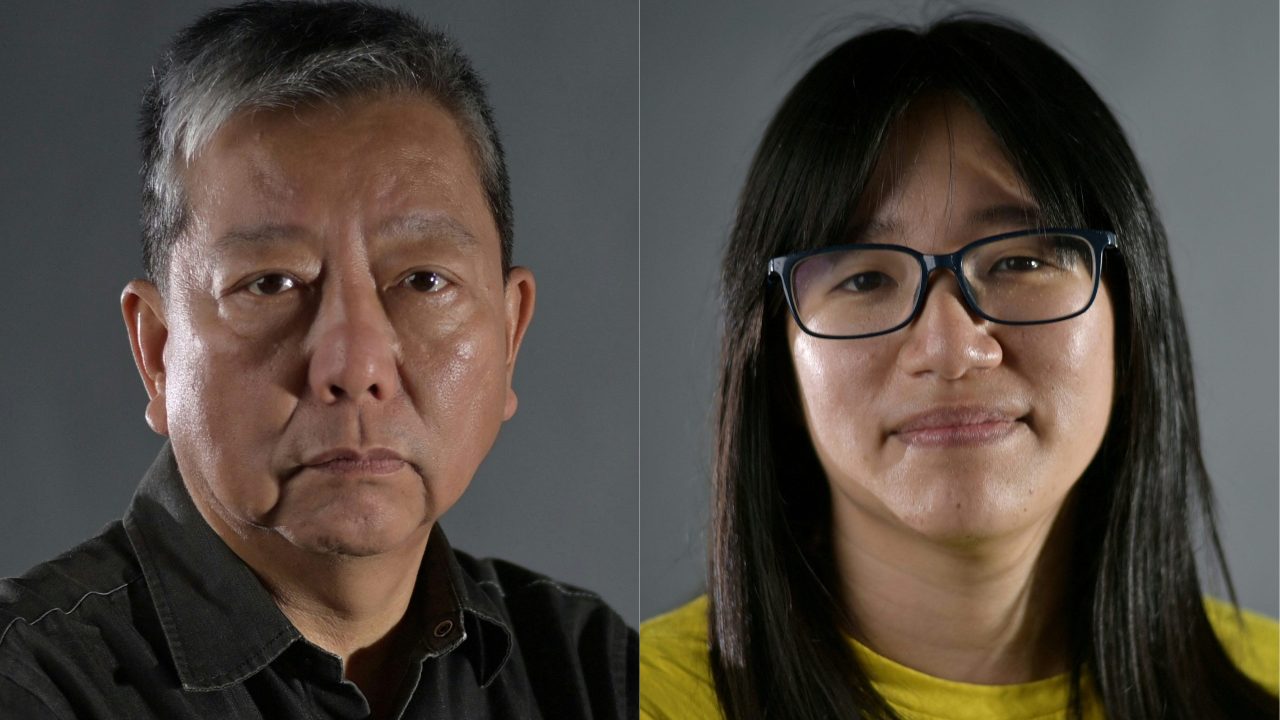
The organizers of the annual Tiananmen Square vigil in Hong Kong were found guilty of violating China’s national security laws on Friday and now face sentences of up to 10 years in prison. Before they were banned, the peaceful vigils at Victoria Park were the largest in the world dedicated to remembering Beijing’s violent crackdown on democracy protesters in Tiananmen Square on June 4, 1989.
Chow Hang-tung (鄒幸彤), a human rights lawyer, and Lee Cheuk-yan (李卓人), a former pro-democracy lawmaker and labor leader, were convicted of “inciting subversion of state power” by Hong Kong’s High Court. Albert Ho (何俊仁), another former pro-democracy lawmaker, pled guilty to the same charge in January.
Chow, Lee and Ho were leaders of the Hong Kong Alliance, which organized the Tiananmen vigil for three decades before it was banned by authorities in 2020 during the Covid-19 pandemic. In 2021, authorities “effectively forced” the alliance to disband, arresting its leaders and launching a police investigation into its activities.
Chow and Lee have been held in pre-trial detention since their arrests in 2021.
“Under a regime that fears subversion from flowers and candlelights, the only ‘crimes’ the members of the Alliance have committed are for daring to seek the truth, pursue justice and democracy, and commemorate the sacrifice of those who lost their lives in its pursuit,” said Megan Khoo, policy director of Hong Kong Watch, in a statement.
Hong Kong authorities have tried to argue that the charge “did not involve any issue relating to democracy” and that political will or beliefs was not on trial. Rather, by calling to “end one-party rule” in China and organizing others around that message, the alliance was effectively seeking to overthrow the Communist Party, which is in violation of Article 22 of the National Security Law. It did not matter whether their actions involved violence, the court ruled.
“The defendants intended to cause others to lose confidence in the CPC by stirring up hostility and causing division,” Hong Kong’s Secretary for Security, Tang Ping-keung (鄧炳強), said in a press conference after the ruling, using an acronym for the Chinese Communist Party. “You can see how evil the defendants are in trying to undermine our Constitution and trying to undermine our Central Government.”
Chow, who represented herself in the trial, argued in her closing statement that China’s constitution can be interpreted in a way that accords with the principles of the rule of law, but it is impossible for the court to claim to uphold the rule of law while also criminalizing a phrase like “end one-party rule.”
“A rose won’t become a chrysanthemum just because you refuse to call it a rose,” Chow said. “It is precisely because the party has taken control of the gun and monopolised overwhelming force that the constitution and the law [are] stripped of any real power and reduced to mere window dressing. That explains how the June 4th massacre transpired.”


Leave a Reply