
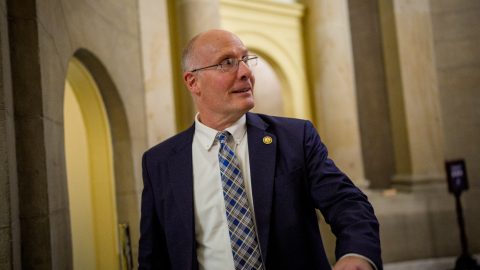
Congressman John Moolenaar, chairman of the House Select Committee on China, has asked the Federal Reserve to revisit financial arrangements with Hong Kong that were based on the city’s legal and institutional independence from China.
Since Beijing’s 2020 national security law, that independence no longer exists, Moolenaar wrote in a letter to Fed Chairman Kevin Warsh on Tuesday, calling into question a policy instrument that had granted the Hong Kong Monetary Authority easy access to liquidity.
“The United States has historically treated Hong Kong as a separate financial and legal jurisdiction because it maintained the rule of law, an independent judiciary, a free press, and protections for political expression guaranteed by the 1984 Sino-British Joint Declaration and Hong Kong’s Basic Law,” Moolenaar wrote. “Each of those foundations has now been removed.”
During the COVID pandemic in 2020, the Fed set up a repurchase agreement facility in Hong Kong, which allowed the city government to quickly transform its U.S. Treasury bond holdings into liquid dollars.
But that was before Beijing’s national security sparked mass protests, leading to the arrest and imprisonment of numerous high-profile democracy activists, including the former Apple Daily publisher Jimmy Lai (黎智英).
“This request is prompted by two distinct but reinforcing developments: (1) a material change in the strategic and financial landscape since the FIMA Facility was made permanent in July 2021, and (2) the complete dismantling of the legal and institutional autonomy that has historically distinguished Hong Kong from mainland China and justified its preferential treatment under U.S. law,” Moolenaar wrote.
Hong Kong’s adherence to Western institutional norms based on the British legal system had long allowed it to serve as a preferred financial entry point to the Chinese market. Some of China’s largest private firms have chosen to make their initial public offerings on the stock exchange there, eager for the exposure it enabled to Western capital.
But a series of tighter and tighter crackdowns from Beijing on Hong Kong’s independence have called into question the very identity of the city. Now that Hong Kong’s status has changed, Moolenaar argued, perhaps the Fed’s policy should, too.





Leave a Reply