
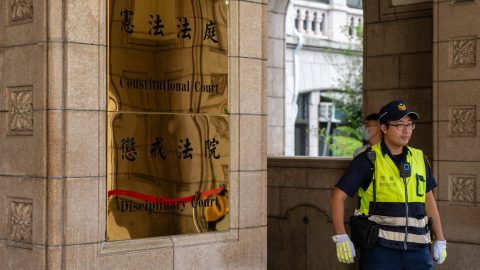
On Friday, Taiwan’s Constitutional Court effectively reactivated itself, declaring amendments that had prevented it from delivering rulings for more than a year unconstitutional and adding yet another twist to the island’s brewing constitutional crisis.
The amendments, which the opposition-led legislature passed after President Lai Ching-te (賴清德) took office last year, had raised the minimum number of judges required to issue a ruling. This paralyzed the court, which was understrength after seven members reached their term limit last year. The legislature has since repeatedly rejected Lai’s nominees for the open places on the 15-seat court.
The judiciary’s ruling came at the end of a week of political gamesmanship, which saw both the Chinese Nationalist Party (KMT) and President Lai’s Democratic Progressive Party (DPP) cast the other as a threat to Taiwan’s democracy.
On Monday, Taiwanese Premier Cho Jung-tai (卓榮泰) announced that he would not sign amendments to a spending bill that the legislature passed last month. Cho said the legislation’s stipulated increases in local government funding would push government borrowing past the statutory debt ceiling of 15 percent of the national budget, thus forcing the executive branch to enforce one law in violation of another.
Cho had previously sent the bill back to lawmakers for further consideration under a provision in Taiwan’s constitution that allows the executive branch to hold up bills it considers difficult to enforce. The legislature then rejected Cho’s request by a simple majority, a move akin to overriding a veto.
Under the Taiwanese constitution, the premier is required to co-sign any bill that reaches his desk following an overridden veto. Under ordinary circumstances, it would then fall to the Constitutional Court to rule on the constitutionality of Cho’s refusal. Without enough justices to form a quorum, the court could not do so.
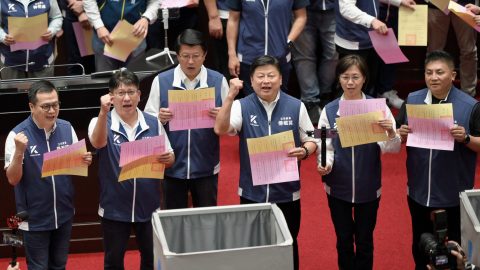
On Thursday, the KMT and its ally the Taiwan People’s Party (TPP) had threatened to introduce a vote of no confidence for Premier Cho, a move he said he would treat as a “democratic badge of honor.”
Under Taiwan’s constitution, if Cho were to be removed, it would allow Lai to dissolve the parliament and call new legislative elections. Observers have pointed out that this is probably too great a risk for both the KMT and TPP to countenance.
Then, on Friday morning, the KMT held a press conference to announce that it intended to introduce a petition to impeach Lai early next week. The petition would then pass to the Constitutional Court, which had remained in frozen limbo until Friday afternoon’s declaration.
Analysis: High Court Ruling Was a Curveball
It’s Friday evening in Taipei. While members of the DPP-led executive branch could perhaps have known this was coming, it seems very unlikely that the KMT-TPP alliance would have planned for this eventuality.
Even after the court’s ruling, which could conceivably allow them to rule on impeachment proceedings against Lai, the president still appears safe for now. Removing him would still require a final two-thirds’ majority vote of the legislature, where the KMT-TPP coalition only holds just over 50 percent of seats.
With the Constitutional Court back in business, the executive branch could now refer the legislation that Premier Cho refused to countersign to the existing seven justices. That could defuse the current constitutional crisis: If Cho were no longer actively refusing to countersign, and especially if he committed to abide by the court’s decision, the crisis would appear to disappear.
In that new context, the KMT and TPP must decide whether to proceed with impeachment of Lai, while also working out how to defend the legislative prerogative they established by moving to restrict the court’s ability to operate last year.
Will they ask the Constitutional Court to make a ruling on whether its reactivation ruling was unconstitutional?



Leave a Reply