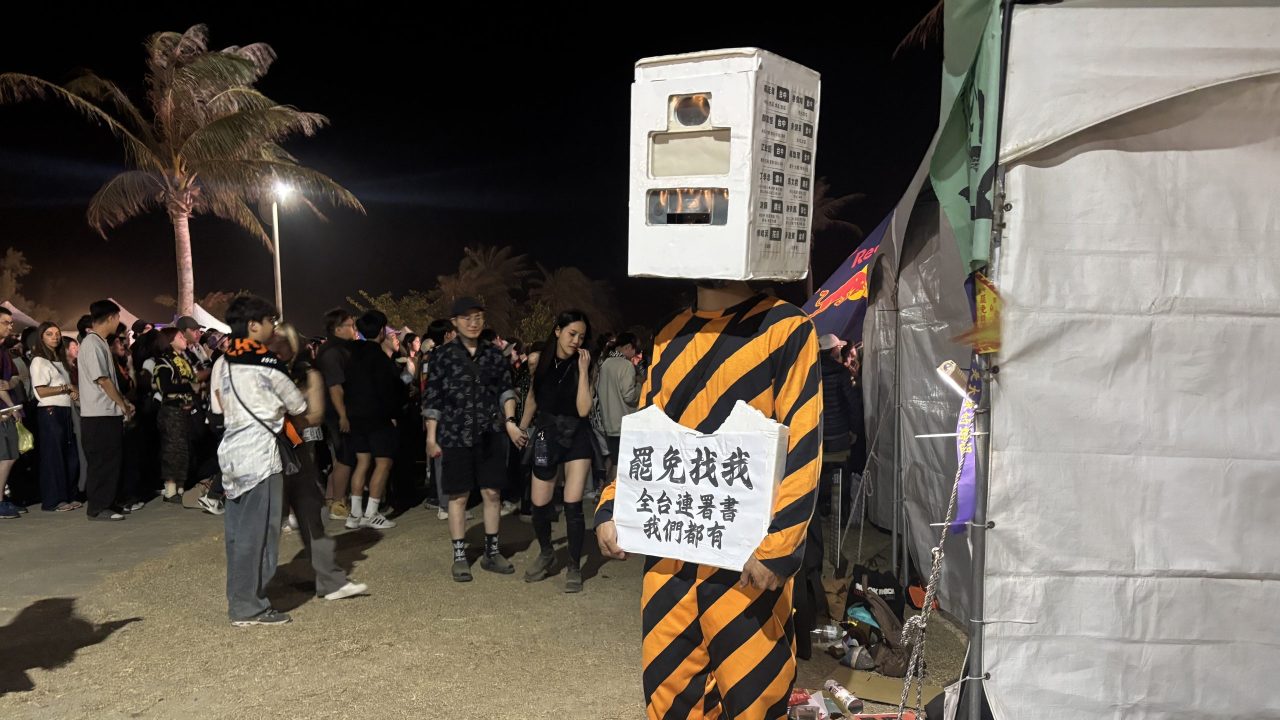
Over 1 million people cruised into the Taiwanese beach town of Kenting last weekend to attend the Taiwan Music Festival. It is the unofficial successor of Spring Scream, which two American expats, Jimi Moe and Wade Davis, started in 1995 as “a festival held by musicians and for musicians.” Spring Scream was the longest-running outdoor music festival in Taiwan and the “progenitor of countless other music festivals across the country” and even across the region, preceding Japan’s Fuji Rock Festival by two years.
Spring Scream had a South by Southwest vibe mixed with a bit of Woodstock and it is credited with jump-starting Taiwan’s indie music scene. The festival petered out in 2019 following an unusually low turnout which then Kaohsiung Mayor Han Kuo-yu (韓國瑜) tried to recover with an infamous karaoke performance. The Pingtung County government took the mantle in 2021, introducing the Taiwan Music Festival.
The Taiwan Music Festival is quite a bit more corporate than Spring Scream was, particularly in its early years. But there is still an independent spirit to the festival — Made Mantle Hood, the director of the Graduate Institute of Ethnomusicology at Tainan National University of the Arts, told Domino Theory that the event is “enabling” of up-and-coming indie artists, with the support of more mainstream acts and corporate sponsorships.
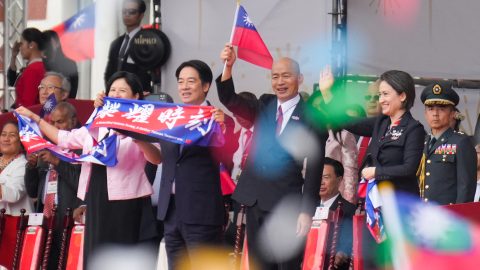
The festival also had explicitly political elements to it. It featured not only grassroots organizing, but also a pre-recorded appearance by Taiwanese President Lai Ching-te (賴清德), who held up a towel with the event’s slogan “At least we still have music.” Chinese Nationalist Party (KMT) politician Hsu Chiao-hsin (徐巧芯) called out the unfortunate irony of Lai’s use of the slogan following Trump’s imposition of 32% tariffs on Taiwan, which led to the largest single day drop in the Taiwan Stock Exchange on record on Monday. Although the video was technically recorded on March 26, this was Lai’s first public appearance since the tariffs were announced last week. Other instances of partisan tension at the festival happened at the grassroots level.
Activist Hsieh Min-siou (謝旻修) came to the Taiwan Music Festival dressed in a tiger onesie to advocate for the recall of certain KMT legislators and collect signatures in support of the recall. His activism is part of a wider recall battle happening right now between Taiwan’s two largest parties, the KMT and Lai’s Democratic People’s Party (DPP), whereby each is trying to recall 12 and 35 of the other’s legislators, respectively. A primary difference between the KMT and the DPP is their position toward China — while the KMT tends to be more conciliatory toward Beijing, the DPP tends to view China as a threat that needs to be countered.
KMT politicians have complained that the efforts to remove 35 of their legislators were roused by the DPP from the top down, but Hsieh’s efforts were as grassroots as could be. Hsieh came to Taiwan Music Festival by himself — the group of about 25 people who gathered to help him over the three-days mostly met him at the festival, while some joined after seeing his posts on Threads.
“Since around May of last year, [the KMT has] been pushing for bills that could put the country in danger,” Hsieh said, highlighting three controversial pieces of legislation: amendments to the budget, the Election and Recall Act and the Constitutional Court Procedure Act. Hsieh also mentioned a proposal the KMT is pushing that would let Chinese spouses obtain a Taiwanese ID card in four instead of six years, “basically turning Taiwan into a place vulnerable to infiltration.” “A lot of young people still don’t know about these issues. That’s why we’re holding this recall movement — to raise awareness,” Hsieh added.
From a position of elevated influence up on stage, a member of the band GOODICK (固定客) gave Hsieh a shout out, encouraging festival goers to go sign the petition. “I support us being our own masters,” he said.
Multiple other artists also voiced support for the recall, according to reporting by TVBS. GIGO, the lead singer of Flesh Juicer (血肉果汁機), took the stage on Thursday night and proclaimed, “If you want to protect your homeland, then go sign the recall!” Sunset Samurai (夕陽武士) also urged their audience to sign the petition.
At Kaohsiung’s Megaport Music Festival on the weekend prior, the band Sorry Youth (拍謝少年) played an animation during their performance that many have connected to the KMT recalls. The animation featured Taiwanese as pigs and the People’s Republic of China as wolves (connotating evil, as well as wolf-warriorism). At one point in the animation, several wolves are seen disguised as pigs riding on Taiwan’s metro. This could be a reference to a number of things: PRC disinformation, pro-Beijing Chinese influencers in Taiwan (three have recently been deported) or pro-China politicians in the KMT. Regardless, the message was clear: “This island still holds so many stories waiting to be told. If we don’t protect it, others will speak for us,” the band said.
Indeed, music has played an important role in Taiwan’s political development. Chu Meng-tze (朱夢慈) — an associate professor at Tainan National University of the Arts, who told Domino Theory she performed during the first year of Spring Scream with her all-female punk band — has focused on how black metal music in Taiwan, particularly the band Chthonic (閃靈), who also performed at Spring Scream, contributed to the articulation of specifically Taiwanese national identity in the years following democratization. In 1998, Chen Shui-bian (陳水扁), who would become the first DPP president, said of Chthonic, “in their music is written the history and spirit of Taiwan.”
Chthonic’s lead vocalist, Freddy Lim (林昶佐), is now a Taiwanese legislator. Inspired by the 2014 Sunflower Movement — a student-led occupation of the Legislative Yuan to protest the passage of a trade agreement with China that protesters feared would make Taiwan vulnerable to Chinese economic coercion — Lim co-founded the New Power Party (NPP). The NPP supports Taiwan independence.
The Taiwanese punk rock band Fire Ex. (滅火器樂團), a headliner at Taiwan Music Festival this year, was also deeply involved in the Sunflower Movement. Their song Island’s Sunrise (島嶼天光) was the movement’s unofficial anthem. On Saturday night, eleven years after the Sunflower Movement, Fire Ex. closed out the Taiwan Music Festival. After the concert ended, festivalgoers streamed out of the venue and into the night market along Kenting’s main drag.
Taiwan independence flags that had been flying high throughout the festival — manned by indefatigable grassroots activists — seemed to switch hands like a common good in motion. Several left the concert with “I stand for Taiwan independence” draped over their shoulders.




Leave a Reply