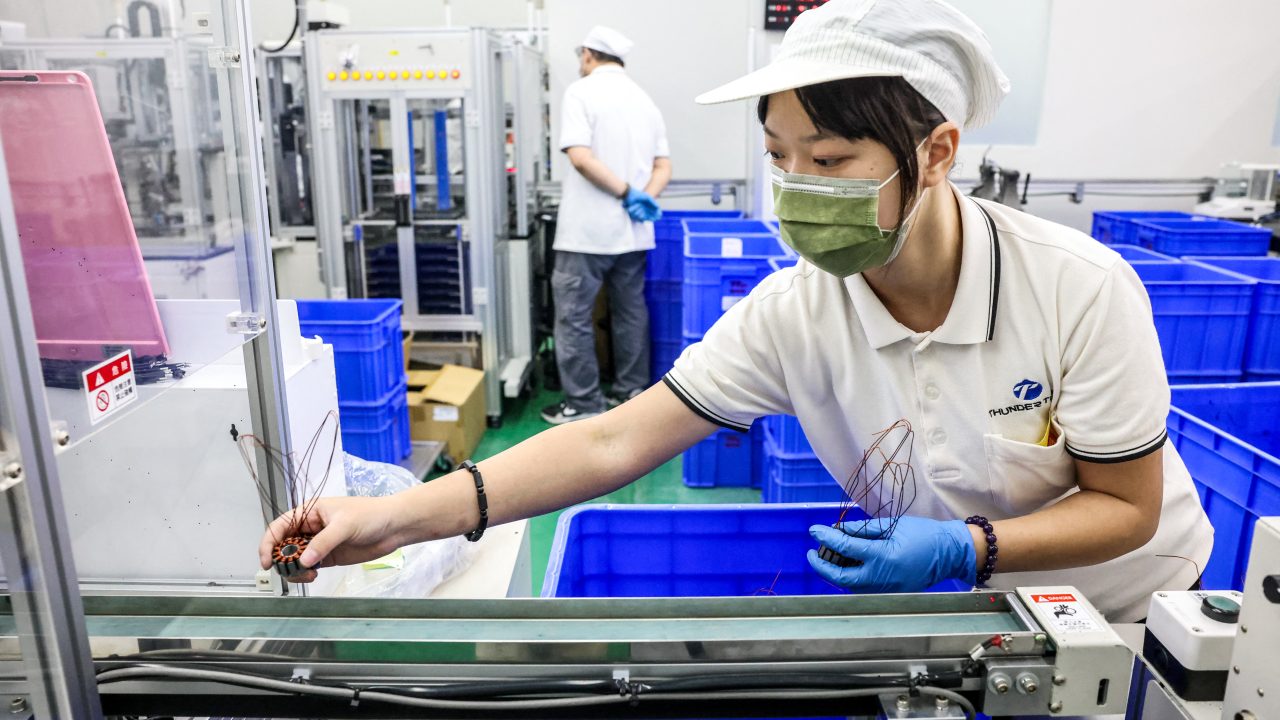
Taiwan’s drone industry has been experiencing an export-driven surge lately, driven in part by the promise that it can provide an alternative for countries wary of reliance on China, whose firms have long dominated the global market for drones. Central to Taiwan’s sales pitch is the concept of the “non-red supply chain,” the guarantee that not only will its drones be manufactured in Taiwan, but that none of the parts that make up those drones will be sourced from China.
So the revelation last week that leading domestic drone maker Thunder Tiger provided the Taiwanese military with drones that contained microchips packaged in China has raised some eyebrows.
In April, Thunder Tiger won a contract worth 20 million New Taiwan dollars (roughly $600,000) to supply training drones to the Taiwanese military. While army personnel were inspecting the delivery, they found “CHN” markings that had been partially removed from the drone’s flight control chips, according to a report from CNA.
Thunder Tiger has since denied that any of the chips powering its drones were manufactured in China. The components discovered by the military, the company said, are compliant with the Taiwanese military’s procurement requirements. The company said its flight control chips are sourced from STMicroelectronics, a French firm that manufactures its products in Europe, but sends some to China for packaging.
The incident has revived debates about what exactly qualifies as a non-red supply chain, and the plausibility of such a requirement in frontline democracies desperate to scale up their defense industrial bases in an era of growing geopolitical risk.
Chun-Yi Lee (李駿怡), director of the Taiwan studies program at the University of Nottingham, says the complexity of supply chains for high-tech industries like drones makes truly non-red compliance an unrealistic standard, even for firms most eager to comply.
“It’s difficult for the company to really control the details of their suppliers, because it’s very difficult for them to say that you cannot outsource to a third party,” Lee said. “And who knows? Who knows [whether] the third party is or is not Chinese.”
Thunder Tiger is not the first Taiwanese defense manufacturer to come under scrutiny for its reliance on Chinese components. In March 2024, local media discovered that a Geosat Aerospace and Technology drone prototype presented to Lai Ching-te (賴清德), who was then president-elect, during a visit to Taiwan’s drone research and development hub in Chiayi contained a motor sourced from a company that supplies the Chinese military. Geosat’s chief executive, Max Lo (羅正方), later sought to assure the public that Chinese components would not be used in units actually delivered to the military.
Security concerns about Western democracies’ reliance on Chinese manufacturers have been growing for years. In 2015, the Chinese government released its “Made in China 2025” initiative, which sketched out a plan for the country to dominate high-end manufacturing in sectors like drones, batteries and solar panels.
More than a decade and billions of dollars worth of subsidies later, China has achieved many of those goals. That industrial dominance, together with Beijing’s increasing willingness to weaponize it in the pursuit of a more favorable trade environment, has left the rest of the world scrambling to develop their own alternatives.
In the United States, drones procured by the military must receive a “Blue UAS” certification, which prohibits them from using critical components, electronics or software sourced from foreign adversaries, most notably China. Last September, Thunder Tiger’s Overkill suicide drones became the first Taiwanese drone to qualify for the certification.
Chip packaging, when chips are encased in a protective material so that they can be integrated into a larger device, has not traditionally been viewed as a critical component of high-tech supply chains. Thunder Tiger said the “CHN” markings on the training drones they supplied to the Taiwanese military indicated that the flight control chips had been packaged in China, but that this did not mean they violated the government’s non-red requirements.
In the AI era, massive demand for data centers has transformed chip packaging from one of the least glamorous steps in the tech supply chain into an area of fierce competition, where Taiwan continues to lead the way. But for drones, which do not contain the intricate arrangement of logic and memory chips found in today’s AI servers, the packaging step remains a relatively low-tech link in the chain.
One alternative would be to advocate instead for technological sovereignty, where countries carefully control the most high-tech components of the supply chain, while allowing for less complicated steps to remain in China. This appears to be the standard to which Thunder Tiger is holding itself, even as the Taiwanese government continues to tout the non-red supply chain.
“The non-red supply chain, I really think, is ideology rather than reality,” Lee, the Nottingham professor, said.




Leave a Reply