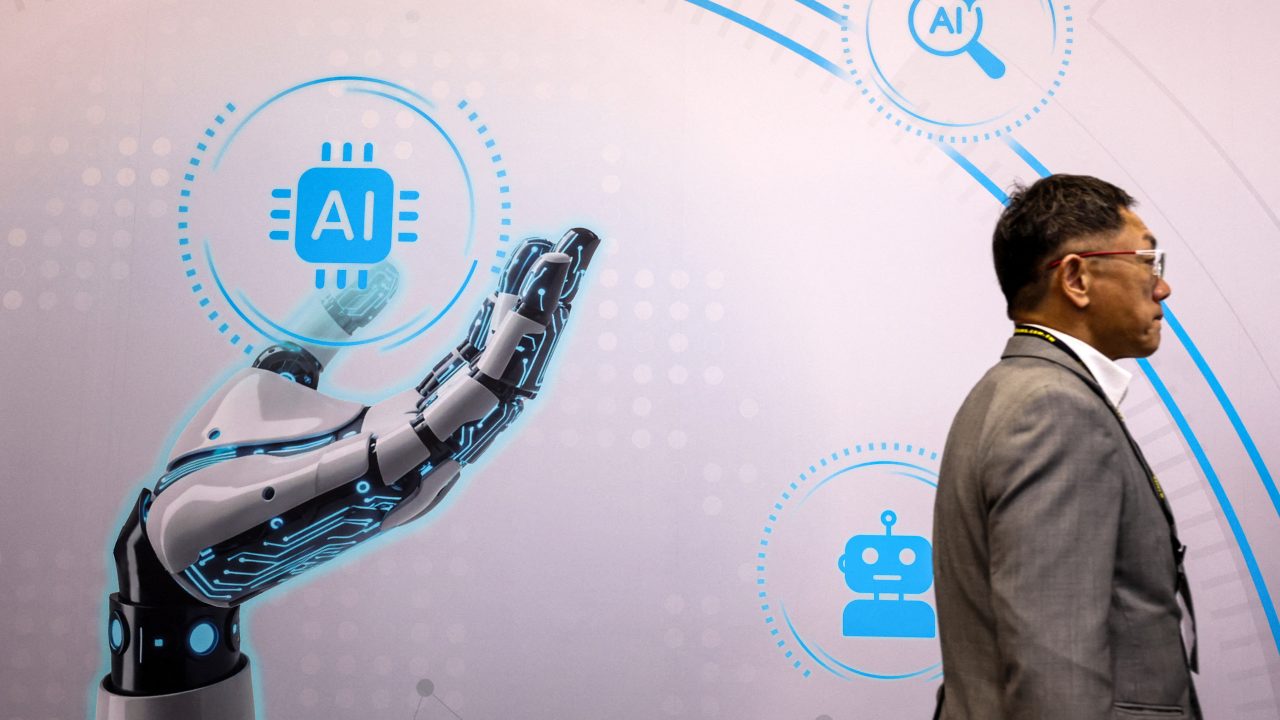
Many robots could be spotted competing for eyeballs and internet bandwidth at the Computex trade show in Taipei this week as they picked up boxes, walked, gestured and chatted. The machines sometimes struggled to walk or talk, leaving the impression that robotics, at least in Taiwan, remains on the frontier of artificial intelligence.
“The next leap in AI is general-purpose robots — humanoids,” said Jensen Huang, chief executive of Nvidia, during his keynote speech at the Nvidia GTC conference on Monday. “But building one is hard. Every team starts from scratch.”
Domino Theory spoke to several Taiwanese vendors showcasing their own robots. While none of them built their machines entirely from scratch — many use technology sourced from China’s cheaper and more abundant market for robotics components — some intend to do so by the end of the year.
“The reality is that what you are watching over here is a combination of multiple companies at the same time,” said Brian Tsai (蔡宜盛), a sales director for the Taiwanese manufacturer AAEON Technology. Tsai gestured at the humanoid that AAEON developed in partnership with Intel, which was busy picking up and putting down a small pedestal with a computer chip glued to the top of it. “It’s not made by one single company. No one has this capability for the moment.”
Under the leadership of President Lai Ching-te (賴清德), Taiwan’s government has focused on marketing itself as the linchpin to a “non-red” tech supply chain that excludes China. But for Taiwanese companies in the robotics industry, this can be difficult to achieve.
It’s “very difficult” to stay away from China’s robotics supplier market because components like depth cameras, a type of 3D camera, are “always cheaper” in China, said Jeffrey Hwang (黃子洋), a sales coordinator at Aeolus, a Taiwanese company that has deployed cleaning robots in Taoyuan International Airport and a receptionist robot in the Tainan mayor’s office. But since some customers don’t want to buy products that contain Chinese components, particularly if those components connect to the internet, Aeolus has sourced its cameras from elsewhere.
Solomon, a Taiwanese industrial AI and machine vision company, adapts their use of Chinese hardware according to customer preferences — high-tech manufacturers tend to be more sensitive to China branding than lower tech manufacturers who have fewer data security concerns and care more about cost, said sales director James Chen (陳敬孟). The robot bodies of Solomon’s humanoids on display at Computex, which could walk about two meters to pick up a sleeve of oreos, were made by Unitree, the Chinese robotics giant based in Hangzhou. Chen said that Solomon uses Unitree hardware for their robots because “they’re actually in production,” as opposed to being in the prototype stage like many other robotics companies. For customers not interested in a product that incorporates Unitree technology, Solomon sources humanoid hardware from companies in the U.S. and Japan like Under Control Robotics and Kawasaki, respectively.
“Unlike the U.S., Chinese companies aggressively launch products into the market even before they reach full technical maturity,” wrote Taiwanese startup founder and investor White Hsu (徐唯槐) for his blog, the Taiwan Tech Dispatch. “Unitree, for example, sells consumer quadrupeds at roughly one-tenth the price of Boston Dynamics’ Spot, already exporting globally.”
Avoiding China means that robotics components might not only be more expensive, but also harder to source.
A Taiwanese vision company called oToBrite makes AI-enabled vision technology for drones, vehicles and other robots. At their factory in Hsinchu, they integrate image sensors from Japanese and American companies like Sony and Omnivision, and lenses from Chinese companies. OToBrite’s customers generally do not mind that the lenses come from China, since these components are not related to security risk concerns, said Steven Wu (吳思緯), a sales manager. While high resolution lens systems are similarly expensive in Taiwan and China, less advanced lenses tend to be 40% cheaper in China. For all lenses, the options are more plentiful in China.
A researcher at Foxconn, who wished to be unnamed, told Domino Theory that Foxconn does not source any hardware components from China for its medical robot collaboration with the Japanese manufacturer Kawasaki, making these robots about 10% to 20% more expensive to produce.
The cost of making a robot in China is lower because they have economies of scale, said Tom Wang (王政堂), the general manager for the Taiwan branch of Graphen, an American robotics company. Once the market in Taiwan grows, he expects the industry to become competitive with China. His team has noticed some quality and reliability issues with Chinese humanoids that he believes can be fixed with better management and manufacturing in Taiwan.
Graphen has a team based in Taiwan that is dedicated to making an entirely Taiwanese humanoid robot by the end of the year. The robot’s name is Aiter One — it’s a homophone for “I love Taiwan” in Chinese.






Leave a Reply