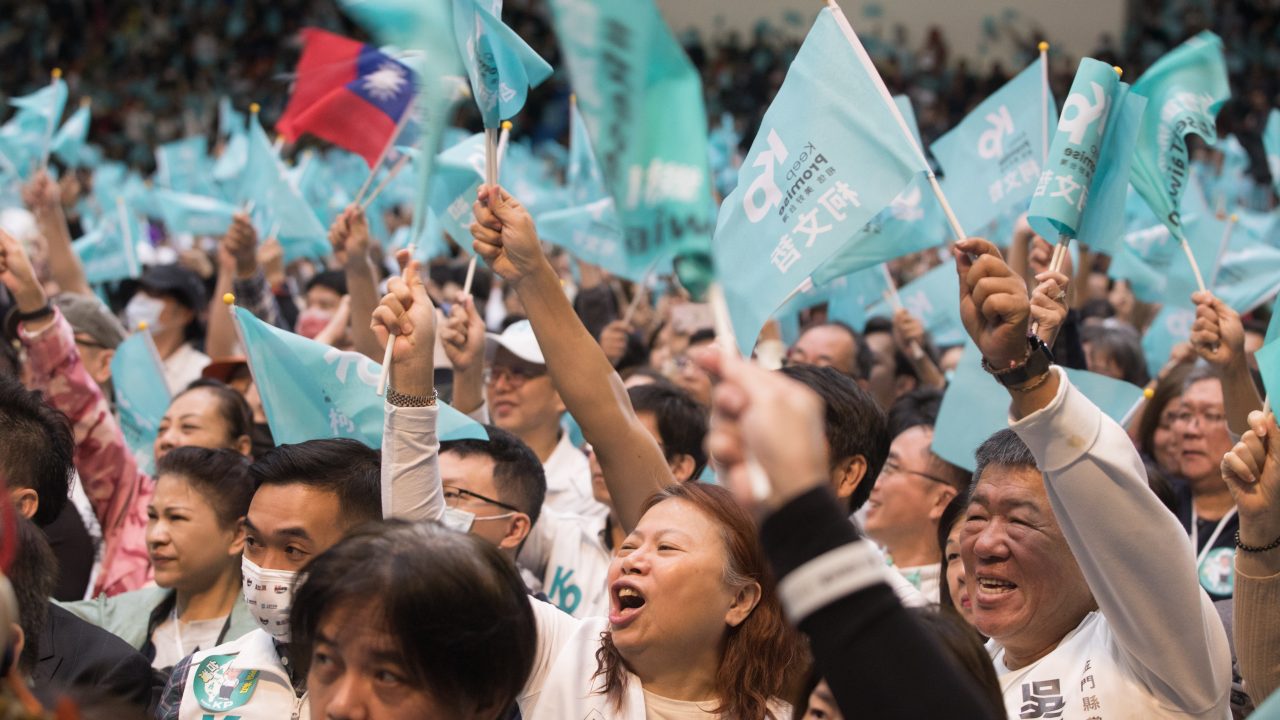
In a blogpost last month, Taiwan election analyst Nathan Batto pointed out that straightforward voting intentions aren’t the only important kind of polling data when predicting election results. The way voters feel about candidates also matters. This is because although certain core groups of supporters make up their minds about who to vote for well in advance of election day and won’t change, other members of the public have less strong preferences and are more likely to “vote with their guts.” Thus, you could say that these more changeable voters might be swayed by the overall “vibe” a candidate and their supporters are giving off.
For anyone interested in this nebulous metric, Tsai Yu-chieh (蔡宇傑) and Wu Mu-tan (吳至袁; 木炭) might be the best two people in Taiwan to talk to. Running a YouTube channel with more than 80,000 subscribers, Tsai and Wu make videos that achieve hundreds of thousands of views, and that following has been built up by doing political street interviews. Having completed over 3,000 interviews about January’s election, plus around 1,000 about last year’s local elections, they believe they’ve spoken to more people on this topic than anyone else. That combined experience makes them foremost experts on “the vibes.”
So, whose supporters seem most enthusiastic? “Most people are pretty passionate, especially when speaking of the subjects or the candidates they care about,” Tsai says via video call. But if he had to lean one way or the other? ”Looking at the results from the long term, Ko [Wen-je (柯文哲)]’s supporters are just a little bit more passionate. It could be the policy or the things they hope that can be changed,” he says.
This verdict is also reflected in their overall polling. Contrary to the professional pollsters, who have had the Democratic Progressive Party (DPP) candidate Lai Ching-te (賴清德) out in front for some time, Tsai and Wu’s unofficial “street” polling has Taiwan People’s Party Ko up around the same level, with the Chinese National Party’s (KMT) Hou Yu-ih (侯友宜) a more distant third.
Now, beyond this “vibe check,” both Wu and Tsai are admirably cautious about making any big declarations regarding public opinion. To our inquiry about how informed different sets of voters are about their choice of candidate (amid relatively common suggestions from elsewhere that Ko supporters don’t really understand Ko’s politics), they point us to their interviews and say they stand for themselves, so the audience can judge.
Partly this caution might reflect their background — at university they both majored in mass communication, rather than politics (though they note by email that of course media and politics are connected.) But mostly they seem genuinely committed to just letting Taiwanese voters speak for themselves, rather than imposing their own narratives on their thoughts. They say they keep the videos raw, uploaded without edits. They only cut out the people who say no to being interviewed entirely.
Still, Tsai and Wu are willing to pull out certain interesting themes from their interviews. The most common topics brought up by interviewees were the economy and China, they say. And when we ask why many people seem reluctant to talk on camera about who they will vote for, they’re both pretty clear that it doesn’t represent disinterest in the election — rather, it’s not everyone, and it’s a circumstantial issue.
“I think a lot of people aren’t that close to elections, so they don’t have a candidate set in mind yet, or they just occasionally learned about it from TV news. They won’t immediately know who they would like to vote for, they would have to think about it first before answering,” Tsai says. “There’s also the factor that if you suddenly shove a microphone in front of them, they won’t know what to say. Not everyone can express themselves freely in front of a camera,” Wu adds.
All of this doesn’t mean the two YouTubers have come away from all of these interviews entirely optimistic about the state of Taiwanese democracy, however. When asked about it, Tsai was the more optimistic of the two, saying that people felt free to express their opinions. But both had doubts about the media’s coverage of the election being fair, suggesting bias meant people were provided with only a fragmented knowledge of politics. In short, they’re generous in their view of Taiwan’s people — who they also note are always polite in interviews — but they’re openly sceptical of the media providing them with information.
In the end, they don’t say it, but that is a niche their channel helps to fill. It’s a direct line into the views of Taiwanese people about this election and offers a useful insight into the nature of public opinion on the whole, showing it as sporadic, moveable, simultaneously shallow and deep, and always a bit more surprising than a set of polling numbers can really represent. Wu and Tsai have spoken to 80-year-old Ko supporters (his base is supposed to be 20-somethings), a city full of Hou supporters in the middle of DPP-held Chiayi County (Puzi City is Hou’s hometown) and found that Ko was less popular in traditional Taipei City markets than they expected (he served two terms as its mayor).
The overall effect is to remind people that the truth of public opinion is always somewhat of a rich tapestry. Though, yes, of course we will be asking these guys to give us their prediction for who’s going to win in the week before the election.
Photo: Jameson Wu/EyePress via Reuters Connect




Leave a Reply