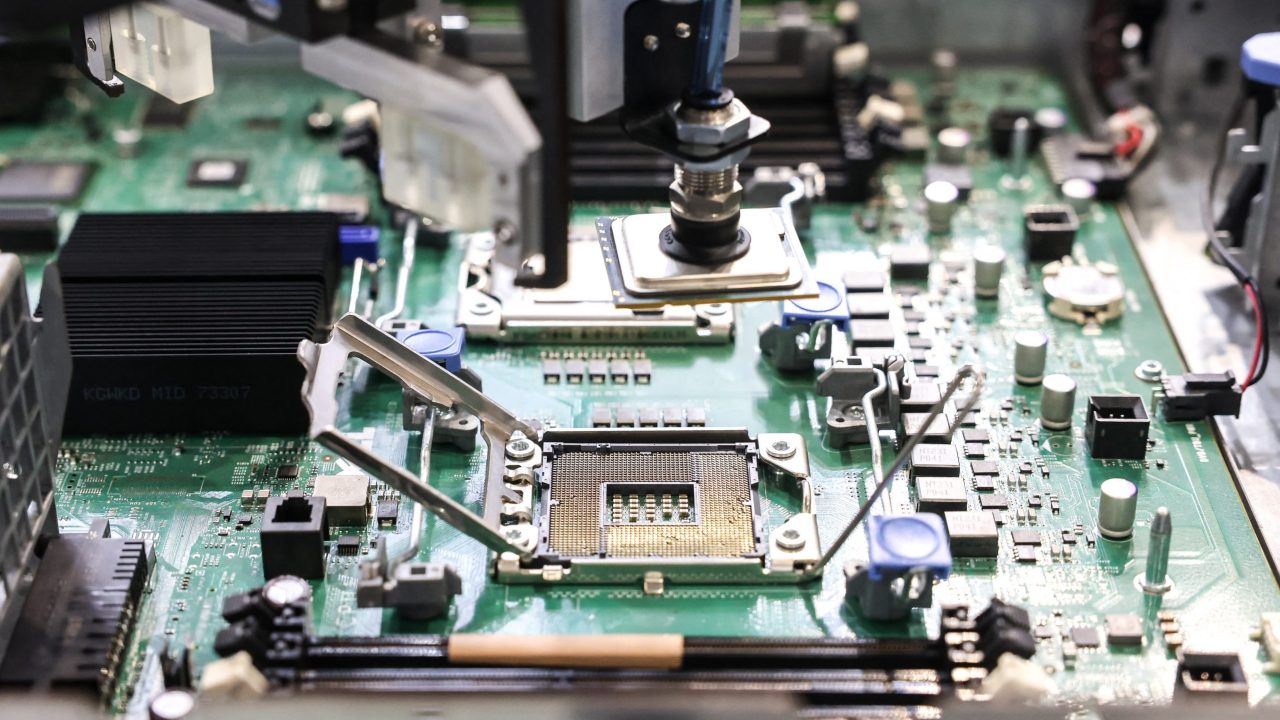
In late January 2026, Jensen Huang, the chief executive of chip-making giant Nvidia, rang in the Lunar New Year with employees and customers in Shanghai, Shenzhen and Beijing, then flew to Taipei for a banquet with key supply chain partners in the AI infrastructure ecosystem. But while Nvidia designs the chips, Taiwanese semiconductor giant TSMC fabricates them. At the leading edge, TSMC has no peer and no substitute. “No TSMC, no Nvidia,” Huang has said. His influence in Washington, his access in Beijing, his standing as the face of the AI boom rest on a production capacity he does not own and cannot replicate.
Nvidia’s H200 chip captures the precariousness of Nvidia’s position: dependence on TSMC for production capacity it does not control. Built on TSMC’s 4-nanometer process and next-generation high-bandwidth memory, it is Nvidia’s most powerful chip that is currently eligible for export to China. Washington and Beijing have each approved sales — the U.S. Commerce Department through a January rule revision, and supposedly Chinese authorities during Huang’s visit. Although some purchase orders from Chinese customers have materialized, it is not clear how many chips will actually flow. The issue is informational: Every Chinese purchase order flows through Nvidia to the U.S. government for review, exposing who is buying what and how much.
Beijing is probably calculating whether access to American chips is worth the transparency. The calculus extends beyond commerce. The same information asymmetry that governs chip sales shapes the more important competitions over AI capabilities, military modernization and the future of Taiwan. As Washington and Beijing finalize the timing of Trump’s visit to China amid uncertainty of the Iran war, Huang navigates a triangle of demand, regulation and vulnerability that represents the state of play for the Taiwan Strait in the AI Era.
Huang’s predicament is a window into a larger structural shift that binds AI competition and cross-strait stability into a single, accelerating problem. Dario Amodei, CEO of Anthropic, a leading artificial intelligence company that makes the Claude model series, has likened allowing Nvidia to export chips to China to Boeing selling nuclear weapons to North Korea. The comparison reflects a deeper conviction on the powerful artificial intelligence systems. In a recent essay titled “The Adolescence of Technology,” he argued that the stakes extend beyond economic competition, that the very AI chips Huang is trying to export to China are key inputs to increasingly powerful systems that will reshape the balance of power.
The systems he describes are taking shape. Agentic AI systems that can plan, execute and deliver outcomes with minimal human oversight will likely confer decision advantage on the battlefield in the not too distant future. The AI race, therefore, bears on a potential cross-strait contingency.
But the dependency runs in both directions. If Amodei’s premise holds, then dynamics in the Taiwan Strait have the potential to change AI’s trajectory. The United States, China and Taiwan are the most consequential actors shaping the speed and direction of AI’s development, and all three are vying for the same input: compute. It is not being produced in Silicon Valley or Shanghai but in Hsinchu. Nearly all of America’s compute demand is manufactured by TSMC in Taiwan. Until recent years, so was China’s. Yet China is actively rehearsing to take the island by military force.
The commercial AI race and cross-strait military dynamics have created a feedback loop, each accelerating the other. China advances its AI capabilities while racing to escape its compute dependency. America pushes the frontier in model performance, deepens its reliance on Taiwan while pushing to reshore production. Taiwan works to preserve its centrality in the supply chain and with it, the silicon shield. Export controls meant to maintain an edge become bargaining chips. Beijing restricts American chip imports and rehearses scenarios to seize Taiwan outright. Each move is seen as offensive by the other and generates a defensive reaction. Mishandled, this technological confrontation becomes a military one over the chips that enable AI itself.
To analyze these developments, this paper proceeds in four parts. Part I examines China’s AI ambitions and the compute deficit constraining them. Part II maps America’s AI buildout and its deepening dependence on TSMC. Part III explores the onshoring paradox: how U.S. efforts to secure AI chip supply may inadvertently weaken Taiwan’s deterrent value. Part IV traces the evolution of export controls and China’s response, including the emerging role of AI chips as diplomatic leverage. The conclusion examines whether the feedback loop can be slowed and what happens if it cannot.
Background
The fusion of AI competition and cross-strait instability can be traced to 2022. In May, Chen Wenling (陳文玲), a former chief economist at an influential think tank under China’s powerful National Development and Reform Commission, publicly argued that Beijing should seize TSMC if the West imposed sanctions. Her statement framed Hsinchu’s fabs not as commercial assets but as military objectives. Three months later, House Speaker Nancy Pelosi visited Taipei to discuss semiconductor cooperation with TSMC’s chairman and Taiwan government officials. China responded with its largest military exercises around the island in decades, conducting joint drills from August 4 to August 10 that simulated a blockade of the territory responsible for the majority of the world’s advanced chip production.
Washington moved to protect its lead in AI and reduce its dependence on Taiwanese manufacturing. On August 9, President Joe Biden signed the Chips and Science Act, providing the framework to shift some chip production to U.S. soil. On October 7, the Commerce Department announced sweeping export controls on AI chips to China, restricting Beijing’s access to the high-end compute needed to train frontier models. By late November, OpenAI had released ChatGPT, and the commercial AI race was underway. The military balance had already been shifting. For years, the deterrence gap has been widening: the erosion of external constraints and internal restraints that once discouraged Beijing from using force. Events in 2022 added a new variable to that calculus. Although they did not necessarily unfold in a causal sequence, together they marked the moment when AI development, semiconductor production and Taiwan’s security became inseparable.
Part I
Chinese AI
Beijing seeks to become the world’s leader in artificial intelligence by 2030. At the 20th Party Congress, Chinese President Xi Jinping (習近平) called on the People’s Liberation Army to “speed up the development of unmanned, intelligent combat capabilities,” framing the pursuit not just as an economic priority, but as a military imperative. The ambition is backed by state investment, a deep talent pool and an ecosystem of firms now producing competitive models at a fraction of American training costs.
Two distinct tiers of Chinese firms are pursuing that goal. The first consists of platform incumbents such as Alibaba, Tencent, ByteDance and Baidu who are integrating AI into existing cloud services and consumer applications. The second consists of frontier-focused startups, sometimes called the LLM tigers: DeepSeek, Zhipu (which rebranded internationally as Z.ai), Moonshot, MiniMax and others. These startups have gained attention for developing competitive open-weight models at a fraction of American training costs, DeepSeek’s R1 most prominently among them. DeepSeek’s R1 matched OpenAI’s o1 on key reasoning benchmarks, while Zhipu’s GLM-4.5 and Moonshot’s Kimi K2 now rank among the top performing open-weight models globally. On ChatBot Arena, a crowdsourced leaderboard, the best Chinese models are statistically tied with offerings from U.S. AI companies like Anthropic, Google DeepMind or OpenAI.
Chinese AI models are gaining adoption for three reasons: customization, cost and competitiveness. Open-weight models can be downloaded and adapted for specific use cases. They can also be trained and run at lower cost than their American competitors, with DeepSeek’s R1 being the clearest example. And performance is closing: Airbnb chose Alibaba’s Qwen over American alternatives for its customer service app, a decision it likely would not have made if Chinese models were not near parity.
Open-weight does not mean totally free. Chinese models are capturing mindshare — and possibly soft power — in markets beyond the United States. By September 2025, Alibaba’s Qwen had surpassed Meta’s Llama as the most downloaded LLM family on Hugging Face, the industry’s primary hub for open AI development. Chinese developers accounted for more downloads than their American counterparts. Singapore’s national AI program chose Qwen3 over American alternatives for its flagship model. U.S. labs will face a more competitive global market unless they release more open systems, as OpenAI has begun to do with GPT-OSS. Beijing is paying attention: state-backed policies are accelerating this trajectory.
Capability transfer extends beyond open-weight distribution. In February 2026, OpenAI alleged in a memo to the House Select Committee on China that DeepSeek employees circumvented access restrictions to systematically extract outputs from American frontier models, a practice known as distillation. Anthropic announced a similar campaign targeting its Claude models by DeepSeek, MiniMax and Moonshot AI 12 days later. If open-weight models spread influence, distillation captures capability directly, compounding competitive pressure on U.S. frontier labs. And when paired with China’s focus on industrial application, that combination accelerates the translation of acquired knowledge into deployable systems.
Model capability acquisition is only half the picture. The Chinese government is also focused on applying AI to industries where it already has an edge. Published in July 2025, China’s “AI+” initiative directs artificial intelligence toward priority sectors including manufacturing and robotics. Even if Chinese AI models remain several months behind the American frontier, they may still produce novel products that can be quickly scaled across China’s industrial base. For some experts, this is a concern: China’s goods output is greater than the next four largest manufacturing nations combined. Chinese planners may not be chasing the most intelligent systems so much as applying bespoke models to specific sectoral use cases.
The next frontier is agentic AI — systems that plan, execute and deliver outcomes rather than merely respond to prompts. In March 2025, the Chinese startup Butterfly Effect launched Manus, a general-purpose AI agent capable of completing multi-step tasks autonomously. By year’s end, the company had relocated to Singapore and sold to Meta — a reminder that talent and companies can still exit China’s ecosystem when the incentives align. ByteDance’s Doubao and Alibaba’s Qwen now handle transactions directly within their interfaces, turning chatbots into autonomous commerce platforms. The commercial applications are proliferating; the military ones are not far behind. A CSET analysis of 2,857 AI-related PLA contract awards between 2023 and 2024 found that while legacy defense contractors still dominate, an emerging set of private companies and civilian research institutions is winning a growing share — exactly the pattern military-civil fusion is designed to produce. Contract volume rose 16% year over year, with applications spanning data fusion, battlefield decision support and autonomous systems.
DeepSeek may be the most prominent case. In December 2025, the House Select Committee on China asked the Pentagon to designate DeepSeek a Chinese military company. After a senior State Department official said it appeared in more than 150 PLA procurement records. One month later, the committee’s chairman, John Moolenar, wrote to Secretary of Commerce Howard Lutnick that Nvidia had provided technical support enabling DeepSeek to achieve frontier capabilities now integrated into PLA systems. How quickly China can move from acquisition to deployment remains uncertain, but the infrastructure for integration is expanding.
In sum, China’s focus is on open-weight models, industrial applications and agentic systems that may deliver gains in economic and military power even without frontier performance. But those gains face constraints. China still lacks access to the vast amounts of compute needed to train and run AI at the scale of American firms. And as the Manus acquisition showed, talent and companies can still exit when the incentives align. Barring a major architectural breakthrough, China’s AI aspirations will require far more compute to expand beyond the country’s borders — a key part of the contest.
China’s Compute Deficit
For their hardware, Chinese AI firms still prefer American AI chips for model development. Recent reporting suggests chip shortages are growing due to U.S. chip controls and lack of domestic alternatives. DeepSeek, Alibaba, Tencent and Baidu have all publicly acknowledged this limitation. With constrained access to large numbers of U.S. AI chips, some of their AI development plans have stalled.
China’s primary domestic alternative comes from Huawei, which designs the Ascend series of AI chips, and SMIC, which manufactures them. Adoption has been limited due to quality and production obstacles. Gregory Allen of the Center for Strategic and International Studies has argued this is for two reasons. First, Huawei’s software environment, Compute Architecture for Neural Networks, or CANN, is not easy to use for model training or inference. Chinese AI developers are therefore hesitant to switch from Nvidia’s CUDA, at least for now. Second, SMIC is unable to produce or access the semiconductor manufacturing equipment needed to achieve consistently high yields below the 7-nanometer process node. ASML’s extreme ultraviolet lithography machines are the ideal solution, but Dutch authorities, under U.S. pressure, have largely blocked their export to China for several years.
TSMC’s own leadership has reinforced this assessment over the past several years. For instance, TSMC’s founder Morris Chang stated in 2023 that China remains five to six years behind in chipmaking technology and that export controls are working. At the company’s 2024 shareholders’ meeting, TSMC’s chairman and CEO, C.C. Wei (魏哲家), was asked whether Huawei could catch up and responded with a single word: impossible. The company fabricating Nvidia’s chips does not share Huang’s view that restricting their export is counterproductive. Beyond Huawei, a cohort of chip startups — Cambricon, Moore Threads, Kunlunxin and Enflame — are developing AI chips, primarily for inference rather than training. Several of these startups went public in late 2025 and early 2026 to strong valuations. Yet domestic production remains limited: China’s semiconductor national champion Huawei produced roughly 200,000 Ascend chips in 2025, a fraction of what American firms deploy.
As long as large quantities of American AI chips, numbered in the tens of thousands, are not shipped to China, its compute shortage is unlikely to ease soon. And Huawei is unlikely to produce a chip equivalent to Nvidia’s H200 until late 2027 at the earliest. This partially explains why Xi spoke out against U.S. controls as a form of suppression two years before Chinese firms began publicly acknowledging chip shortages and stalled development plans. Couple these obstacles with the computing and model exponentials already underway, and Chinese firms risk falling further behind as the U.S. sprints to build AI infrastructure. Taken together, Chinese leaders face an accelerating strategic deficit in the AI contest with the United States.
That deficit shapes more than commercial competition. If compute determines AI capability, and AI capability increasingly determines military advantage, then China’s window to act may be narrowing. The PLA’s accelerating pressure on Taiwan is driven by familiar irritants: U.S. arms sales, Taiwan’s domestic politics, perceived challenges to Beijing’s version of the status quo. Yet whatever the stated motivation, each exercise encircles the same fabs, the same supply chains, the same chokepoint. China is rehearsing options while the balance of power remains contested. The longer China’s compute gap persists, the stronger the incentive to leverage Taiwan’s centrality before American AI capabilities and Taiwanese chip production become insurmountable advantages. This is the strategic logic binding the AI race to cross-strait instability, and it runs in both directions.
Part II
U.S. AI
What Xi views as all-around containment, U.S. leaders have framed as maintaining a technological edge, even as the current administration signals greater flexibility on chip exports. To comprehend the scale of the AI buildout happening by U.S. firms, a good indicator to start with is capital expenditures. In 2026, the dominant U.S. hyperscalers driving a massive buildup of AI infrastructure, Amazon, Google, Microsoft, Meta and Oracle, are expected to invest $600 billion on AI infrastructure combined, almost 10 times their Chinese competitors. Alibaba, Tencent, Baidu and Bytedance are projected to spend $70 billion next year. Despite warnings of an AI “bubble,” American spending on AI is projected to climb to two trillion dollars by 2030.
Most of this investment is going toward gigawatt-scale data centers. In the next two years, roughly a dozen complexes will each consume energy comparable to medium and large-sized cities, housing millions of AI chips. China has an edge in power generation. Per recent testimony to the Senate Foreign Relations Committee from Tarun Chhabra, head of national security policy at Anthropic, China’s electrical grid added 400 gigawatts of net new capacity in 2024, or more than 10 times what the United States added.
To avoid the slow process of connecting to the U.S. grid, American AI firms have been building behind the meter by connecting AI data centers directly to power sources, bypassing interruptions to the grid. In effect, AI model developers have become their own power providers.
Epoch AI predicts five AI data center clusters will require one gigawatt of power in the year of 2026: Anthropic-Amazon’s Project Rainier, xAI’s Colossus 2, Microsoft’s Fayetteville, Meta’s Prometheus and OpenAI’s Stargate. xAI, OpenAI, Meta and Microsoft will each have at least one million AI chips. For reference, Microsoft’s Fairwater data center in Fayetteville, Georgia can complete more than 20 GPT-4-sized training runs per month. Expanded data center capacity enables labs to boost the size of training runs and accelerate research and development. Inference is less compute-intensive, so these facilities should have capacity to serve deployed models in addition to training new ones.
What this compute enables is changing as fast as the infrastructure itself. The frontier has shifted from chatbots to agents. AI agents can currently complete long tasks over extended time horizons of several hours. Execution time periods for these systems are doubling every seven months. For example, Anthropic’s Claude Code, Cursor and OpenAI’s Operator now write, test and deploy software autonomously. Anthropic reports that its engineers use Claude in 60% of their work, with self-reported productivity gains of roughly 50%. Further, Anthropic recently had more than a dozen Claude models run autonomously for two weeks to produce a C compiler from scratch. The costs involved were less than that for any single human or group of humans to perform the same task. Relatedly, Cursor demonstrated hundreds of AI agents coordinating autonomously for a week, producing more than one million lines of code for a web browser built from scratch which would have taken human teams months to attempt.
The autonomous execution horizons described above are not just a commercial metric. Anthropic’s latest frontier model, Claude Opus 4.6, achieved a 427-fold speedup on complex research tasks in scaffolded evaluations — a result its own developers described as exceeding the threshold they had set for autonomous AI research capability. These are not projections; they are measurements from systems running today on chips fabricated in Hsinchu.
In mid-2025, the Pentagon awarded $200 million contracts to each of four frontier labs — OpenAI, Anthropic, Google and xAI — for warfighting AI capabilities. OpenAI integrated its models into Anduril’s Lattice command-and-control platform; Anthropic deployed its Claude models within Palantir’s AI platform for U.S. military end users. These systems are already reaching the island. In August 2025, Anduril signed a memorandum of understanding with Taiwan’s National Chung-Shan Institute of Science and Technology for AI-enabled command and control, integrated Lattice onto the institute’s systems in live-fire demonstrations, and delivered its first tranche of Altius loitering munitions. In February 2026, Shield AI contracted with the institute to deploy AI pilots with Taiwanese unmanned systems via its Hivemind software. Lately, the integration of AI for defense runs from frontier model to defense platform to Taiwan’s defense architecture.
The implications for cross-strait stability are specific. In a crisis, AI-enabled command and control systems on both sides would accelerate the OODA loop (observe, orient, decide, and act) to a pace that leaves little room for diplomatic signaling or off-ramps. The risk is not that one side deploys AI and the other does not. It is that both sides deploy systems optimized for speed, creating use-it-or-lose-it pressures around the very infrastructure this paper describes. A PLA exercise that today takes days to plan and execute could, with AI-enabled planning and autonomous coordination, compress into hours, reducing warning time for Taipei and Washington alike. Conversely, U.S. autonomous platforms already integrating with Taiwan’s defense architecture would themselves accelerate, tightening the spiral.
There is a further dimension that the commercial AI race has surfaced. Frontier AI systems are growing increasingly capable of carrying out such cyber operations as identifying vulnerabilities, generating exploits and persisting in target networks with limited human direction. In February 2026, Google’s Threat Intelligence Group reported that multiple Chinese-linked groups used Google’s Gemini model to automate vulnerability analysis, generate exploit code and conduct reconnaissance against targets including in the U.S. defense sector. AI-augmented cyber operations, in other words, are no longer theoretical.
Even a narrow application of such capabilities could degrade TSMC’s fabrication processes, achieving disruption without the political costs of kinetic action, and potentially slowing down the U.S. AI buildout. That this represents one of the less dramatic uses of frontier AI underscores how deeply the technology has become embedded in the cross-strait calculus.
The chips are the input. What they produce — systems that see, decide and act at machine speed — is the output. And that output feeds back into the competition over the input itself. The dependency detailed in the next section is not merely commercial. It is the manufacturing base for the systems that would operate in the scenario all three actors are preparing for.
Coevolution: Nvidia-TSMC
Nvidia’s GPUs power most of these AI developments at the frontier. Four of the five major data center projects previously outlined — Anthropic’s Project Rainier, xAI’s Colossus 2, Meta’s Prometheus and OpenAI’s Stargate — are incorporating Nvidia’s Blackwells. Nvidia commands a 90% share of the AI chip market. Its platform underpins the majority of AI innovation in the United States and globally.
Nvidia is now the largest company in the world, a feat it could not have accomplished without TSMC. “No TSMC, no Nvidia,” Nvidia CEO Huang said at TSMC’s sports day in November of 2025. He is correct. Nvidia currently depends entirely on facilities in Taiwan for the production and or advanced packaging of its chips. This reliance extends to other American giants: all of AMD’s MI-Series GPUs below seven nanometers, Google’s latest three generations of TPUs, and Amazon’s Trainium 3 all depend on TSMC for fabrication. It appears this will continue until at least Intel or Samsung are able to offer comparable quality and quantities as TSMC. So, the entire American AI industry is thus tied to manufacturing capacity on an island that the PLA threatens daily. Since 2022, investors and policymakers have increasingly treated Taiwan Strait stability and AI development timelines as linked — a perceptual coupling that shapes capital flows, procurement decisions and strategic calculations on all sides.
To mitigate this risk, the U.S. government has incentivized TSMC to move some production to Arizona. But a critical bottleneck remains: Most chips produced in these domestic fabs must still be sent back to Taiwan for advanced packaging and testing. This requirement is expected to persist for several years until U.S.-based partners can take on that specialized work.
Even as the physical walls of these domestic plants rise, a second bottleneck has emerged: the human capital required to run them. TSMC has faced significant challenges in transplanting its rigorous management culture to an American workforce unaccustomed to such demands. This friction has led to delays and a heavy reliance on Taiwanese engineers flown into Phoenix, proving that while a factory can be built in years, the specialized foundry culture that sustains Hsinchu’s efficiency cannot be replicated overnight.
This creates a circular dependency: Hardware powering American AI is forged in the desert but finished across the ocean. Despite billions in investment, the future of the American frontier remains tied to the stability of the island for the foreseeable future. This physical vulnerability with technology geographically split between two shores sets the stage for the diplomatic friction explored in the next section.
Part III
The Onshoring Paradox
Acknowledging the possibility that a conflict could play out during the initial stages of the U.S. AI buildout, Lutnick, the commerce secretary, proposed to his Taiwanese counterpart that half of Taiwan’s chip production for U.S. customers be moved to U.S. soil. If Lutnick’s proposal, which Trump has reiterated, comes to fruition in the form of additional transfers of TSMC’s advanced technology to Arizona, then Taiwan’s position as the AI hardware hub could be upended. This is probably why Cheng Li-chiun (鄭麗君), Taiwan’s vice premier and Lutnick’s counterpart, denied reports that a proposal was made in the first place.
Beneath the denial is a heightened fear that TSMC, which Huang refers to as the pride of the world, is shifting abroad in ways that are weakening Taiwan’s global economic position, and eroding its security vis-a-vis China. The scale of TSMC’s influence underscores these fears: Its 2024 revenue was 5.4 times Taiwan’s defense budget; its market cap, 63 times. Taiwan has perhaps inadvertently outsourced a significant portion of its security to a private company. Add on TSMC’s lawsuit against Wei-Jen Lo (羅唯仁), a former TSMC executive who was recently hired by Intel, and the question of onshoring becomes complicated. In some ways, these concerns are not overblown. A two-decade consensus was formed that Taiwan-China relations could be managed without war because of positive expectations of continued technology and trade flows.
Journalist Craig Addison’s concept of a silicon shield protecting Taiwan from attack because the U.S., Japan and Europe would not allow China to prevent Taiwan’s export of information technology hardware partially contributed to those ideas. Addison wrote in 2000, when China was negotiating WTO accession and its military was not equipped to take Taiwan. The silicon shield likely began to fracture when Washington started weaponizing semiconductor interdependence decisively with Biden’s October 2022 export controls (though the process began with Huawei’s Entity List designation in 2019). Onshoring threatens the silicon shield from one direction; export controls, discussed below, threaten it from another. As the silicon shield weakens, the PLA increases pressure: more exercises, more ADIZ incursions, more gray-zone operations.
Since Pelosi’s 2022 visit, the PLA has conducted seven major exercises encircling Taiwan, each building on the last: from blockade simulations to coast guard boarding drills, from carrier strike groups to coordinated assaults on simulated liquid natural gas terminals. In 2025 alone, the PLA conducted two major exercises: Strait Thunder 2025A rehearsed boarding inspections and strikes on energy infrastructure, while Justice Mission 2025 fired live rockets into Taiwan’s contiguous zone and explicitly rehearsed blocking foreign intervention. Today, China’s military modernization has dramatically changed the balance of power across the Taiwan Strait, posing reasonable questions about the silicon shield’s longevity.
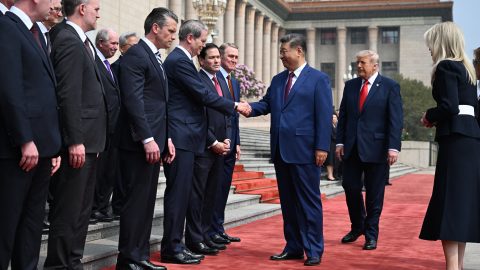
It seems the current U.S. administration believes Taiwan’s fears may be mitigated. With Taiwan’s continued support, U.S. companies may be in a position to achieve powerful AI, deploy it around the world, and gain substantial market share ahead of their Chinese competitors. Both may work in Taiwan’s favor over the long term, if TSMC is able to retain its lead in cutting-edge production technologies. Herein lies the paradox of securing a vulnerability. What the U.S. side views as a logical policy, many in Taiwan look at with skepticism despite rhetorical support from TSMC’s executive leadership and Taiwanese President Lai Ching-te (賴清德). China’s proximity and persistent threat to Taiwan adds a layer of urgency that investors, U.S. tech corporations, and Taipei have largely discounted, until recently. One month after Cheng and Lutnick’s crucial exchange, Lutnick participated in Trump’s meeting with Xi, where even the mere mention of negotiating AI chips underscores the strategic consequences artificial intelligence has for the trilateral relationship.
A seized TSMC is a destroyed TSMC; the company’s fabs depend on supply chains that would freeze the moment a conflict began. The ultimate danger of this paradox is that it may inadvertently alter the calculus of war, not by making seizure possible, but by making disruption tolerable. This hollowing out of Taiwan’s strategic indispensability could embolden Beijing to test American resolve, turning a move intended to find security into a trigger for the very conflict it sought to avoid.
The Silicon Shield’s Persistence
The silicon shield’s erosion is not as advanced as the framing of halving Taiwan’s production capacity suggests. In March 2025, Wei, TSMC’s CEO, joined Trump in the White House to announce an additional $100 billion in Arizona investment — bringing TSMC’s total U.S. commitment to $165 billion — then flew to Taipei two days later to meet with Lai and reassure the public. At the presidential office, Wei emphasized (in a transcript released in Chinese only) that the company’s plans on the island would accelerate rather than contract through the buildout of 11 new fabs. TSMC’s earnings call on January 15, 2026 confirmed the pattern: Capital expenditures would reach $52-56 billion, with 70-80% directed toward advanced nodes. Most of that leading-edge production would remain in Taiwan for practical reasons according to Wendall Huang (黃仁昭), TSMC’s chief financial officer. A new 2-nanometer fab is underway in Kaohsiung, while expansions are being made to an advanced packaging plant, or AP7, in Chiayi. The numbers do not describe a company hollowing out its home base.
Taiwan’s position in AI infrastructure extends beyond fabrication. Six Taiwanese original design manufacturers, Foxconn, Quanta, Wistron, Wiwynn, Inventec and Gigabyte, control more than 90% of global AI server production. These firms are building assembly capacity in the United States and Mexico, but their engineering talent, research and development centers, and corporate headquarters remain in Taiwan. Assembly may diversify, but the core of AI hardware manufacturing will likely endure.
Even these reassurances did not change the strategic calculus. Taiwan’s political leadership has begun making a different case altogether. In his February 2026 interview with AFP, Lai argued that U.S. support for Taiwan predates the silicon shield, rooted in the Taiwan Relations Act, the Six Assurances and repeated G7 affirmations that strait stability is essential to global security. He is not defending the shield; he is arguing it was never the foundation. Deputy Foreign Minister Chen Ming-chi (陳明祺) put it more directly in a Foreign Policy interview: “I’m not a true believer in the silicon shield. Taiwan has been important before semiconductors … because of geography, because of values, because of democracy.” Semiconductors, he said, adds another layer to Taiwan’s importance to the world.
The Lai administration is actively repositioning toward a post-shield deterrence logic — one anchored in geography, the first island chain, and alliance architecture. Lai warned AFP that if China took Taiwan, its expansionist ambitions would not stop there, with Japan and the Philippines next. Yet this reframing runs ahead of public opinion. Polling shows a majority of Taiwanese believe onshoring weakens the shield, and over 80% see TSMC’s U.S. investments as the product of American pressure. The leadership is abandoning a frame its own electorate still holds, making the onshoring paradox not just a bilateral strategic problem but a Taiwanese domestic one.
Taiwan has mostly chosen to embrace its role in America’s AI buildout rather than resist it. The negotiations led by Lutnick and Cheng, the vice premier, culminated in two agreements signed 12 days apart. On January 15, Taiwanese semiconductor and technology companies committed to invest $250 billion to expand production capacity in the United States, backed by an additional $250 billion in government credit guarantees. In exchange, the United States agreed to cap tariffs on Taiwanese goods at 15%. The Commerce Department’s stated goal — 40% of Taiwan’s semiconductor supply chain on American soil — fell short of Lutnick’s 50-50 pitch, but still represented a significant shift, if realized. Then, on January 27, Taiwan formally endorsed the Pax Silica Declaration, a U.S.-led multilateral initiative to secure the physical infrastructure powering artificial intelligence. The joint statement framed AI as a transformative force and committed both sides to “an economic security order based on trust, technological complementarity, shared interests, and a shared commitment to a more prosperous future.” Shortly after, Taiwan’s foreign minister, Lin Chia-lung (林佳龍), wrote in Foreign Affairs that allies stand to gain what they cannot access elsewhere through partnership with Taiwan — casting the island not as a vulnerability to defend, but as an asset to invest in.
U.S. officials argue these agreements reinforce Taiwan’s security by “hardwiring the island’s industrial ecosystem into the American economy,” effectively converting Taiwan’s AI supply chain into an U.S. strategic asset worth protecting in a crisis. The logic is that deeper integration commits Washington more deeply to Taiwan’s defense. But this assumes the commitment is unconditional and that the shield’s value does not depreciate as production shifts. Beijing is watching the trajectory, not the reassurances.
Part IV
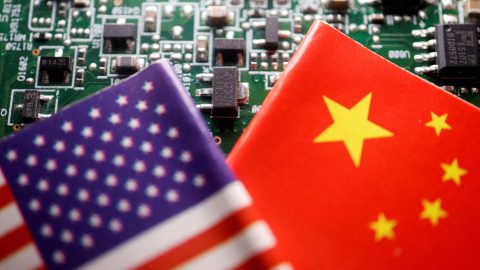
Onshoring is one threat to the shield; export controls are the other. Increasingly, the chips themselves have become instruments of leverage. The Biden administration tightened restrictions several times between 2022 and 2024, each round closing loopholes Chinese firms had exploited. The Trump administration has taken a different outward approach in treating AI chips less as a national security red line than as a negotiating variable. Trump’s December announcement about the H200 signaled a shift, even though no large shipments have been made as of this writing.
The Commerce Department’s January 2026 revised rule implementing it came with strings attached: Nvidia must certify that sales won’t delay U.S. orders or divert TSMC foundry capacity; exports are capped at 50% of U.S. volume; Chinese buyers must disclose cloud customers to Washington and implement U.S.-approved compliance procedures; and every shipment must undergo third-party testing at a U.S. lab.
The logic behind the policy shift requires a different perspective to understand, at least according to the administration. Lutnick, describing the internal debate in an All-In podcast, laid out Nvidia CEO Jensen Huang’s argument to Trump: a total ban would funnel all of China’s resources into Huawei, accelerating the very self-sufficiency Washington hoped to prevent. Controlled access, by contrast, might slow that investment. If American chips remained better than what China could produce domestically, Chinese firms would keep buying and every dollar spent on Nvidia was a dollar not spent on Huawei. Trump accepted the logic, then added his own condition: Nvidia would pay 25% of its China revenue to the U.S. Treasury.
“He does play a better game of chess,” Lutnick said of the president.
The game, though, is only as sound as the argument behind it, and Huang’s rests on an unresolved tension. In the United States, he describes AI as a technology that confers superpowers on whoever leads, one that will reshape industries, compress decision cycles, and redefine the balance of power. But when the conversation turns to exporting the chips that enable those superpowers, the framing shifts: China’s use cases become benign, the national security risks become ambiguous, and restrictions become counterproductive. If AI is as transformative as Huang tells American investors, then the chips powering it are strategic instruments, and the case for controlling them follows directly. Former National Security Adviser Jake Sullivan, who designed the Biden era controls, put it bluntly: If China’s main problem is insufficient computing power, selling them powerful American chips is solving their problem for them.
But chess requires anticipating the opponent’s moves. The H200 decision is not just export policy it is a signal, arriving months before Xi’s expected visit to Washington and amid ongoing debate over Taiwan’s future. If the United States is willing to sell China the chips powering its AI ambitions, what does that imply about American resolve on the Taiwan Strait? And if Beijing ultimately rejects the offer in favor of self-reliance, the chess match returns to where it started: a race for supremacy with no moves left to trade. Whether Washington’s moves pay off will depend on Beijing’s response.
China Responds
Beijing is not waiting for relief. Even as the H200 path opened, key institutions responsible for domestic security, competition and cybersecurity have made it unacceptable for Chinese technology firms to purchase Nvidia’s H20 — one of a handful of AI chips still available for export. The restrictions stem in part from three U.S. actions: the Commerce Department’s April letter to Nvidia to stop H20 shipments to China, later reversed; Trump’s request for a 15%share of AMD’s and Nvidia’s China chip sales; and Lutnick’s remarks about keeping China addicted to inferior AI chips. Starting around late July, the Cyberspace Administration of China, the Ministry of Industry and Information Technology, and the National Development and Reform Commission launched a coordinated campaign. The Cyberspace Administration, China’s internet watchdog, requested that Nvidia answer questions on chip security. The Ministry of Industry and Information Technology posed questions to Alibaba and Tencent on why they needed to purchase the H20. The National Development and Reform Commission published informal guidance to promote greater self-sufficiency. In November, China banned American AI chips from being used in state-funded data centers and blocked ByteDance from buying Nvidia chips.
In 2025, China produced approximately 160,000 AI chips equivalent to Nvidia’s most advanced processors. That compares to about 4 million from the United States. Why restrict American imports without a scalable alternative? The logic is likely related to leverage — and it may be working. Both Washington and Beijing have now approved H200 sales, a chip Huawei is unlikely to match until late 2027, according to Chris McGuire, who helped develop technology controls for the Biden administration. Access would let Chinese firms train more competitive models and deploy them faster than current chips allow. That the H200 path opened at all suggests restricting the H20 achieved its purpose: short-term pain for strategic gain.
Yet Chinese commentators have framed American chips as “sugar-coated bullets” (糖衣炮弹), a Mao-era phrase for seductive offers that undermine long-term strength. Wei Shaojun (魏少军), vice chairman of the China Semiconductor Industry Association, put it more directly in an interview with the Global Times: Whether America’s relaxation is a genuine signal or “a new strategy intended to disrupt our development pace and make us lower our guard,” China must not waver on indigenous production. The concern has an empirical basis. Paul Triolo argues that controls have accelerated China’s domestic semiconductor equipment development faster than expected, with Huawei targeting 70% self-sufficiency by 2028 — and that, ironically, relaxing controls may be the only way to slow that drive. If that trajectory holds, controls may be losing their leverage, and every delay in strengthening them narrows the window further. But controls address only one vector of capability transfer. The distillation campaigns launched by Chinese AI companies demonstrate that capability transfer can reduce the effectiveness of the hardware chokepoint. Yet distilled models still ultimately require compute to deploy at scale, which reinforces rather than replaces the case for strengthening AI chip restrictions.
On the hardware side, the new export rules also add friction. Purchase orders now flow through Nvidia to the Commerce Department, exposing which Chinese firms are buying and in what quantities. The situation has left Nvidia in an unusual position. That is why Huang, Nvidia’s CEO, said: “I think we’re the first company in history that has been banned on both sides” at the Center for Strategic and International Studies in December. Every other country is racing to acquire Nvidia chips; whether Beijing ultimately embraces them or holds the line on self-sufficiency remains to be seen.
Running parallel to its “struggle” (斗争) for establishing a domestic AI chip base in the face of U.S. controls, China is simultaneously messaging that it can raise the costs on Taiwanese and American AI industries by cutting off AI chip flows. The day after Trump met Xi on the sidelines of APEC in South Korea, the Chinese Embassy posted on X that Taiwan’s Hsinchu Science Park was under the purview of the Jilin-1 satellite system, whose owner, Chang Guang Satellite Technology Company, is sanctioned by the U.S. Treasury Department. TSMC’s headquarters, its research and development center, and eight fabrication facilities are all located in Hsinchu. The message was formally aimed at “separatist forces.” But broadcasting reconnaissance capabilities over the locus of Taiwan’s chip industry, the day after a summit where AI chips were on the table, carried a second meaning: If export controls persist, this is what is at stake.
Conclusion
The feedback loop described in this paper is now fully visible. China’s AI ambitions remain constrained by a compute deficit it cannot quickly close. America’s buildout depends on manufacturing capacity it does not control. Efforts to secure that capacity — onshoring, tariff agreements, the Pax Silica Declaration — risk eroding the silicon shield that protects it. And the chips themselves have become instruments of leverage, with Washington and Beijing each using access as both a weapon and concession. What began in 2022 with military exercises, export controls and the dawn of the commercial AI race has fused into a single accelerating problem. Each defensive move looks offensive from the other side. Each reaction tightens the spiral.
A seized TSMC is a destroyed TSMC. Beijing knows this. The fabs cannot be captured intact; their operations depend on hundreds of foreign engineers, continuous supplies from Western equipment makers, and software updates that would halt the moment a conflict began. So what is the calculus? Not capturing the fabs, but leveraging their centrality before the balance of power shifts. That is the dynamic Trump carries with him when he visits Beijing later this year. Xi has already made clear what matters most: Taiwan. The chips on the table are inputs, manufactured overwhelmingly in Taiwan. The AI capabilities they unlock are what both sides are actually competing for.
The Pentagon’s 2023 Joint Concept for Competing warns that adversaries seek to win without fighting by gaining technological advantage below the threshold of armed conflict. Whether the summit produces a framework for managing that competition or accelerates it may test the very threshold the doctrine describes. As the systems outlined in this paper mature, compressing decision cycles, enabling autonomous targeting and cyber operations against the very infrastructure all three actors depend on, the probability of strategic miscalculation increases. A real risk is that the spiral tightens incrementally until a crisis finds no off-ramp. For now, the chips remain the object of competition rather than conflict. Whether that holds depends on what Washington, Beijing and Taipei decide next.




Leave a Reply