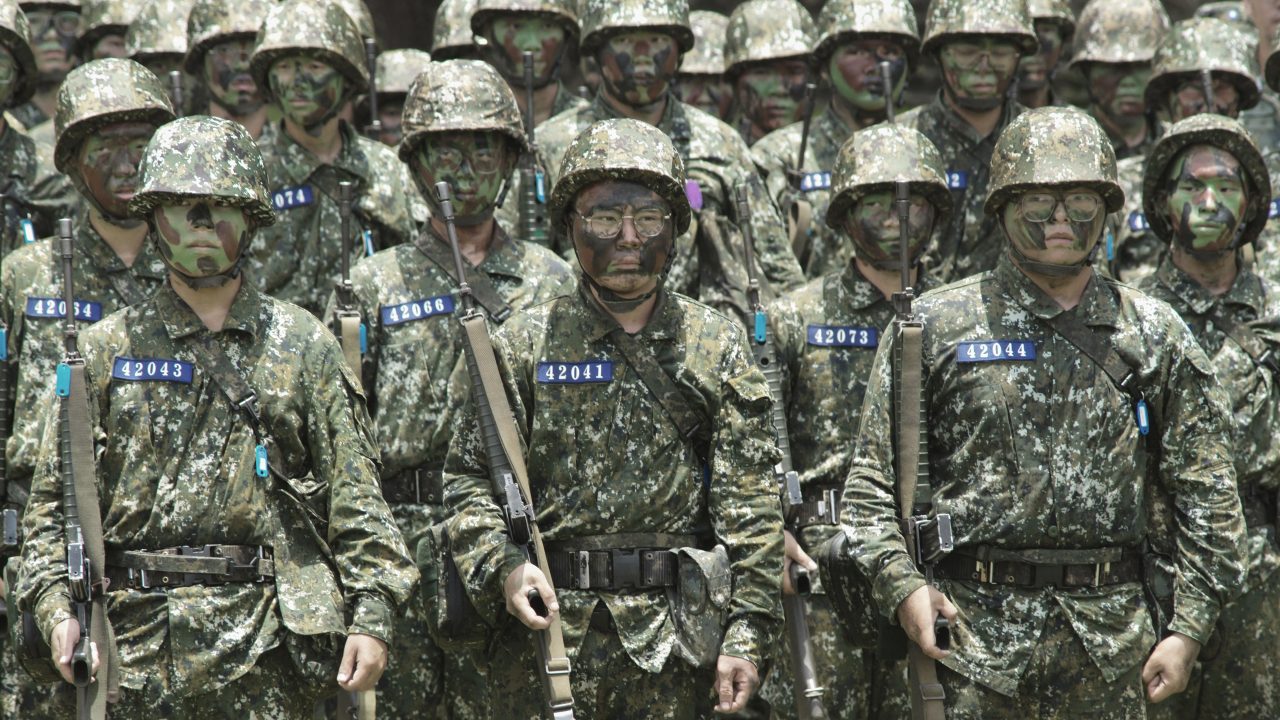
For a nation under threat of invasion, Taiwan’s confidence in its armed forces is remarkably low.
Only 14% of Taiwanese have “strong confidence” in their country’s military, down from 20% six months ago, according to a recent poll.
The poll was conducted at a time of ever-heightening security awareness in Taiwan. The same poll found that 33% of people think China is Taiwan’s greatest security threat. However, 65% of respondents think it is unlikely that China will attack Taiwan in the next five years.
China’s military activity around Taiwan has increased in recent years, and the number of Taiwanese arrested for spying for China has also risen sharply.
The results were published in the March 2025 Taiwan National Defense Survey, commissioned by the Institute for National Defense and Security Research, commonly known as INDSR, Taiwan’s government-affiliated defense think tank.
The same poll found that 30% have “no confidence” in the military, a five percent increase on the previous results.
Data gleaned from a paper published in early 2024 by INDSR researchers shows that high levels of confidence in the military has tended to hold steady around 20% in recent years.
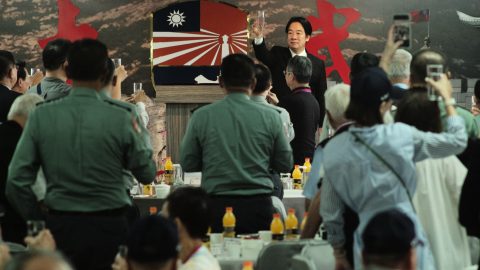
New weapons purchases and reforms to conscription were carried out by the previous president of Taiwan, Tsai Ing-wen (蔡英文). Even though her successor Lai Ching-te (賴清德) has continued them, they do not appear to have raised public confidence in Taiwan’s armed forces.
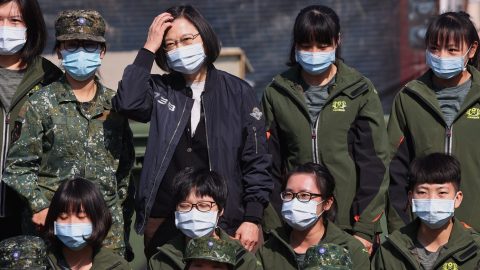
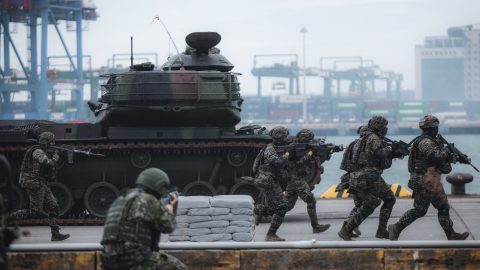
Tsai increased conscription for young Taiwanese men from four months to one year. The first cohort under this new system completed their one year’s service in 2024, which has received relatively positive media coverage.
To be sure, other factors impact upon public confidence in the military. The 2024 paper by INDSR researchers pointed out that people’s confidence in Taiwan’s military is highly correlated with their perception of the U.S.’s security commitment to Taiwan.
In the results from March this year, confidence in the U.S. to “definitely intervene militarily” dropped to 14%, from 19% in March 2024. Confidence in the U.S. fell sharply in Taiwan after the American withdrawal from Afghanistan and the Russian invasion of Ukraine.
Comparison with poll results from other countries is instructive, although different wordings can impact answers. In 2024, 51% of Americans reported “a great deal of trust and confidence in the military.” In South Korea, only 7.4% said that the military was “very trustworthy,” in 2024 (up from 3.3% in 2023), though a further 66.8% said it was “trustworthy.”
Although the number for “confidence” in the Taiwanese military (as opposed to “strong confidence”) hasn’t been released for INDSR’s March 2025 survey, in previous editions it was around 33%, giving a very approximate figure of 53% confidence in total before 2025.
South Korea’s military is far more powerful than Taiwan’s by numbers alone and has conscription of 18 to 21 months instead of Taiwan’s 12. However, both countries share an authoritarian past that might shed some light on a lack of confidence in the military.
During Taiwan’s martial law period, when the Chinese Nationalist Party (KMT) ruled Taiwan as a dictatorship, the military was seen as a tool of the regime This has left the armed forces with an uneasy relationship with the now-ruling Democratic Progressive Party (DPP), which emerged out of Taiwan’s democratic transition.
After democratization, defense spending in Taiwan fell steadily from the 1990s until the mid-2010s. As part of this, many military facilities were closed. Conscription, which was unpopular with voters, was reduced progressively from two years to four months.
The four-month conscription period in particular came to be regarded as a waste of time, and itself likely reduced confidence in the military due to the exposure of young Taiwanese to ineffective training.
Lai has committed to increasing Taiwanese defense spending to 3% of GDP this year. To do that will mean passing a special budget in the Legislative Yuan, Taiwan’s opposition-controlled parliament, which is currently blocking a substantial portion of the existing military budget.
The recent defense survey found that 51% of Taiwanese support increasing defense spending. If an increase to 3% of GDP can be achieved, how will public confidence in the military respond?
The INDSR survey is conducted four times a year by the Election Study Center of National Chengchi University. According to INDSR, “a total of 1,285 valid responses were collected, including 920 landline and 365 mobile phone samples.”


Leave a Reply