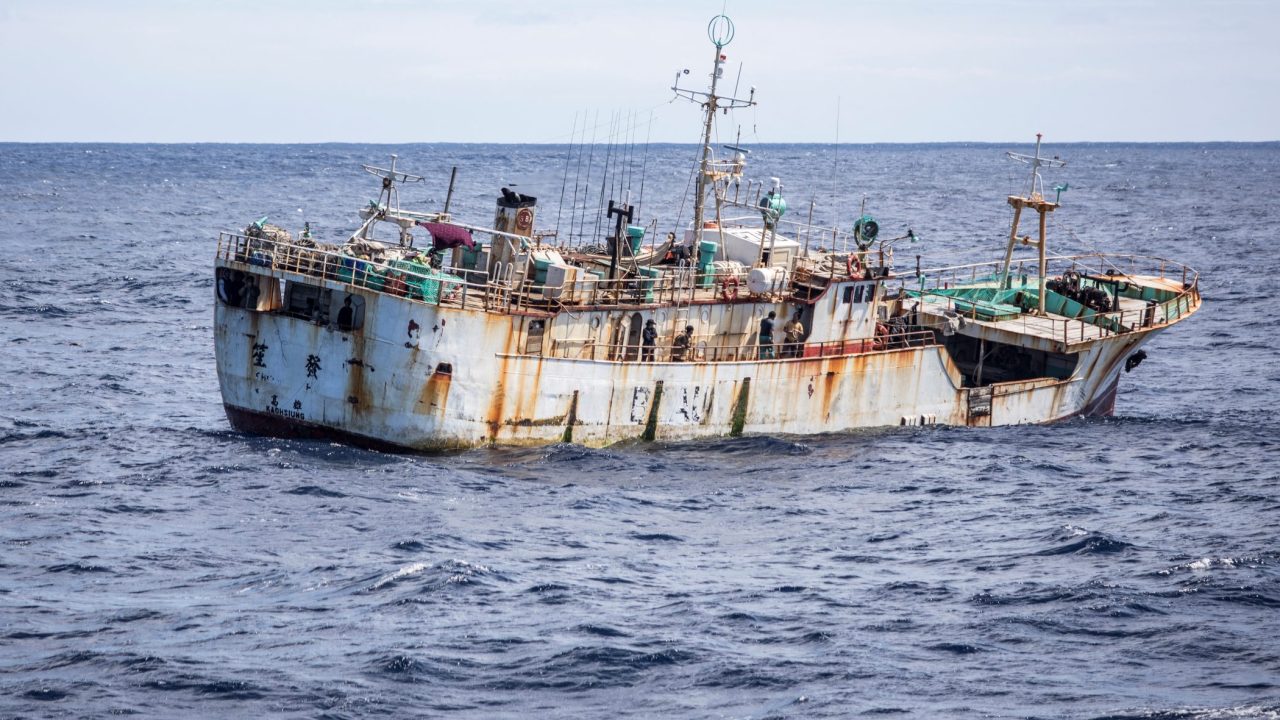
Taiwan’s fishing fleet is one of the largest in the world, bringing in $44.6 billion New Taiwan dollars’ ($1.41 billion) worth of catch per year from distant-water fishing and NTD 14.6 billion ($460 million) from coastal and offshore fisheries. It is also heavily subsidized by Taiwan’s government. And yet it is plagued with concerns about the human rights of its migrant fishers.
This month, the catch of its distant-water fleet was included on the U.S.’s “List of Goods Produced by Child Labor or Forced Labor,” which set out a wide range of rights violations.
“Workers face hunger and dehydration, live in degrading and unhygienic conditions, are subjected to physical violence and verbal abuse, are prevented from leaving the vessel or ending their contracts, and are frequently not paid their promised wages or have food and lodging fees illegally deducted from their wages,” the U.S. Department of Labor said.
None of this is new, however. This is the third time in a row that Taiwan has made the U.S. list since 2020. And serious issues have persisted despite the 2022 launch of an “Action Plan for Fisheries and Human Rights” that included measures for improving salaries and labor conditions, as well as managing broker arrangements.
“We can see the Fisheries Agency has paid some attention on revising laws and to make a good image, but I think they spend more on propaganda; what has been improved is far less than what they claimed,” Lennon Wong (汪英達), director of migrant worker policies at the Serve the People Association in Taoyuan, told Domino Theory by email.
Criticism pertains to both policy and enforcement.
Policy Criticisms
On policy, migrant fishers employed by Taiwanese companies overseas are not covered by the “Occupational Safety and Health Act” or the “Labor Standards Act” which, among other things, establishes Taiwan’s minimum wage. This has been labeled a dual employment system.
But preceding that disparity, there is the key issue of foreign brokers — notably in Indonesia and the Philippines — charging exorbitantly high recruitment fees and deposits to get work on these vessels. These can then see migrants accrue debts which brokers or employers use for coercion.
Taiwan’s government should enforce fair recruitment for all migrant workers and promise to revise laws which contradict that principle in the short term, Wong of Serve the People Association said. His recommendation is that employers should have to pay the fees for the entire recruitment process and that Taiwan should sign agreements with all migrant-sending countries “to enforce fair recruitment in both the sending and receiving country.” Additional costs should be passed on to brands and retailers who currently profit most from the labor of the migrant workers, he added.
Enforcement Criticisms
On enforcement, Taiwan’s Fisheries Agency has been accused of being ill-equipped to handle labor issues and outsourcing to employer groups and intermediaries while the Ministry of Labor “shirks responsibility.”
But below that level there are further issues. Late wage payments and lack of rest remain key complaints, despite legal commitments, and it has been noted that employers do not pay punitive damages for late wage payments. An increase in the number of inspectors since 2022 has been called insufficient because vessels travel in international waters for months and fishers fear deportation if they report violations. Most practically, lack of Wi-Fi installations on vessels has been the subject of long-running dialogue about improvements to reporting mechanisms.
Taiwan Fisheries Agency View
Taiwan’s Fisheries Agency has issued regular rebuttals to these points.
In response to the U.S. listing, it said that migrant fishers receiving full wage payments reached 98 percent in the first half of 2024. And in response to a high profile incident of unpaid wages earlier this year, it said in August that it had “conducted inspections on 1,364 vessels at domestic and international ports from October 2022 to July 2024.” It added that “All identified violations have been addressed in accordance with the law and regulation, and cases involving criminal offenses, such as human trafficking, have been referred to prosecutorial authorities for further investigation.”
Regarding Wi-Fi, the agency said it had “increased subsidies to distant water fishing vessels to provide communication facilities for crew members on board.” This week the agency told Domino Theory by email that three meetings between stakeholders had been held in September and feedback was now being compiled.
“During these meetings, we established guidelines regarding data usage, costs, usage time, designated areas for Wi-Fi access, and other important considerations. Based on the feedback received from participants, we are adjusting these guidelines to be in line with the International Labour Organization’s Work in Fishing Convention (ILO C188), ensuring that migrant crew members can reasonably utilize communication facilities,” Hsueh Po-yuan (薛博元), the head of the Fisheries Agency’s Fisheries Manpower Division, said.
Economic Interests Over Human Rights?
Taken as a whole, many remain deeply unsatisfied with that progress. And while “improvements in reducing extreme human rights violations like fatalities at sea” were acknowledged by a USAID Asia Counter Trafficking in Persons case study published in August, the idea that politicians have prioritized political and economic interests over human rights was a key emphasis in rights groups’ response to the latest U.S. listing.
If that analysis is correct, it leads to a question about what kind of pressure might change those priorities.
Internally, pressure from activists and workers has become an important variable. Externally, diplomatic pressure was applied this month not only by the U.S. but also by the Indonesian envoy to Taiwan, who called for Taiwan’s government to expand a direct hiring program for Indonesian migrant workers. However, is there any chance of outright bans on Taiwanese fish imports — as has previously been threatened by the European Union?
There are no obvious signs. On one hand, the EU — the largest overall importer of fish in the world — lifted its yellow card for Taiwan in 2019, saying it was content with its progress. On the other hand, Sari Heidenreich, Greenpeace USA’s senior human rights advisor, told Domino Theory it was unlikely from the U.S. side — the largest single-country importer of fish — despite mechanisms that would allow it and despite a 2022 Biden-Harris Administration pledge for a whole-of-government approach to addressing illegal, unreported, and unregulated fishing and associated labor abuses.
“Given what we know about the prevalence of goods produced with forced labor being imported to the U.S., the identification and enforcement rates significantly lag behind infractions,” Heidenreich said. She added that the U.S. Customs and Border Protection authority has only sanctioned three Taiwanese vessels since 2020, with one sanction recently lifted.
Where Now?
For Greenpeace and other NGOs, that leaves the recommendation that corporations buying the fish take responsibility. “Given the shortcomings of our current system, voluntary market supply chain monitoring and worker engagement are essential,” Heidenreich said.
What this likely means is there will be no single moment of transformation for the industry. What it definitely means is that below the rhetoric about Taiwan being at the “front line” of democracy and human rights, there will continue to be a fight for those rights to apply to everyone.






Leave a Reply