
Late one evening this past February, a cargo ship loitered off the southwestern coast of Taiwan. It was flying a Togolese flag. The ship’s electronic charts showed that it had entered a no-anchor zone, but Wang Yuliang (王玉亮), the Hong Tai 58’s (宏泰58) Chinese captain, ordered his crew to drop anchor anyway. For the next two days he sailed in a zigzag pattern, dragging the anchor back and forth across the ocean floor.
At roughly 2:30 a.m. on February 25, the Taiwanese Coast Guard approached the Hong Tai and ordered it to leave. An hour later, they received a report from Chunghwa Telecom Company that its Tai-Peng No. 3 submarine cable, which connects Taiwan to the outlying islands of Penghu, had been severed.
Wang was later sentenced to three years in prison by a district court in southern Taiwan for violating the Telecommunications Management Act, with the BBC hailing the incident as a “landmark case” in the fight against submarine sabotage. But more than two years since Taiwan amended the act to include aggravated penalty provisions for national security, cybersecurity experts and government representatives told Domino Theory that Taiwan is still struggling to secure its submarine infrastructure.
A report published by the Research Institute for Democracy, Society and Emerging Technology last week cast doubt on the government’s legal efforts to punish and prevent cable sabotage. “Despite numerous policy initiatives from both domestic and international experts, key limitations continue to limit effective prevention, enforcement and attribution,” the report concluded.
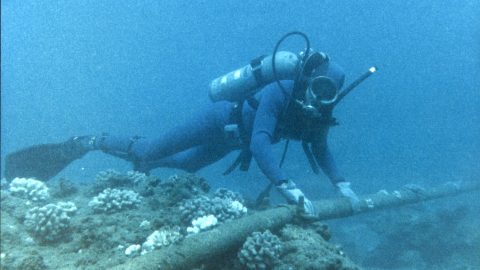
Submarine cables carry more than 95% of international internet traffic. Reports of sabotage in recent years, in both the Taiwan Strait and the Baltic Sea, have transformed the cables from a fascination of internet infrastructure nerds into a locus of discussions about gray zone tactics, or subversive acts that fall below the threshold of war.
Fourteen international submarine cables connect Taiwan to the outside world, with direct links to China, the Philippines, South Korea and Japan. Charles Mok, a research scholar at Stanford University’s Cyber Policy Center, said that Taiwan’s geography makes its cables especially vulnerable. “Think about the situation in Ukraine,” Mok said. “When the invasion comes on one side, the other side, it’s still connected by land to Poland and other countries … It’s not like Taiwan, which is surrounded by water.”
Suspicions of sabotage first emerged in February 2023, when Chinese-connected vessels severed a pair of cables connecting Taiwan’s Matsu islands. The damage left Matsu residents to cope with minimal internet access for almost two months. The Taiwanese government stopped short of directly blaming Beijing. The ships involved in the damage were allowed to proceed to South Korea while Chunghwa Telecom, which operates the cables, scrambled to restore connection.
For law enforcement, protecting submarine cables has proven difficult. Some of the densest areas of cable concentration, like the South China Sea and the Taiwan Strait, pass through the most crowded shipping lanes, and thus sabotage efforts can easily be disguised as regular operations. Most cable routes cross international waters, making it hard for coast guards to exercise jurisdiction over suspicious vessels. And when they do detain a ship, it can be hard to prove the captain’s liability, let alone his intention.
In May 2023, Taiwan amended the Telecommunications Management Act to include undersea cables as protected objects and increase penalties for damage motivated by an intent to harm Taiwan’s national security. Lii Wen (李問), a spokesperson for President Lai Ching-te (賴清德) who was serving as director of the Democratic Progressive Party’s Matsu Islands chapter when its cables were cut in 2023, said that strengthened legislation, when combined with enhanced law enforcement, can effectively counter sabotage.
According to Lii, Lai’s government has been working to compile a blacklist of ships that could pose a threat to cables. This approach, he said, “has successfully helped Taiwanese authorities detain and hold accountable a vessel responsible for a cable-cutting incident near Penghu in February,” referring to the Hong Tai captain’s sentencing.
Lii is not alone in seeing the Hong Tai 58’s capture as a sign of progress. But Chen Ta-chen (陳大楨), who authored the Research Institute for Democracy, Society and Emerging Technology report that was released last week, is more skeptical.
Rather than prove that Captain Wang intentionally severed the Tai-Peng cable on behalf of China, Chen’s report points out, the Tainan District Prosecutor’s Office was only able to show that Wang demonstrated reckless disregard for posted warnings about submarine cables. He concludes that the 2023 amendments to the Telecommunications Management Act played no role in the prosecution of the Hong Tai’s captain, who received the minimum possible sentence under the old version of the law.
Because of limits to maritime law, not to mention Taiwan’s ability to enforce it outside of its territorial waters, some experts argue that resources should focus instead on redundancy. The crudest version is to lay more cable, so that if one is severed, internet traffic can be rerouted to a backup. But most undersea cable construction is funded by consortia of multinational companies, not national or local governments. And building more international cables requires buy-in from neighboring countries, like Japan or the Philippines, who would need to approve construction along their own coastlines.
Another option is microwave radio transmission. After the Matsu cables were severed in 2023, residents had to rely on microwaves for nearly two months. According to Lii, undersea cables had provided a total bandwidth of eight to nine gigabytes per second, the microwaves could only provide just over two. Earlier this year, the Matsu cables were damaged again, but by this time Chunghwa had improved microwave bandwidth to 12 gigabytes per second, and most residents kept their connection.
But Kenny Huang (黃勝雄), board chair of the Taiwan Network Information Center, said that microwave transmission only works in a domestic context, where receivers are close enough to catch signals directly. Beyond that, the curvature of the earth gets in the way.
In January, the Legislative Yuan, which is controlled by a coalition of the Chinese Nationalist Party (KMT) and the Taiwan People’s Party (TPP), passed a budget that cut funding for the Ministry of Digital Affairs by 40%. Huang said that those cuts have made it impossible for the government to supplement private sector resilience efforts, like laying new cables. “Right now, at least for this year,” Huang said, “we don’t have the capacity for additional protection.”
At his office on the fifth floor of the Legislative Yuan’s Research Building last Wednesday, KMT Legislator Ko Ju-chun (葛如鈞) kept steering the conversation from submarine cables back to satellites.
“I didn’t do the math,” he said. “But for the general usage of [the] internet, for example, like texting or daily usage, not gaming … I think the basic usage could be able to be covered by satellite or a similar service.”
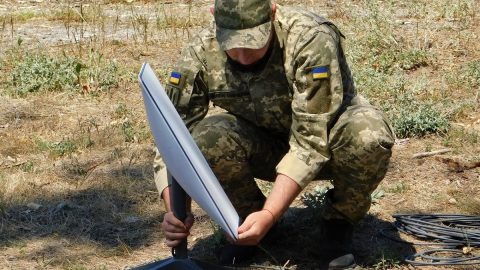
Displayed on the desk behind him were a pair of White House chocolates, which Ko later explained were mementos from his trip to Washington this past January. Ko, whose personal website includes a section titled “Blockchain Government Proposals,” was part of Taiwan’s tripartisan delegation to Trump’s second inauguration. Several days after our conversation, he sent a picture of a receiver made by Starlink, SpaceX’s satellite communications system, next to a message saying that his terms of service had been updated.
Efforts to bring satellite internet to Taiwan have been dogged by concerns that Elon Musk would abandon the island in the event of a conflict. In 2022, Musk told the Financial Times that Beijing had expressed to him its disapproval over the rollout of Starlink in Ukraine. Later in that same interview, he proposed that Taiwan be turned into a special economic zone. “It’s possible,” Musk said, “and I think probably, in fact, that they could have an arrangement that’s more lenient than Hong Kong.”
When pressed on the issue, Ko dismissed concerns about Musk as a conspiracy theory peddled by pro-DPP netizens. “Maybe when there is a war,” he said, “you can switch to another satellite network.”
Even if Taiwan did fully embrace Starlink, or one of its rivals, Mok and Huang say that satellites could only ever replace a small fraction of Taiwan’s required internet bandwidth. (Taiwan’s Ministry of Digital Affairs has been pursuing its own indigenous satellite communication system since 2019.) Gahon Chiang (江佳紘), a legislative staff member in the office of DPP Legislator Chen Kuan-ting (陳冠廷), compared the data transmitted through internet cables to an oil field. “The communication satellites are just like a gas station,” he said.
Three weeks before the Hong Tai 58 was detained, a cable repair ship operated by a Japanese company arrived in the southern port of Kaohsiung. It had come to Taiwan to repair cables connecting the Matsu Islands. When the Ministry of Digital Affairs got word that the Tai-Peng cable had been cut, it asked Chunghwa to reserve the Japanese vessel for these repairs as well. But only after it had finished up in Matsu. That, depending on sea conditions, would take another month or more. The Ministry of Digital Affairs estimated that the Tai-Peng cable would be repaired by the end of May. (The ministry declined a request to be interviewed for this story.)
This saga reveals a disturbing fact. In Taiwan today, it can take just as long to repair a submarine cable as it does to indict, arraign, try and charge the person responsible for breaking it. In the Indo-Pacific context, such timelines are not unusual. An analysis by the International Institute for Strategic Studies from last year found that it can take up to 30 days for a repair ship to be dispatched.
Cable repair ships are often delayed while they seek permission to enter territorial waters, said Collin Koh, a senior fellow at Nanyang Technological University’s Institute of Defence and Strategic Studies. “It isn’t just about the capacity,” he said. “But it’s also about the country’s cable policy. And that, of course, determines whether they could get foreign vessels to come to do the repairs and all that.”
Out of the 60 cable ships tracked by the International Cable Protection Committee, 15 are based in the Indo-Pacific, more than any other region in the world. But the ships are privately owned, and the majority specialize in the more profitable activity of laying new cables, not repairing old ones.
After the Matsu Island cables were severed in 2023, Taiwan’s National Communications Commission reportedly called on Chunghwa Telecom to invest in its own cable repair ship. It is unclear whether any progress has been made on that front. (Chunghwa declined a request to be interviewed for this story.)
Gahon Chiang, the DPP staffer, who also serves as youth representative to the Taichung City government, wonders whether the talented engineers of his generation would be willing to staff such a project. “They just go to TSMC or another chip company,” he said, “but are they really going to do this kind of cable repairing work?”
In peacetime, delayed repairs leave Taiwan’s population of 23 million almost entirely unaffected. But Kenny Huang, who sat on a public panel on Wednesday to discuss the findings of Chen Ta-chen’s Research Institute for Democracy, Society and Emerging Technology report, worries that Taiwan will become complacent. “In a wartime, sorry, I guarantee not any ship [will be] willing to come here,” he said.





Leave a Reply