On the face of it, Washington has taken a brave and principled step to further the rights of Tibetans. The U.S. Congress, on June 12, passed the bipartisan Promoting a Resolution to the Tibet-China Conflict Act, better known as the Resolve Tibet Act, which looks to oppose China’s imperial occupation of Tibet with the most potent and peaceful weapon available: truth.
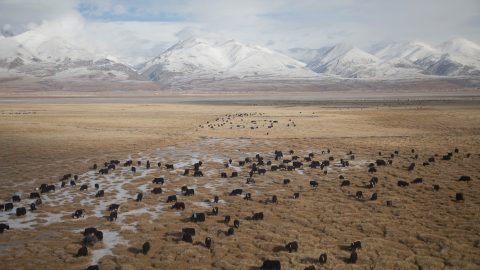
Provisions in the act refute that Beijing either has lawful control of Tibet or rules with the consent of its people. They set a geographical definition for the country that goes beyond the narrow “autonomous region” defined by the Chinese government and includes the “Tibetan areas of Qinghai, Sichuan, Gansu, and Yunnan provinces.”
Pressing China to enter authentic dialogue with either the Dalai Lama or his representatives and democratically elected members of the Tibetan community, the act also denies Beijing’s claim to have held Tibet since ancient times and amends the U.S. Tibetan Policy Act of 2002 to insert pledges to debunk Chinese disinformation “about the history of Tibet, the Tibetan people, and Tibetan institutions.” It underlines Tibetans’ “right of self-determination under international law […] and that their ability to exercise this right is precluded by the current policies of the People’s Republic of China.”
The affirmation of U.S. support, which comes with a mechanism to release funds for the purpose, does not come a moment too soon. The Chinese Communist Party is currently accelerating efforts to ensnare Tibet within its economy, smudge socialist doctrine into Tibetan Buddhism, silence the Tibetan language and dissolve the cultural links between children and their families so that any trace of a Tibetan identity distinct from China can be disappeared forever.
Replacing the word “Tibet” itself with the Mandarin “Xizang” on the international stage is all part of the ploy, and Beijing is now advancing a Sinicization drive for locations in the Indian state of Arunachal Pradesh, which borders Tibet, too. Here, it is redrawing maps and giving new Chinese titles to locations that often have symbolic meaning to Tibetan people, in what appears to be a concerted, strategic preparation for annexation of India’s territory.
Yet, while China is stomping its feet about Washington’s “wrong signal” with the Resolve Tibet Act and no doubt dreaming about smashing separatists in revenge for the attempt to thwart its intentions, it will also take comfort in the knowledge that the U.S. has, not for the first time, contrived to delegitimize its own voice in front of the rest of the world and rendered any neutral party unable to take anything it says at face value.
For just two days after Congress sent Joe Biden its cross-party vow to counter China’s lies, Reuters filed an investigation reporting that the Trump-era Pentagon had embarked on a deliberate antivax campaign in the Philippines, Central Asia and the Middle East during the height of the COVID-19 pandemic.

The aim was to discourage people from using vaccinations from the Chinese company Sinovac Biotech, and thereby puncture China’s prestige. The methods included inauthentic social media accounts that impersonated local people, made unproven claims about the inoculation containing pork so as to put off Muslims and operated under hashtags like #Chinaangvirus, which means “China is the virus” in Tagalog.
Although Sinovac’s product was notoriously borderline in terms of efficacy and lacked complete supporting data at its inception, it was still capable of saving lives at a critical juncture when the majority of the world’s population had no alternatives. Moreover, instead of challenging it via verified social media accounts on the grounds of its opacity, the U.S. appears to have instead resorted to stigmatizing the vaccine as “Chinese” and spreading disinformation through sock-puppets that were intended by their very nature to mislead.
But it gets worse. As stated by Reuters, the U.S. military is forbidden from targeting Americans with propaganda and does not seem to have done so, which sends the impression that the lives of other nationalities, peoples and individuals, including Filipinos and Muslims across Asia, are not accorded with the same value.
Hence, as Washington steps up to establish itself as the lodestar for a truthful portrait of Tibet, it has simultaneously been caught telling the most morally reprehensible of mistruths in a manner that suggests it would abandon any sense of right or wrong in order to get one up on Beijing. Whoever gets caught in the middle be damned.
True, the Biden administration did (slowly) discontinue the antivax salvo, but most of the world will not be paying attention to the details, and skepticism about U.S. intentions and honesty are unavoidable against the backdrop of this kind of scandal. Presumably, some of the audiences to which America will be promoting Tibet’s authentic history and geography will be the very same people whom it attempted to leave unprotected against a potentially deadly disease by bombarding them with disinformation.
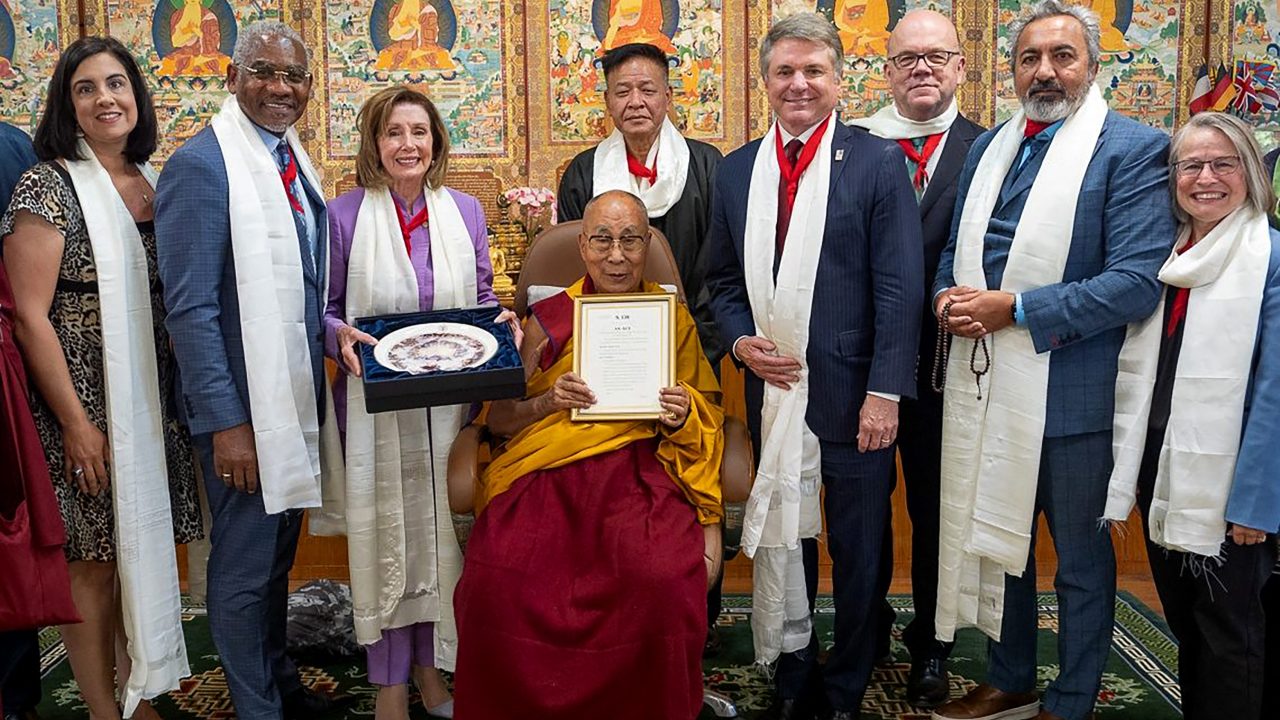
On June 19, former U.S. House speaker Nancy Pelosi accompanied a delegation to present the Dalai Lama with a framed copy of the Resolve Tibet Act. He and the Tibetan community more broadly are rightly excited and heartened to receive such high-profile support in their legitimate quest for basic rights and self-determination for their homeland. They could be forgiven, however, for wishing that it stood on firmer shoulders.


Leave a Reply