
The wind caught me differently and the people were all welcoming wherever I went. They spoke Hindi rather than Mandarin and proudly identified themselves as Indians. This was Tawang,1 a majestic district in the Indian state of Arunachal Pradesh, bordering not only Tibet (occupied now by China) but also Bhutan. My visit to this region and China’s recent actions, particularly the renaming of 30 locations in the region on March 30, 2024,2 reignited my focus on Arunachal Pradesh, prompting me to collaborate with my friends Tenzin Sherap and Tenzin Younten on an issue brief to delve deeper into the matter.
Our research, published under the title “Thread of Beads: An analysis of China’s renaming of 62 locations in the India state of Arunachal Pradesh since 2017,”3 sheds light on the broader narrative and objectives underlying China’s actions. By contesting and encroaching upon sovereign Indian territory, China seeks to advance its “Chinese Dream,”4 which it wants to fulfil by 2049, directly impinging upon “Viksit Bharat,”5 India’s vision of becoming a developed nation by 2047. The timing of these actions, notably coinciding with India’s general and state elections, including elections in Arunachal Pradesh, raises suspicions regarding China’s motives, which have been highlighted by many China observers and researchers in India.6

The response from the Indian government,7 the Indian media and other stakeholders has predominantly been dismissive and reactionary. While such responses are warranted, it is imperative to recognize the significance of these frequent and concerted actions, particularly in the context of China’s utilization of the “Three Warfares”8 strategic framework, which was adopted around 2003. Despite India’s response, there is a palpable concern that China may be gaining ground in this form of engagement.
The Three Warfares are public opinion/media warfare, psychological warfare and legal warfare, also known as “lawfare.”
Our analysis has revealed China’s calculated efforts in weaving what we termed the “Thread of Beads” across the Northern Himalayan front of India. Analogous to the “String of Pearls”9 strategic initiative in the Indo-Pacific region, China’s actions along its border with India are methodically conditioning the area for potential annexation. Of particular concern is the Indian state of Arunachal Pradesh, which our study has focused on. China claims Arunachal Pradesh as part of “South Tibet”10 (Zangnan, 藏南), as seen in official Chinese maps. South Tibet spans over 90,000 km², as per official Chinese documents, news outlets, social media platforms and other agencies,11 all of which possess a wider reach than their Indian counterparts.
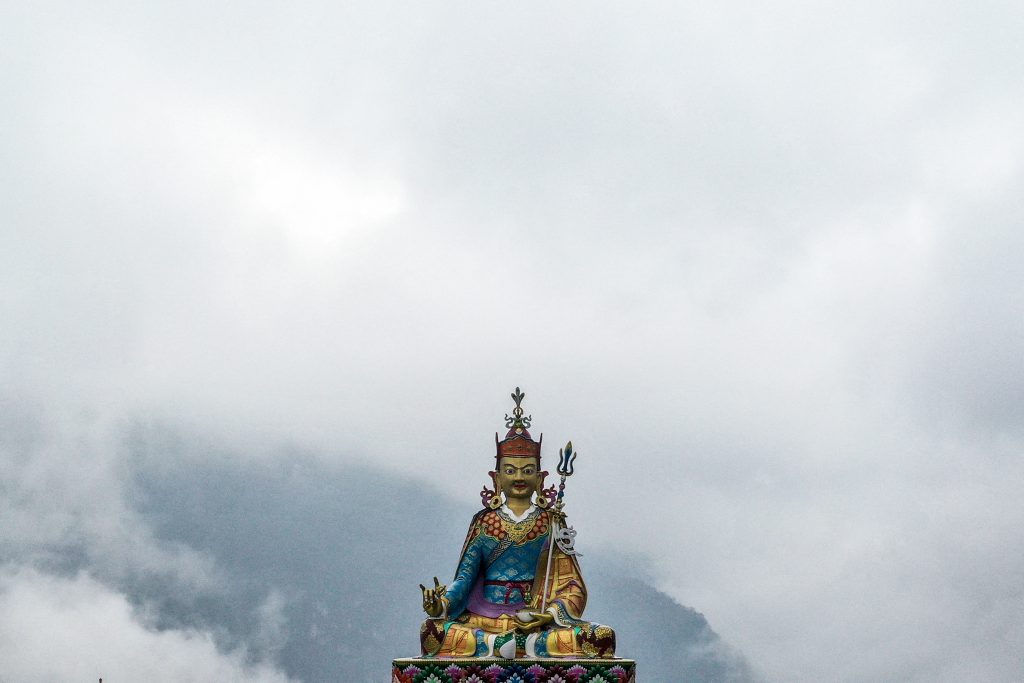
China’s territorial claims over regions in Arunachal Pradesh derive from its historical occupation of Tibet and Tibet’s erstwhile legitimate claims to certain regions of northern Arunachal Pradesh, including Tawang. However, Tibet’s claims were addressed through the 1914 Shimla Convention,12 where the “McMahon Line”13 was delineated and mutually agreed upon by then-independent Tibet and British India. Despite China’s participation in the convention, it refrained from signing the eventual agreement. Tibetans even now see Arunachal Pradesh as an inalienable part of India’s sovereign territory. In our issue brief we have proven this by the 2001 Tibet and Adjacent Areas under Communist China’s Occupation Map by Amnye Machen Institute: Tibetan Centre for Advanced Studies,14 which clearly shows Arunachal Pradesh as part of India, aligning with Indian official records, the Tibetan government in exile and widely cited by scholars in the field of Tibetan Studies.
Among the 62 locations recently renamed by China in Arunachal Pradesh, two sites hold major significant historical ties to the Dalai Lama, the spiritual leader of Tibet:
- Ugyenling (Wujianling, 烏間嶺)15: Designated as the birthplace of the sixth Dalai Lama, Tsanyang Gyatso, this location holds profound spiritual and cultural importance in Tibetan Buddhism. The inclusion of Ugyenling in China’s official mapping efforts raises questions regarding China’s intentions and motivations in asserting control over areas with historical ties to Tibetan religious figures. Ugyenling was renamed Wujianling on April 13, 2017.
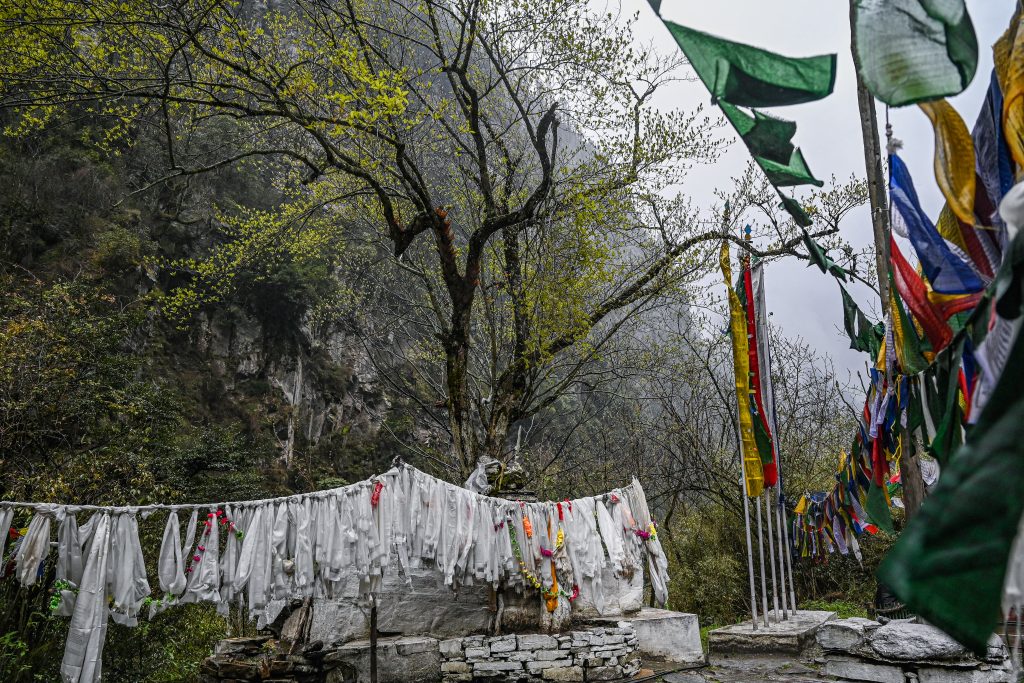
- Hathung-La (Hadong Shankou, 哈東山口): This strategic ridge near Khinzemane Village holds particular significance due to its association with the Dalai Lama’s escape from Tibet in 1959. The village served as a pivotal point in the Dalai Lama’s journey to seek asylum in India, marking a momentous event in Tibetan history. The anecdote of the Dalai Lama planting his walking stick,16 which later grew into the Holy Tree at Khinzemane, further adds to the site’s cultural and spiritual significance. It is noteworthy that China did not assert claims over this territory as part of its proclaimed “South Tibet” during the Dalai Lama’s escape in 1959.17 Hathung-La was renamed Hadong Shankou on March 30, 2024.
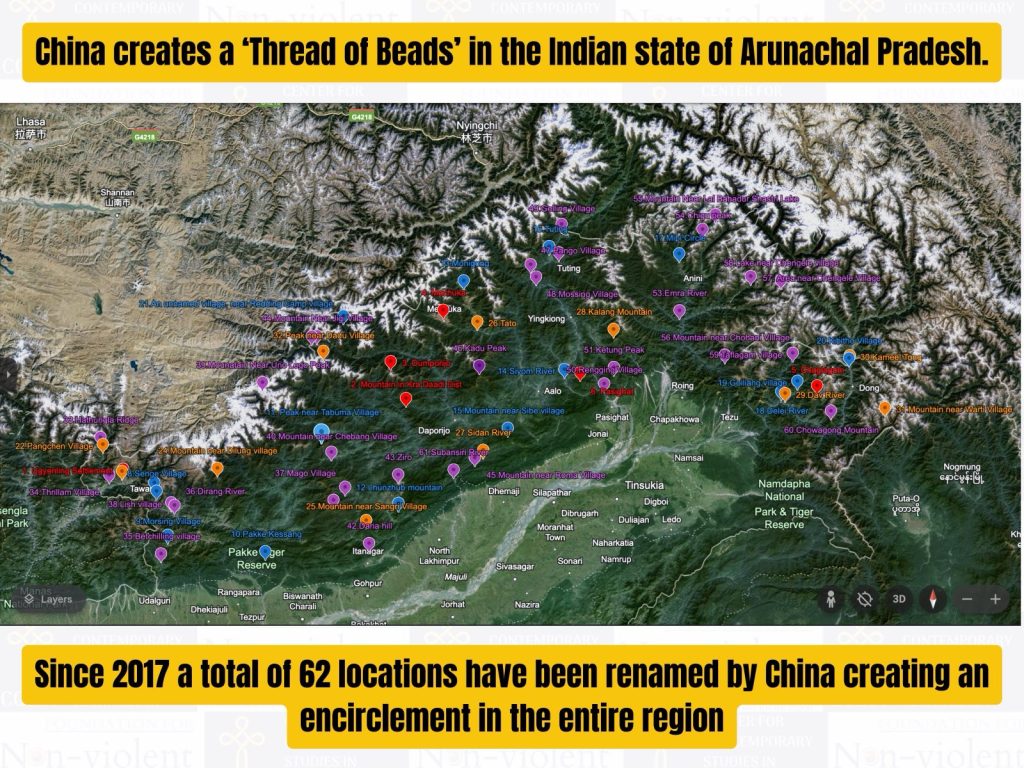
Since 2017, China, under the Ministry of Civil Affairs, has been assigning standardized names to a total of 62 locations, along with the release of official maps depicting these locations. Our research indicates that these 62 locations are strategically positioned and can be categorized according to their geography or the district in which they are located:
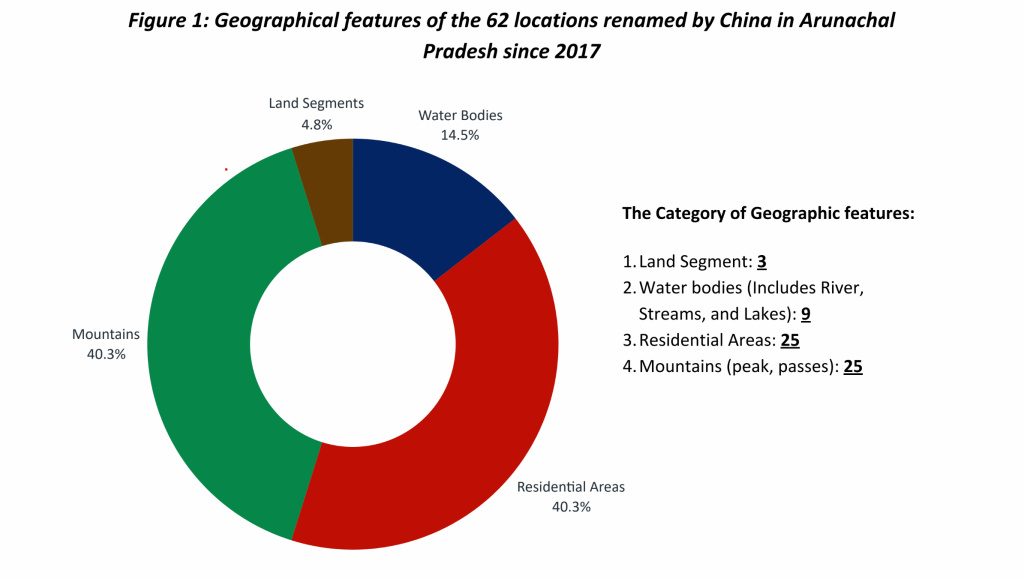
- Geographically:
- The 62 locations cover the geographic terrains of mountains, bodies of water, residential areas and land segments (地片).
- Mountains and residential areas are associated with 25 locations each, totaling 50 out of the 62 locations. The targeting of mountains and residential areas is perhaps not surprising, given both would be crucial variables in an actual hot war.
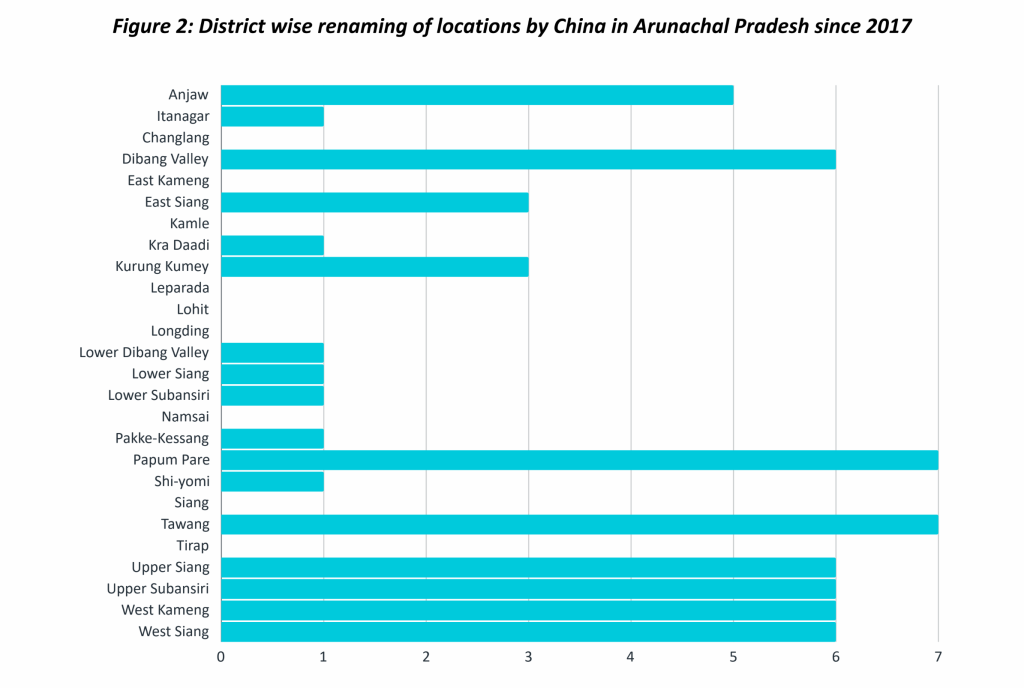
- District-wise:
- There are 26 districts in the Indian state of Arunachal Pradesh. The 62 renamed locations are located in 17 of these districts.
- The majority of the renamed locations are in six districts: Papum Pare (the district inside which the capital city Itanagar is located, with Itanagar also having the special status of being a separate district); Tawang; Dibang Valley (the largest district in size and sharing some of the longest borders with Tibet); Upper Siang (borders Tibet); Upper Subansiri (borders Tibet); West Kameng (formerly Tawang was part of this district); and East Siang. More than six renamed locations are located in each of these districts. Seven renamed locations are in West Kameng and East Siang each.
China’s modus operandi in its territorial expansionist agenda often begins with a standardized naming and mapping exercise, as evidenced by its past actions in Tibet and Bhutan. Through the gradual establishment of legitimacy over sovereign territories among its populace, China proceeds to illegally annex these areas. A striking example is the case of the Kula Kangri Peak area,18 where China’s persistent pressure, starting with standardized mapping and naming, eventually led to Bhutan conceding to Chinese claims.19 This process underscores the significance of understanding China’s tactics in territorial disputes and their broader implications.
In Tibet, China, first under the Nationalist government, initiated its territorial assertions through the standardization of maps and names, laying the groundwork for subsequent illegal annexation. Through establishing a sense of legitimacy over Tibetan territories among its populace, China gradually expanded its control, with the Communist government ultimately invading Tibet in 1950.20 The case of Tibet serves as a blueprint for China’s approach to territorial expansion, highlighting the importance of standardized mapping exercises in advancing its geopolitical objectives.
The precedent set by China’s actions in Tibet and Bhutan carries significant implications regarding the standardization of maps and names, which serves as a precursor to illegal annexation, highlighting the need for vigilant monitoring of China’s territorial assertions. Moreover, the willingness of neighboring countries to concede to Chinese claims underscores the asymmetric power dynamics at play and the challenges faced by smaller nations in resisting Chinese influence.

However, India is certainly not Bhutan, or Tibet for that matter (the latter being officially part of China, with China only recognizing a portion of its territory based on the Shimla Convention, which it uses as per its convenience). India’s heightened security measures and development of infrastructure in Arunachal Pradesh show it is taking China’s cartographic aggression seriously. The recent inauguration of the Sela Pass tunnel21 sparked strong condemnation from China. To give an idea of the scope of the strategic infrastructural development that has taken place on India’s side of the border, on a previous visit, I found it hard to get a 4G signal. Now one can conduct entire video call sessions without issue. This, despite India’s continued geographical challenges in the mountainous regions on its side of the border, which is less of an issue for China, as Tibet is largely a plateau.22
There is a clear push here from China, and with the exercises carried out in Tibet, we should remain cognisant of how effective China’s Three Warfares framework and other policies have been, especially when it comes to renaming locations. Many identify Tibet and its major cities by “Standardized” Chinese names now, and China last year replaced the use of Tibet with Xizang on official documents.23
This may be the fate of locations in the Indian state of Arunachal Pradesh, if India does not adopt a multifaceted approach that encompasses diplomatic, strategic and narrative countermeasures to safeguard its territorial integrity, national interests and the livelihoods of its people in the regions China covets.
References:
- https://tawang.nic.in/
- https://www.mca.gov.cn/n1288/n1290/n1315/c1662004999979998568/content.html
- https://286358.n3cdn1.secureserver.net/wp-content/uploads/2024/04/Thread-of-Beads-An-analysis-of-Chinas-renaming-of-62-locations-in-the-Indian-State-of-Arunachal-Pradesh-1-since-2017.pdf
- https://www.aljazeera.com/news/2023/6/6/living-the-chinese-dream-beijings-new-world-order
- https://www.narendramodi.in/viksit-bharat-the-vision-of-pm-modi-579810
- https://www.hindustantimes.com/opinion/name-games-beijing-plays-with-new-delhi-101712585658560.html
- https://www.mea.gov.in/response-to-queries.htm?dtl/37761/Official_Spokespersons_response_to_media_queries_on_renaming_places_in_Arunachal_Pradesh_by_China
- https://www.usni.org/magazines/proceedings/2021/march/chinas-three-information-warfares
- https://www.globaljournalceners.org/article.php?e=55
- https://history.sohu.com/a/717760698_121236450
- https://baijiahao.baidu.com/s?id=1751359715946454927&wfr=spider&for=pc
- https://www.tibetjustice.org/materials/treaties/treaties16.html
- https://snu.edu.in/centres/centre-of-excellence-for-himalayan-studies/research/going-back-in-time-when-china-was-clueless-about-mcmahon-line/
- https://www.amazon.in/Map-Tibet-Amnye-Machen-Institu/dp/8186227164
- https://www.mfa.gov.cn/web/wjb_673085/zzjg_673183/bjhysws_674671/bhflfg/dtdmxgfl/202303/P020230313585384911864.pdf
- https://timesofindia.indiatimes.com/city/guwahati/tree-planted-by-14th-dalai-lama-near-lac-in-arunachal-a-big-hit/articleshow/98847709.cms
- https://286358.n3cdn1.secureserver.net/wp-content/uploads/2023/06/Resetting-Indias-Tibet-Policy-PDF-copy-1.pdf
- https://foreignpolicy.com/2021/05/07/china-bhutan-border-villages-security-forces/
- https://www.orfonline.org/research/doklam-start-very-beginning
- https://freetibet.org/freedom-for-tibet/occupation-of-tibet/chinas-lies/
- https://www.globaltimes.cn/page/202403/1309198.shtml
- https://www.youtube.com/watch?v=vBba_D5HD8Q
- https://www.rfa.org/english/news/china/china-tibet-xizang-10122023021833.html




Leave a Reply