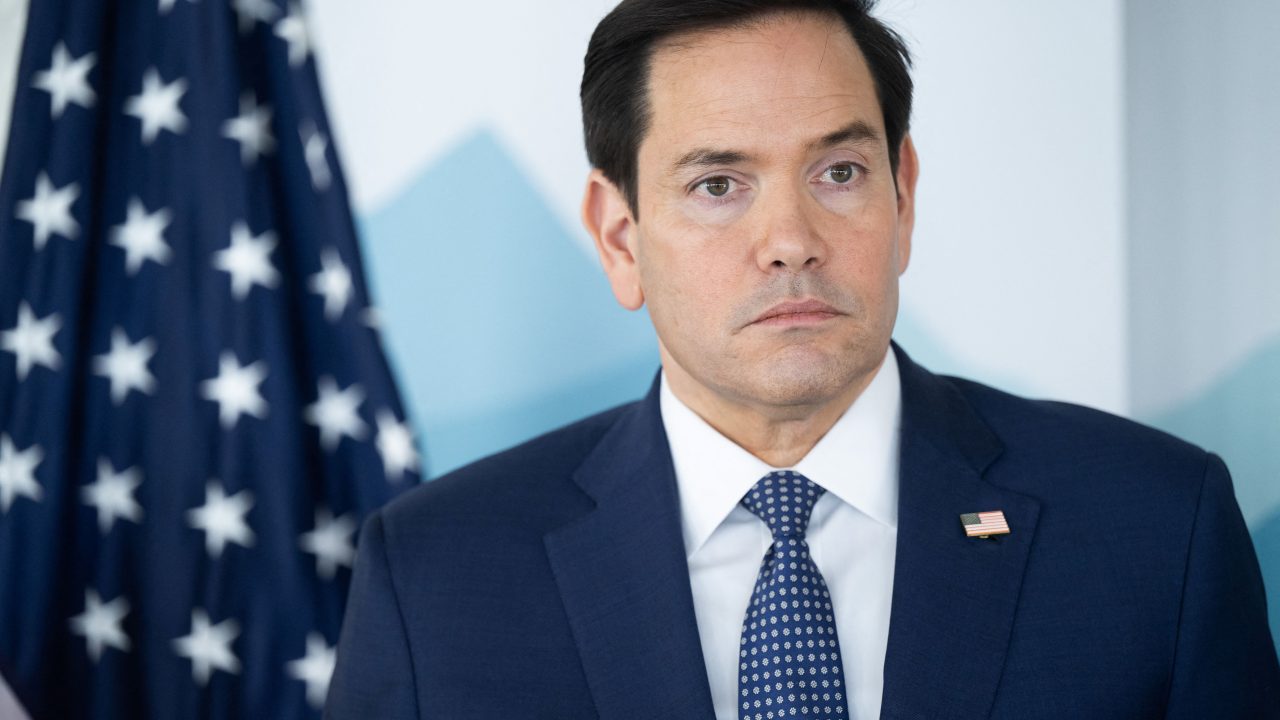
It’s been a tough first few weeks for Marco Rubio, at least in the eyes of some. As the U.S. secretary of state, he has had to applaud and enforce President Donald Trump’s foreign policy initiatives, at least some of which one can only imagine he had no warning of.
When he was nominated for secretary of state, he was seen by many on the left and center as a survivor of the pre-Trump Republican party, a member of the old guard who might have some influence on Trump’s foreign policy. By Taiwanese, the pick was greeted almost with a kind of fervor, as a signal that Trump wasn’t going to withdraw support for Taiwan as he had clearly signaled he was going to for Ukraine.
But after the bruising encounter between Trump, Vice President JD Vance and Ukrainian President Volodymyr Zelenskyy in the White House on February 28, which Rubio watched in apparent discomfort, many felt their hope in the new secretary of state had been misplaced.
I would rather ask this question:
Why did Rubio take the job?
He clearly doesn’t appear to be having a good time in front of the cameras.
But the idea that Trump’s actions have come as a shock to him is completely misplaced.
Rubio the Diplomat
Firstly, Trump’s own positions on Ukraine were well established and communicated prior to his election. After he won, people thought that he would seek to end the war in Ukraine, because he said that he would. It’s just that it was easy to forget or ignore that in the whirlwind days before and after Trump’s inauguration.
Secondly, Rubio himself has been firmly against continuing support for Ukraine since late 2023.
He spoke out against the $60 billion aid package the Biden administration wanted to pass for Ukraine in November, saying “We still have to build up our military because the real risk is China … Why is Ukraine important in that context? I hear that constantly.”
Rubio voted against the measure when it passed in 2024.
Thirdly, in 2023 Rubio published a book titled “Decades of Decadence.” The central argument he puts forward is that the U.S. was hugely mistaken to engage in free trade with China, and that doing so in the 1990s hastened China’s rise and led to the decline of American manufacturing and America itself.
In “Decades of Decadence,” Rubio explicitly states that the U.S. must “prioritize [away from Europe] and direct its resources to effectively counter Beijing in the years to come.”
Rubio is sometimes seen as a stereotypical neoconservative because he came to prominence in that era and because he is hawkish on so many foreign policy issues. This included, until recently, on Russia. His lack of support for arming Ukraine by no means made him a Putin apologist.
But his words and his record actually show that he has become a prioritizer not a primacist. He believes that the U.S. needs to choose where to be strong and where to pull back, and he believes that the priority is East Asia and countering China.
Here, Rubio’s positioning goes back much further to deeper foundations. He has constantly spoken out and voted against the People’s Republic of China. He situates his entire domestic political argument in “Decades of Decadence” in relation to Chinese economic impact on Americans.
Rubio the Politician
Manuel Roig-Franzia is an American journalist who wrote a 2012 biography about the rise of Rubio.
He pointed out to me that Rubio has been loyal to Trump since losing the 2016 nomination battle to him. In his eyes, Trump finds value in a man who was able to take those punches, like being called “Little Marco,” and still be willing to be supportive of him.
Roig-Franzia says that his study of Rubio revealed a man who is politically “agile,” happy to move around depending on what the surroundings call for. He entered the Senate as a favorite of the Tea Party, something almost forgotten now.
I asked if Rubio had hoped to run for president again last year. Roig-Franzia said it would have been political suicide against Trump but that Rubio is still very young and that being secretary of state is one way to establish bona fides for the future.
It’s hard to imagine how Rubio, who attracted a lot of criticism from key Trump supporters as a secretary of state pick, could hope to appeal to the Republican base in its current form as a successor to Trump. But for someone who went into elected politics at the age of 27, a lack of imagination is clearly not something he is burdened with.
In the end, rather than seeing him as someone who hoped to dramatically impact Trump’s foreign policy and steer it into alignment with his own, it would be better to understand Rubio as something much simpler: an ambitious politician taking a job he wants that requires some compromises. But not too many. There is more policy commonality between Trump and Vance on the one hand, and Rubio on the other, than first meets the eye.
But not, however, on every issue. Since Trump announced he would start talks with Moscow, there has been much speculation that he wants to perform a “Reverse Nixon” and pull Russia away from China. Rubio himself said in February that there are tremendous geopolitical and economic opportunities that exist for the U.S. and Russia to partner together on.
One criticism of the strategy runs like this: “While China and Russia could be played off each other during the Cold War, today they share an ambition to upset the global world order.”
Where did those words come from? Rubio’s 2023 book, “Decades of Decadence.”




Leave a Reply