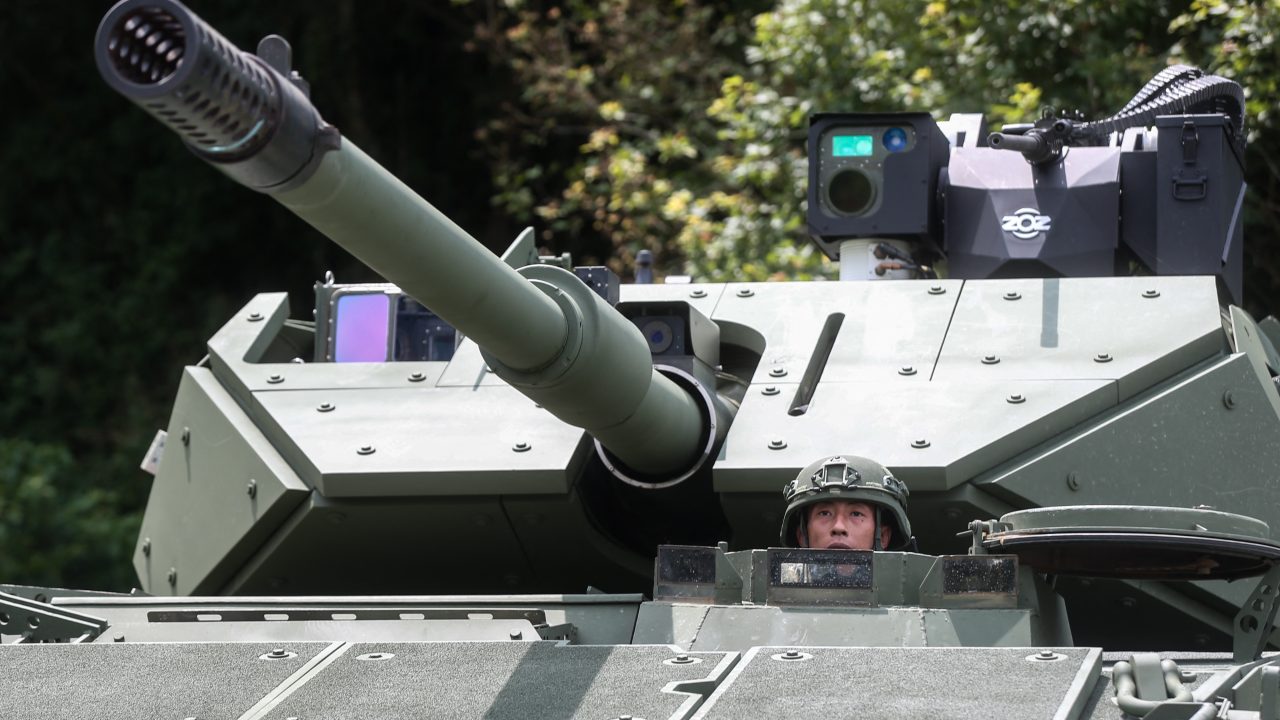
Well actually, it’s not really a tank.
At least, it’s not a main battle tank, which somewhat paradoxically might be defined as a vehicle intended to destroy other tanks and to survive being destroyed by them. Taiwan’s new vehicle is, arguably, a light tank. Light tanks serve similar roles but obviously weigh less and can’t typically survive combat with main battle tanks. Because of this and because it’s easier to deploy them in many situations, light tanks are often expected to serve infantry in a fire support role instead.
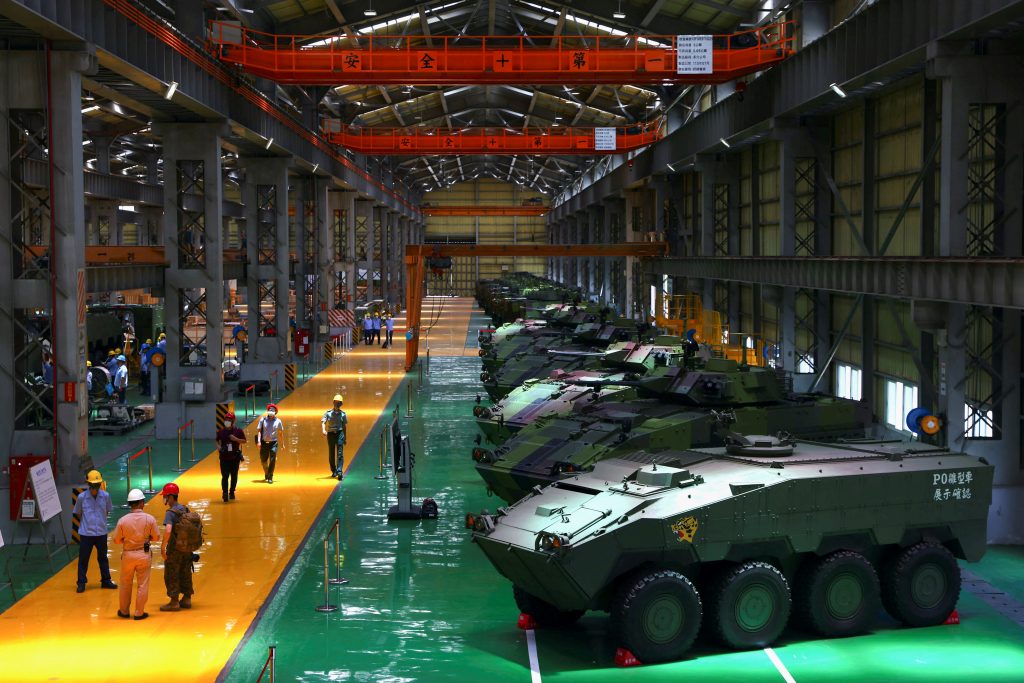
The new light tank doesn’t yet have a name. It’s being called the Clouded Leopard II for the moment. This is because it is heavily based on the Clouded Leopard armored vehicle. The Clouded Leopard family currently in operation by the Taiwanese military includes three variants: the CM32 is a command vehicle; the CM33 is the “basic” armored personnel carrier version, carrying more soldiers but without a turret; and the CM34 infantry fighting vehicle has a turret with a 30 mm gun. An IFV typically has less troop-carrying capacity than an APC but with a larger gun can support infantry better.
But why does it have wheels?

Taiwan is not alone in introducing new wheeled armored vehicles. Over the past decade, many militaries have opted for wheeled armored personnel carriers and artillery. There are several reasons why.
The first is that wheeled vehicles can “self-deploy” (or redeploy). Tracked vehicles need to be transported by train or truck over long distances. Taiwan’s Clouded Leopard II will be able to move around the island by itself, including from south to north and from east coast to west coast, relatively rapidly.
The second reason is maintenance. Tracks require far more maintenance hours than wheels do. This saves money in peace time and lives in war.
The third reason is fuel efficiency. While it’s not desirable to sacrifice performance for this, in any wartime scenario in Taiwan it’s expected that there will be a shortage of resources including fuel, and so this advantage becomes non-trivial.
The obvious disadvantage of wheels over tracks is that they are less mobile over certain ground. This is a real trade-off, but it’s important to note that the new generation of eight-wheeled APCs are still very mobile and able to handle most rough terrain.
At the moment, Taiwan deploys its ancient light tanks, the M41D Walker Bulldogs, on its offshore islands. The Clouded Leopard II is intended to replace these. For small islands with less infrastructure, a lighter vehicle could have less impact and get around easier.
Many militaries have started to reintroduce light tanks, or “direct fire support vehicles,” with a large main gun, distinguishing them from a multitude of similar systems with smaller caliber weapons. The U.S. military has the M10 Booker. The People’s Liberation Army has the Type 15 and the Type 11. Japan has the Type 16, which looks the most similar to the Clouded Leopard II. There are also older types like the Italian Centauro and French AMX-10 RC.
For Taiwan, a light tank, whether wheeled or not, also offers several advantages. Crucially, it can be manufactured domestically. Taiwan’s defense industry likely could not produce a main battle tank.
There are other political benefits as well. Taiwan has been criticized for buying new M1 Abrams at a time when it is supposed to be pivoting to asymmetrical defense. One justification for doing so is that the public wants to see a well-equipped military. A light tank is still a huge piece of metal with a large gun. If this is something that Taiwan’s leadership is concerned about, the Clouded Leopard II can play this role.
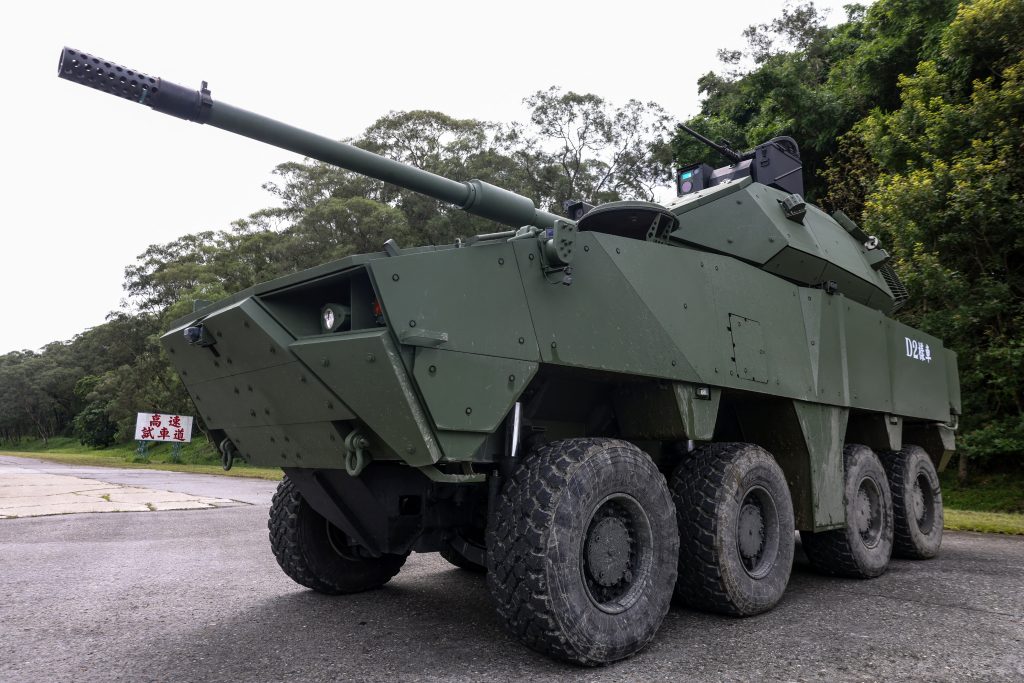
In the period after hostilities have started but before the PLA actually tried to launch an invasion, which could be very short or quite long, it is expected that the Taiwanese military would come under heavy and sustained missile and aerial bombardment. Many military assets would need to be dispersed around the island and essentially hidden during this period. A smaller vehicle like the Clouded Leopard II would have more options to conceal itself. It will also be able to use smaller roads and cross smaller bridges that couldn’t support an M1 Abrams.
It is true that light tanks typically lack the composite armor and 120 mm gun needed to stand a chance against main battle tanks. This is one reason why many militaries seem to not prefer the term “light tank.” However, in an invasion the Clouded Leopard II wouldn’t necessarily need to fight Chinese Type 96 or Type 99 main battle tanks. The vehicles in the first wave would likely be the People’s Liberation Army Navy Marine Corps’s Type 05 and in the second wave the People’s Liberation Army Air Force Airborne Corps’s Type 15. These are much more in the Clouded Leopard II’s weight class.
Taiwan will likely want to introduce other variants of the Clouded Leopard II. With the turret system already integrated, other turret options should come more easily. A fast firing mortar or a light howitzer have both been suggested; likely only one is necessary. A dedicated anti-tank variant with Javelins or a similar missile would also be sensible for something that could take on larger tanks. Likewise a missile carrier with more stand-off range like the tank destroyer the Polish army plans to acquire would be an option.
The Clouded Leopard II as actually is has a 105 mm main gun, which is the same caliber as that of Taiwan’s M60A3 and CM11 main battle tanks. That brings a benefit because more ammunition will be readily available, but it does illustrate that most of Taiwan’s tanks are too lightly armed.
The Clouded Leopard II will have a new chassis, which will eventually be used to upgrade the older Clouded Leopard vehicles. The Clouded Leopard family’s armor is designed to resist small arms and machine gun fire, but not the larger caliber guns wielded by other armored vehicles. Unlike the Clouded Leopard itself, the Clouded Leopard II is unlikely to have the capacity to transport troops because of its larger armament.
A last and least important question is what the new vehicle will be called. Clouded Leopard or Clouded Leopard II are obviously still options, but as a new and exciting model a new name might be called for. Taiwan doesn’t have any other big cats, but the vehicle was developed under the code name Project Cheetah, which might give a clue. Finally, there is always the leopard cat (石虎). Stone Tiger has a nice ring in English, no?






Leave a Reply