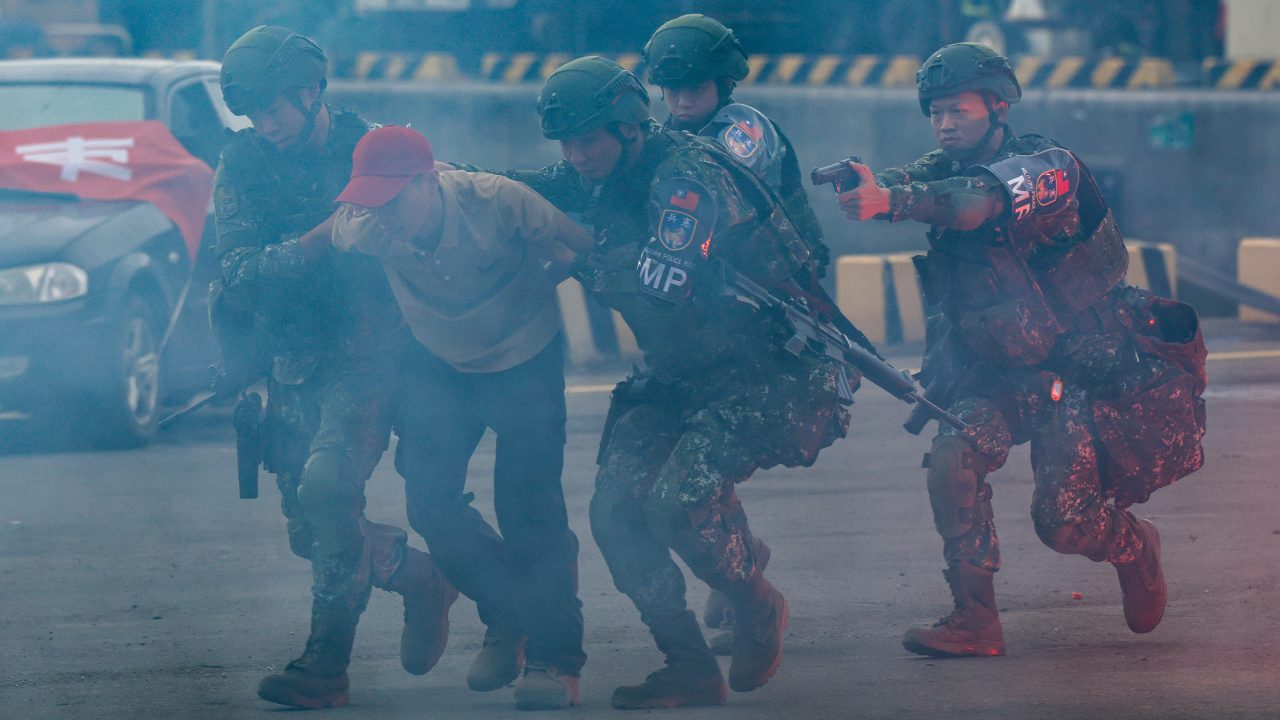
Three weeks ago, the trailer for a new TV show hit the internet in Taiwan and instantly provoked debate and reaction. This was hardly surprising — the series is intended to have an impact on Taiwanese society. But what topic could elicit such a result?
“Zero Day” is a show about a possible invasion of Taiwan by China. The main thrust of criticism has been that the show has received funding from the government, as well as other sources, and that it promotes certain political narratives.
After the trailer was released and digested, though, people were also left with many other questions. What kind of show is this actually?
Yesterday, Domino Theory attended a private media screening of the trailer and then had the opportunity to ask the producer, Cheng Hsin-mei (鄭心媚), and one of the directors, Lo Ging-zim (羅景壬), some questions.
“Zero Day” is being sold as a “war movie” show, the story of a Chinese invasion of Taiwan. However, one of the questions Lo asked himself several times during the panel discussion was: “Is this really a war movie?” His answer? “It’s debatable.”
There is still a lot that we don’t know at this point, but it is at least clear that “Zero Day” is not going to be focused on the depiction of conventional warfighting, and certainly not on large set-piece battle scenes (although we were promised “one” of those). Instead, the show is going to focus on cognitive and information warfare, on mis- and dis-information, on human choices in the face of trying circumstances.
We don’t know at what point during the invasion the show will end, but the name itself gives some clue. “Zero Day” refers to the day the invasion starts. Much of the trailer is explicitly set on days called Z-7, Z-5 and so on, counting down towards Z-Day itself (history fans might be tempted to note that X-Day and Y-Day were part of U.S. plans for Operation Downfall, the abandoned plan to invade Japan at the end of World War II).
It tempts us to ask, will the show end right at the very beginning of the invasion, on Day Zero itself?
Potential audiences will also be very interested to learn that the show will have ten one-hour-long episodes. Each has a different director and each will focus on a different “theme” of the conflict. Some of these were revealed at the event. We can expect to see episodes about political infiltration, about media infiltration, influencers, religious groups, businesses and families. Can you see any controversy yet?
The episode directed by Lo will focus on the impact of A.I. In response to a question, he said he is not worried about keeping up with the latest technology (he said they couldn’t), but rather wants to depict the blurring between truth and falsehood.
A War Series Without Much War
There is risk and reward here. The showrunners clearly want to tell a story about human psychology, about all the different pressures that are exerted on and within a society by the threat of imminent conflict and by an adversary exerting all its informational resources to try to break that society. Producer Cheng also openly stated that depicting an open war across the strait was “quite sensitive.”
The potential reward is obvious: The show may well be excellent, provoking widespread acclaim and starting conversations in Taiwanese society and in Taiwanese homes about how to respond to the threats that are depicted. International viewers may gain insight into Taiwan and the pressures that already exist in reality. Cheng repeatedly pointed out that Taiwan is currently the largest recipient of disinformation.
The risk is a bit more concerning. If “Zero Day” is marketed as a war series, as one possible way that an invasion could unfold, I think a lot of people who tune in may be turned off when they finally realize that this isn’t a modern day “Band of Brothers.” Additionally, Taiwanese society is a complex mix of different groups and motivations, and it may be beyond anyone’s storytelling capability to simultaneously explain how and why that is the case while also showing that society being stretched to a breaking point.
About the show’s funding, both Cheng and Lo stressed that receiving funding from the Ministry of Culture is normal for filmmakers, and that neither the government, other investors or the military who assisted them with filming had any say on the scripts. There is very apparent concern that “Zero Day” will be seen as a work of propaganda. I would suggest that persuading certain quarters this is not the case was always a lost cause. I also do not think that international audiences will care.
What is propaganda anyway? It is information that is intended to influence or persuade its audience towards a particular point of view. There is no real doubt that the directors and producer want Taiwanese people to think more about preparing to resist a conflict with China. Propaganda, ironically, has a bad reputation because of the twin associations with authoritarian states and misinformation. This makes it an especially dirty word in Taiwan. But from a political science perspective, most political communication is propaganda, and the idea that “Zero Day” is not a political show is laughable.
“Zero Day” represents a breakthrough for Taiwanese filmmakers because it will depict a future conflict with China, which Cheng said was a gap in the film industry in Taiwan. Whether it represents a breakthrough for Taiwanese society and Taiwan itself rather depends on its persuasive power, and whether it’s, you know, good. For that, we’ll have to wait until March 2025 to find out.



Leave a Reply