
With only 21 days until the 2024 Taiwan presidential election, the three main political parties are actively targeting Taiwan’s youth and first-time voters.
Vice presidential candidates from the Democratic Progressive Party (DPP), the Chinese Nationalist Party (KMT) and the Taiwan People’s Party (TPP) engaged with students at National Chengchi University (NCCU) last week, covering topics ranging from cross-strait relations and information security to youth political participation.
The DPP’s Hsiao Bi-khim (蕭美琴), the first speaker at NCCU, drew a full house. She spoke at length on identity and national defense, saying she proudly identified herself as a person of the Republic of China.
A student asked Hsiao about China labeling her a “stubborn Taiwan independence element” (台獨頑固分子). She acknowledged the historical taboo around advocating for Taiwan independence in politics. She highlighted President Tsai Ing-wen’s (蔡英文) emphasis on maintaining the status quo, which is not China’s preference as it seeks to make Taiwan another Hong Kong, a proposition deemed unacceptable by Taiwan.
Hsiao emphasized the common interest in peace and security in the Taiwan Strait. Hsiao noted that about 80% of Taiwanese public opinion supports maintaining the status quo, asserting that any responsible candidate seeking the presidency must clearly state their position on defending it.
On gaining electoral support from the youth, Hsiao outlined three reasons. Firstly, DPP candidate Lai Ching-te (賴清德) and her boast comprehensive political experience. Secondly, all three presidential candidates have served as city mayors, with Lai receiving higher satisfaction ratings during his time in Tainan. Lastly, Hsiao emphasized that the DPP did better over the past eight years compared to the previous KMT administration, though she acknowledged areas where improvement is needed.
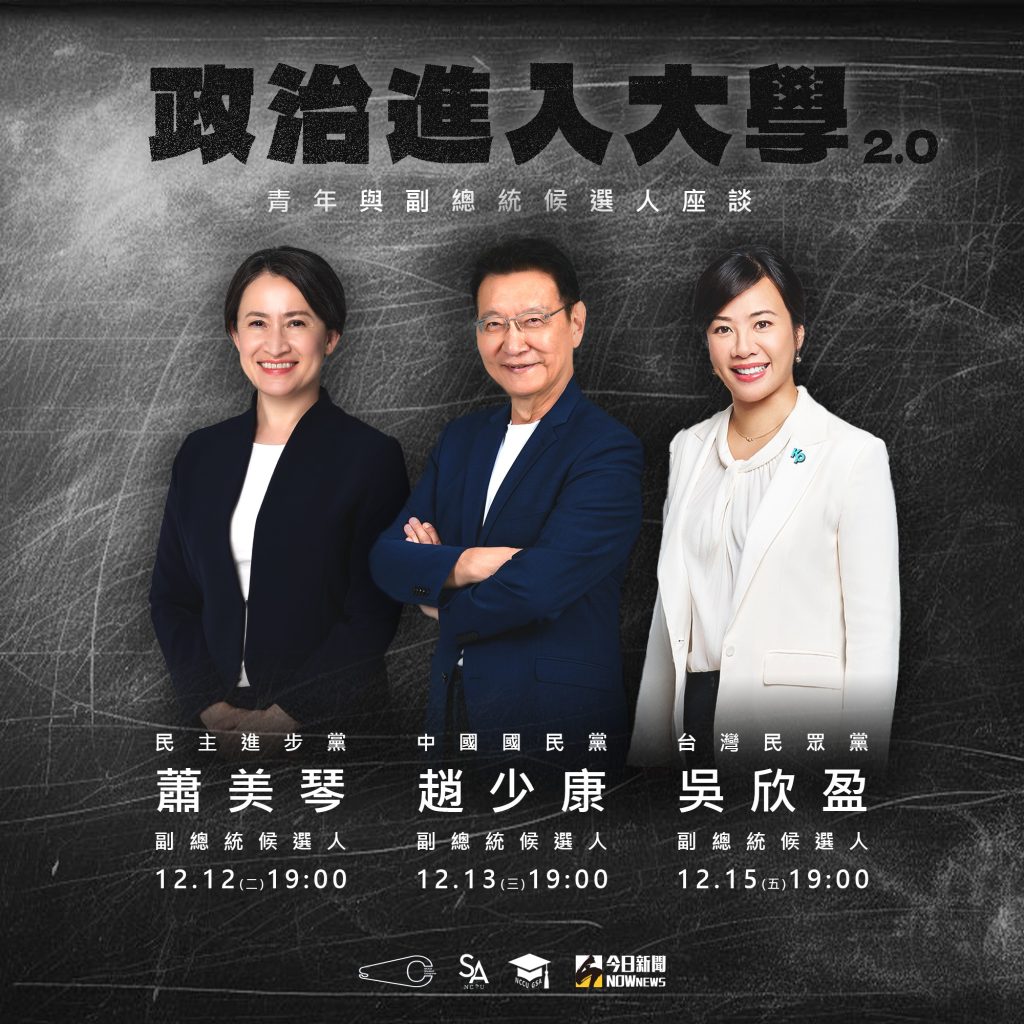
The KMT’s Jaw Shaw-kong (趙少康) was the second speaker to meet the students, also receiving a full house. He spent most of his session answering questions and focused on cross-strait relations and Taiwan’s economy.
Jaw argued for implementing a parliamentary system in Taiwan’s government, because Taiwan’s winner-takes-all presidential system lacks stability. He noted that TPP candidate Ko Wen-je (柯文哲) has been pushing for the same system. Jaw said he would step down if he cannot implement a parliamentary system within his first year as vice president.
Jaw said no political system is perfect and democracy is less efficient compared to authoritarianism, but stressed that democracy serves as Taiwan’s best safeguard against China.
The students cheered when Jaw was asked if he would resign as Broadcasting Corporation of China (BCC) chairman to comply with Taiwan’s election laws. Jaw said he has taken leave from his BCC position and stopped hosting TV shows, which already exceeds the legal requirements. He stated the decision to resign is his own and will not be forced. Jaw later clarified that he will step down if he and Hou win.
Jaw also defended KMT candidate Hou Yu-ih’s (侯友宜) proposed no-down-payment policy for young homebuyers.
Cynthia Wu (吳欣盈) of the TPP started off by inviting the students to respond to a series of rapid fire questions as a way to talk about what Taiwan’s future may look like. The attempt proved to be popular as many students offered answers. However, she lost momentum as her speech took on the tone of a college lecture, and she regularly switched between English, Mandarin and Taiwanese, as she is not completely fluent in Mandarin.
Wu highlighted her background in economics and expertise in green energy and AI. She stressed the importance of a strong economy so Taiwan can attract foreign investment. In contrast to Ko Wen-je’s emphasis on “giving the country back to its people,” Wu advocated for “bringing the economy back to the market.”
Regarding low salaries and high housing prices, Wu stressed the need for industrial innovation and high-paying jobs. She blamed Taiwan’s central bank for the high price of housing, saying it has been deliberately keeping interest rates low to make borrowing easy. Wu said this leads to an unhealthy cycle of speculative property buying, despite its aim being to enhance competitiveness within export markets.
On Ko’s statement that cutting enrollment in college majors with low earning potential, Wu said that low salaries do not necessarily correlate with majors. The focus should be on learning to utilize one’s network and acquiring problem-solving skills.
When asked about Ko Wen-je allegedly being a “misogynist,” Wu paused briefly before answering. Then she replied, “You know, I think Doctor Ko loves his mom. And if he hates women, he wouldn’t pick me, right?”
Regarding cross-strait relations and Ko’s take on following the diplomatic approach set out by President Tsai, Wu said the 1992 consensus is an old term and there are different interpretations. She hopes the new government is one the Chinese government is willing to discuss how to peacefully coexist with.




Leave a Reply