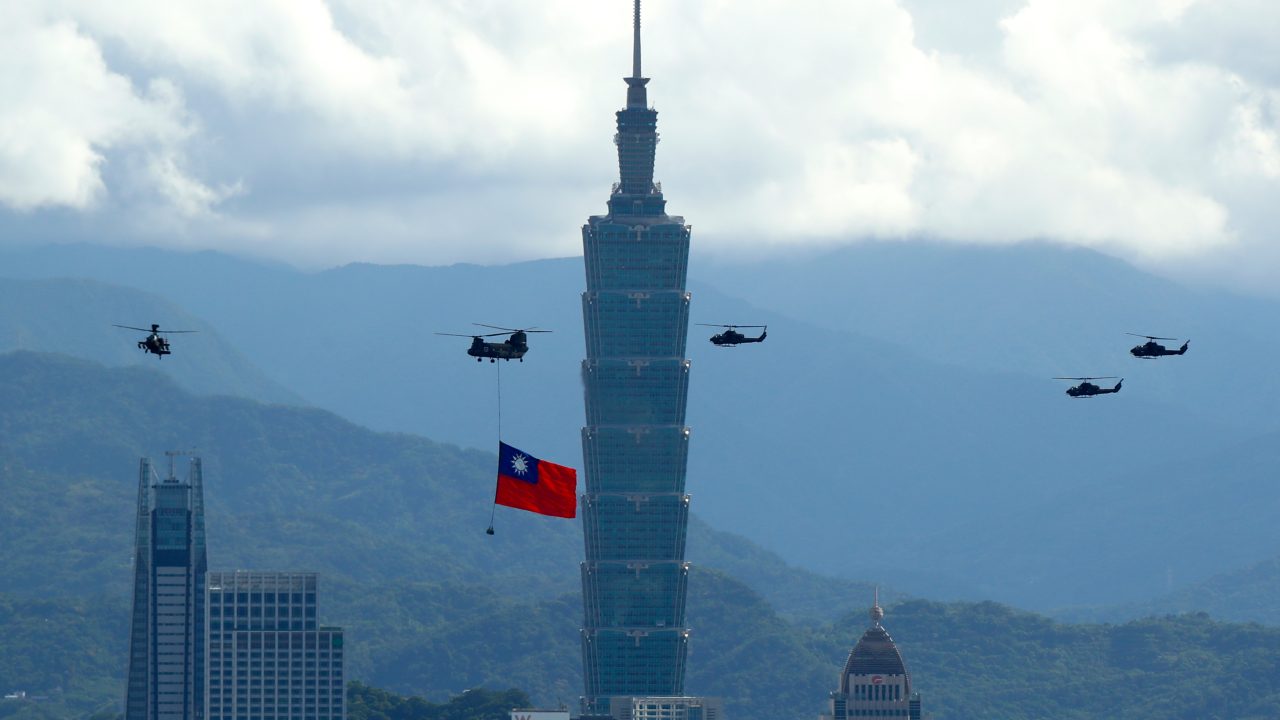
China’s most consequential election tampering is also its most forceful: aircraft carrier formations in the Taiwan Strait, Chinese warplanes crossing the median line that tacitly separates Beijing’s jurisdiction from Taipei’s and, as voting day creeps closer, spooky balloons from the Middle Kingdom, including one that floated directly over Taiwan.
Fresh in the electorate’s memory are also the repercussions of the August 2, 2022 visit to Taiwan by Nancy Pelosi, then speaker of the United States House of Representatives, when China mocked up a blockade around the island and launched cyberattacks on everything from government ministries to convenience stores.
For voters, these actions say one thing: On pain of war, do not choose parties and politicians that seek to build ties with the West, i.e. the incumbent Democratic Progressive Party (DPP). The message is backed by China President Xi Jinping’s repeated promises of “reunification” with Taiwan and direct threats of conflict from the Middle Kingdom’s Ministry of National Defense.
The rhetoric and parade of military gear goes hand in glove with framing of the main opposition, the Chinese Nationalist Party (KMT), which Beijing considers as more in line with its thinking, as the candidates of peace. The party’s former Taiwan president, Ma Ying-jeou (馬英九), fresh from becoming the first present or past leader of democratic Taiwan to ever visit China, has stated, “A vote for the KMT means no battlefield in the Taiwan Strait.”
But Beijing’s support for the opposition is not just bullets and steel. It has been courting Taiwanese politicians that may be favorable to its position in the election lead up with trips to China. These are particularly targeted at local level leaders, whose personal contacts and influence may be able to swing votes. A disproportionate number reportedly come from central Taiwan, which is an identified opinion battleground.
Pressure is also being applied via Taiwan’s sizable cross-strait business community, whose factories and investments in China are a natural foothold for the Chinese Communist Party to exert electoral influence. Since business figures can guide conversations on the economy as Taiwanese make up their minds about who should lead them for the next four years, they are particularly useful, and, in mid-December, upon their invitation, the KMT’s vice chairman, Andrew Hsia (夏立言), visited them in multiple Chinese cities. He is also thought to have met China’s Taiwan Affairs Office, which orchestrates its policy to its neighbor. DPP figures could not embark on a likewise journey without extreme risk of arrest on national security charges.
Customarily, heavy-handedness results when a member of the Taiwanese business community steps out of line and disrupts Beijing’s election strategy. This was illustrated by billionaire Terry Gou (郭台銘), an early presidential candidate, whose stand for office would have eaten into the KMT’s vote by appealing to the same base. Just as his campaign started to get going, however, the sizable Chinese interests of Foxconn, a company Gou founded, were struck with dual tax and land use investigations, an unambiguous signal that he was considered persona non grata in the presidential race. Dutifully, he withdrew candidacy one month later.
Money offers election guidance through de facto sanctions, too. Over many years, China has expressed its displeasure with DPP governance and attacked its southern rural heartlands by placing import bans on agricultural produce: Pineapples, pomelos and, more recently, mangoes have all been affected. In one case, a special exception was given to a region traditionally less supportive of the current ruling party, whose KMT commissioner had been on trips to China, too. Since 2019, before Taiwan last voted for its president, Beijing has also sought to scupper the former’s tourism industry by stemming the flow of Chinese visitors, who once constituted approximately 25% of tourists.
Closer to election day this time around, trade has been weaponized equally explicitly: Just weeks beforehand, China announced an investigation conclusion that Taiwan had contravened both a bilateral trade deal and World Trade Organization rules, which it used as justification to remove tariff cuts on 12 chemical imports from January 1, 2024. Pointedly, its Taiwan Affairs Office claimed that the matter could not be resolved in any other way because of the “independence” stance of the DPP. By this, it strongly hinted that alternative rulership would be treated more leniently.
Predominantly, Beijing’s efforts have looked to shepherd the Taiwanese electorate towards the KMT, but, in a three-way race, it may also be hedging its bets with the Taiwan People’s Party (TPP) and its leader, Ko Wen-je (柯文哲). There have been allegations that two TPP party heads in Taipei were members of the Hongmen, a shadowy group notorious for its China ties, and, at one stage, Ko looked certain to team up with the KMT, a move that the Chinese Communist Party was apparently furious to see fail. A covert and coordinated internet influence group, which China is quite likely to be running, has also been identified giving the TPP a helping hand by Taiwan AI Labs, an organization that produces regular reports on such kinds of behavior.
In line with this approach, misinformation through social media and other channels has been a persistent tactic, albeit one that is escalating towards decision day on January 13. It takes many forms from frightening young TikTok users with the prospect of military call-ups and alleged deep-fake sex videos to making the DPP seem isolated from its allies on the international stage. Falsified polls painting a rosy portrait of KMT popularity, for which one journalist was arrested in December, seem to be another prong in this attack.
And still Beijing’s box of tricks is not exhausted. The recent suspicions that it has failed in an attempt to maneuver the Taiwanese rock band Mayday to make statements in favor of its position on Taiwan affairs are symptomatic of a deeper influence campaign that it is plying through the entertainment industry. As reported by Al Jazeera, it has even been phoning up purchasers of certain book titles, addressing them by name and then advising them which candidate would be better to select, too. Here, by revealing its knowledge of their identities, the Chinese Communist Party, with its history of state violence, could reasonably be accused of intimidation.
Given the astonishing diversity of China’s vote-swinging endeavors — which are certain to go beyond those already listed above — it is quite an indictment of their efficacy that most forecasters still expect Beijing’s most hated candidate to win. Indeed, for every voter it gains with its smoke and mirrors, it may be losing more who are put off by its authoritarian shadow presence in their election. Nothing, however, can be said for certain before the results from January 13 come through.




Leave a Reply