The U.K.’s foreign influence registration scheme was activated at the beginning of July, and China was not placed in the top tier threat category. This happened despite the government announcing the results of the much-anticipated China audit, which found that “instances of China’s espionage, interference in our democracy and the undermining of our economic security have increased in recent years.”
To be sure, the China audit was released in not-so-surprisingly little detail, which experts and opposition leaders are saying provides further evidence that U.K. Prime Minister Keir Starmer is steering Britain closer to China and prioritizing the economic relationship over human rights or security concerns.
Starmer and his team have advocated for a “grown-up” relationship with China, promising to bring consistency (and profitability) to U.K.-China ties following the Conservative Party’s turbulent about-face. After former prime minister David Cameron ushered in a “golden era” in U.K.-China relations between 2010 and 2016, Conservative leadership took a more hawkish turn. Last year, Rishi Sunak called China “the greatest state-based threat” to the U.K.’s economic security.
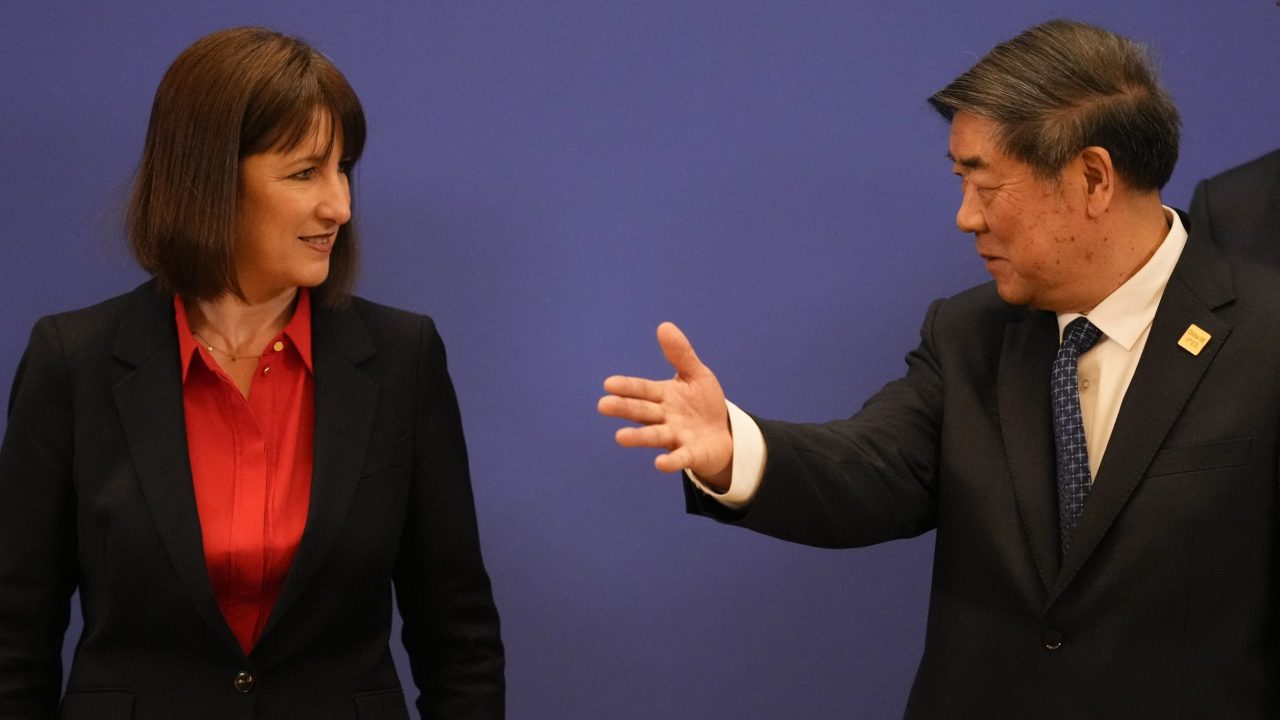
Since Starmer took office in July 2024, the Labour Party has certainly made an effort to deepen the U.K.’s economic relationship with China. Chancellor Rachel Reeves restarted the U.K.-China Economic and Financial Strategy Dialogue in January, which led to GBP 600 million ($824 million) in new deals. The U.K.-China Energy Dialogue was renewed in March by Energy Secretary Ed Miliband. Both dialogues had been suspended for several years due to Covid-19 and geopolitical tensions stemming from Hong Kong, Ukraine and elsewhere. The government also introduced new dialogues, including the U.K.-China Climate Dialogue and the U.K.-China Green Finance taskforce. Ashley Alder at the Financial Conduct Authority confirmed in May that Britain and China are exploring a wealth connect scheme to facilitate Chinese access to U.K.-managed funds. Alder also welcomed the launch of a Chinese sovereign green bond in London. And the U.K. has no plans to impose EU or U.S.-style EV tariffs on China, according to Business Secretary Jonathan Reynolds.
The Starmer government has been much more quiet on other aspects of the U.K.-China relationship, particularly the security and human rights dimensions. Even though the Labour Party voted to recognize Uyghur genocide in Xinjiang in 2021, Foreign Secretary David Lammy did not specifically mention it during his overview of the China audit for Parliament. Several other pending decisions for the Starmer government might reinforce this trend. One is whether to approve the new Chinese mega-embassy in London, which would be the largest diplomatic outpost in Europe and, controversially, could facilitate Chinese transnational repression. According to reports, the embassy is set to be approved imminently. Another set of decisions is related to the extent to which Chinese entities should be allowed to invest in British critical infrastructure, including green tech systems.
The Labour Party has not confronted China at the helm of government since 2010, a time before Xi Jinping’s (習近平) accession, when many still thought that China would inevitably democratize. During the past 15 years, Labour has lacked total access to the classified, nitty-gritty details of China’s evolving security posture. The party also had not been compelled, from a position of power, to respond to China’s intensifying repression of political and human rights. Following Brexit, the U.K. is now responsible for a greater number of sensitive political issues that were previously outsourced to the EU. Although it is not explicitly clear in the public domain whose advice was sought in the creation of the audit or the decision not to place China in the enhanced foreign influence tier, there exists a dense web of individuals and organizations both in and outside of government who are likely advising Starmer on how to steer the ship.
Probably the two most important non-governmental organizations to shape Starmer’s policy — in general, not just on China — are Labour Together and the Tony Blair Institute for Global Change. Labour Together was founded in 2015 in reaction to Jeremy Corbyn, who shifted Labour significantly to the left when he led the party between 2015 and 2020. It has been described as the “emotional core” of the Labour Party under Starmer’s leadership, morphing from a “centrist haven” to an engine for Starmer’s campaign. Labour Together donated GBP 1.5 million to over 100 Labour MPs. The think tank also donated to former shadow cabinet members, including over GBP 67,000 to Lammy. Labour Together’s former director, Morgan McSweeney, is now Starmer’s chief of staff. There are rumblings that the organization’s influence is waning after its leadership was funneled into government roles. Still, one anonymous Labour Together source told The Times that their work is now less public facing, and more focused on “influencing government policy through private conversations with ministers and special advisers.” Labour Together’s new leader, Jonathan Ashworth, visited Downing Street several times during Starmer’s first 100 days in office, according to The Independent.
In the lead-up to Starmer’s election last year, Labour Together published several briefs on Labour’s approach to foreign policy, which were framed heavily by policy positions articulated previously by Lammy and Reeves. What is notable about the reports is that they very rarely mention China. The 25-page report on Lammy’s “progressive realist” approach to foreign policy doesn’t mention “China” at all. The reports on economics are a bit more substantial on this front, but not much. The brief on critical minerals expressed concern about China exploiting its dominance in this sector, while the report on Reeves’ signature term, “securonomics,” briefly touched on sanctions, supply chain resilience and industrial policy as tools to counter China’s “threat” to economic security. This China-light approach could indicate multiple things, including that Labour Together lacks China expertise or interest from its funders to discuss China at length — its main funders don’t have major economic links to or political interest in China. The party might also have wanted to leave the door open for deepening economic relations with China by avoiding touchier political subjects.
The other influential NGO in the Labour Party is the Tony Blair Institute for Global Change, which was established by the former prime minister in 2016. It is considered a “shadow policy network” for the Starmer government. Blair himself is an important personal advisor for Starmer and speaks to him regularly. When Blair was prime minister, he deepened U.K.-China ties by upgrading the relationship to a comprehensive strategic partnership and facilitating massive growth in trade with China. More recently, Blair has cautioned against the use of Cold War analogies that could jeopardize trade with China. He met with China’s senior diplomat, Wang Yi (王毅), in 2023, where they discussed strengthening coordination on global challenges. On June 10, Blair met with Liu Jianchao (劉建超), the head of the international department of the Chinese Communist Party. He traveled to China again in June.
Like Labour Together, the Tony Blair Institute itself doesn’t seem to possess an abundance of China experts. For a 900-person strong think tank, it has only three staff members focusing specifically on the Asia-Pacific — the leading manager for the region is an investment expert. Their China lead, Ruby Osman, regularly speaks in the news about the importance of high-level dialogue and expanding all types of engagement with China, including in academia and business. The one big report the Tony Blair Institute has written on China is about why the U.K. lacks China expertise. Since the U.K. doesn’t have enough think tanks focused on China, a good China talent pipeline or a revolving door dynamic with the government, the report argues that some of the best China talent can be found in the private sector and encourages Starmer’s government to engage with the private sector on China policy.
The Labour Party was well positioned to integrate business expertise into its government, as it vigorously courted the sector for years leading up to Starmer’s election. This effort was spearheaded by Reeves, with support from Reynolds and others. “The industry has had positive and constructive conversations with Labour since 2019. If they win, very few new governments will have entered office better briefed on what our ecosystem needs to help act as a dynamo for growth and competitiveness,” said Miles Celic, chief executive of financial lobbying group TheCityUK. The donation patterns of the Labour Party’s major supporters reveal how convincing the Labour Party really was, drawing in millions of pounds from high-flyers like Gary Lubner, who had grown “disenchanted” with the Conservative Party, and Lord David Sainsbury, who had been a staunch Blairite but disliked the leftist direction Corbyn took the party in. London’s business elite played a more major role in funding Starmer’s campaign than previous Labour campaigns — while unions provided over half of Corbyn’s funding, this number dropped below 30% under Starmer.
In government, the Labour Party has formally integrated perspectives from the private sector through the appointment of advisory positions. Reynolds appointed eight new non-executive members of the Department for Business and Trade Board in December 2024. One of the members, David Sayer, had a connection to China through his former role at the China Britain Business Council (he stepped away in 2022). Lammy launched an initiative for all ambassadors to become honorary presidents of their host-country’s Chamber of Commerce branch. Lammy is also reportedly creating positions for business leaders in Whitehall to help inform the U.K.’s foreign policy, according to The Times.
Beyond this formal integration of business interests into the mechanisms of governance, there is a lot of intermingling between civil society and business-oriented groups related to China in the U.K. A look into the various layers of these networks reveals the extent to which they might informally influence Labour Party officials and advisors.
China-Britain Business Council
The China-Britain Business Council’s history dates back to 1954, but it was rebranded in 1998 following the British handover of Hong Kong. At this time, Charles Powell, brother of Starmer’s National Security Advisor Jonathan Powell, became the president of the organization. The council’s first task under the new leadership was to accompany Blair on a business delegation to China. The council remains very active today, providing research, consultation and lobbying services to facilitate China-U.K. trade and investment.
The China-Britain Business Council also frequently gathers politicians and business leaders from both China and the U.K. The council hosted an event in May that featured Caroline Wilson, the British ambassador to China; Ashley Alder, chair of the Financial Conduct Authority; and representatives from the Bank of England, the Bank of China and the Asian Infrastructure Investment Bank. The event also featured notable pro-engagement voices like Professor Kerry Brown of the Lau Institute at King’s College, who cautions against viewing China as an economic security threat because the risks of economic disengagement are more serious. The Lau Institute, which is the largest China studies center in the U.K. and which Brown directs, is primarily funded by Lau Ming-wai (劉鳴煒). Lau is a Hong Kong businessman who has connections to China’s United Front Work Department through his chairmanship of the Youth Development Commission, which promotes Hong Kong’s integration with mainland China. China’s “united front” refers to a set of strategies and activities that aim to convince individuals and groups who are not in the Communist Party to serve the party’s goals.
Sherard Cowper-Coles is the Chair of the China-Britain Business Council. Prior to this, he worked for ten years at HSBC and remains a senior advisor for the bank. Cowper-Coles was fired from his full time role at HSBC in 2023 for calling the U.K. weak on China. He unsurprisingly advocates for stronger U.K.-China economic ties. He is also apparently a “proud member of the Labour Party” and has expressed support for Reeves’ engagement with China. The council’s CEO, Peter Burnett, was previously managing director at Standard Chartered, chair of the British Chamber of Commerce in Hong Kong and chair of the Hong Kong Association of Banks’ One Belt, One Road Committee. He wrote an op-ed in China Daily in March in support of stronger economic ties between the U.K. and China.
On the council’s board are representatives of major companies who have an economic interest in the Chinese market and Chinese investment in the U.K., including Standard Chartered, Schroders, the Oxford International Education Group, PwC and InterContinental Hotels Group. The council’s 2025 U.K.-China Business Forum was sponsored by HSBC, Standard Chartered, Alibaba Cloud and China Telecom, among others. The council has also collaborated with Confucius Institutes, which are controversial for their connection to China’s united front strategy.
HSBC
HSBC was founded in 1865 to fund trade between China and Europe. As of 2024, the bulk of its revenue is made in Asia. Hong Kong is the largest source of HSBC’s revenue, contributing 32% of the pie in 2024. Hong Kong is also an important source of growth for the bank — while revenue grew 6% in Hong Kong in 2024, revenue from the U.K. shrank by 5%. HSBC stated in its 2024 annual report that it is continuing to expand its operations in mainland China and that future growth in Hong Kong will be “directly linked to mainland China.” Across the continent, Asia accounted for $47 billion of the bank’s $64 billion in new invested assets for 2024.
Mark Tucker, who is currently the group chairman of HSBC, is outspoken on the U.K.’s China policy and is well-integrated into Chinese politics. (Tucker is stepping down and transitioning into a role at the Hong Kong-based insurance company AIA Group later this year.) He has met with senior Chinese officials on multiple occasions in recent years. In an interview on CCTV in 2019, Tucker condemned the “violent” protests in Hong Kong. The South China Morning Post reported that Beijing relies on Tucker as an “important bridge” in U.K.-China ties.
Official records indicate that HSBC donated over GBP 75,000 to Starmer’s campaign.
Standard Chartered
Although it’s a British bank, Standard Chartered has been operating in China for 167 years and makes most of its money in Asia, participating in cross-border RMB services, sustainable financing and Belt and Road initiatives. Just like HSBC, Hong Kong is Standard Chartered’s biggest market, contributing 25% to the bank’s total operating income in 2024. In terms of growth, mainland China was the second largest (after the U.S.) source of growth for Standard Chartered in 2024, with an increase in net operating income of 14.8%. The U.K. was the only major market where Standard Chartered’s income shrank, having declined 24% in 2024.
Standard Chartered’s CEO, Bill Winters, told China Daily in November 2024 that the bank’s commitment to China “has only increased.” In 2025, the bank launched the “Global Chinese Services” initiative, which China Daily framed as part of Standard Chartered’s efforts to seek “shared identity and values among global Chinese communities — a vision resonating with the concept of a ‘shared destiny.’”
Both HSBC and Standard Chartered have been leading voices in the effort to lobby against restrictions on Chinese engagement via the Foreign Influence Registration Scheme, according to Bloomberg.
Liz Lloyd, who is now Starmer’s Director of Policy, Delivery and Innovation, was formerly group company secretary of Standard Chartered and before that, deputy chief of staff for Blair’s government. The Telegraph described Lloyd’s role in the Starmer government as a “drab title that in fact carries considerable influence.” Her political temperament is globalist and pro-business — overall, aligned with the Blairite wing of Labour.
British Chambers of Commerce
The Tony Blair Institute named the British Chambers of Commerce as one of the best versed British bodies on engaging with Chinese authorities. Indeed, some of its leaders have extensive ties to China. The London Chamber of Commerce is led by Michael Mainelli, who served as Lord Mayor of the City of London Corporation last year. Mainelli is also chair of Z/Yen, a think tank and consultancy headquartered in the City of London. Z/Yen’s platinum sponsors include the China Development Institute, the Hong Kong Financial Services Development Council and the Global Times Consulting Company (which appears to sit within the Global Times ecosystem). All three organizations are affiliated with the Chinese government on a state-run or quasi-governmental basis.
TheCityUK
TheCityUK is a prominent financial lobbying group in London. Celic, the group’s current CEO, was described by Politico as “one of the most recognizable financial services lobbyists in the U.K.” who has regular access to the highest levels of government. In the leadup to Starmer’s election, Celic provided soft support for Labour, telling CityAM he believed the party would remain committed to consulting with Britain’s finance industry if elected. Emma Reynolds, who is now a fixture in Starmer’s government as the Economic Secretary to the Treasury and City Minister at HM Treasury, was managing director of TheCityUK between 2020 and 2024. Bloomberg reported that when Reynolds was in this role, she lobbied the U.K. government to not put China in the enhanced tier of the Foreign Influence Registration Scheme.
The City of London Corporation
The City of London Corporation is the local authority for London’s financial center. It has a dedicated lobbying arm and is well integrated into British politics, having been called the “driving force” of U.K. economic policy. Chris Hayward is the current policy chair (the de facto political leader) of the City of London Corporation. Hayward recently travelled to China and contributed an op-ed piece to the South China Morning Post, where he discussed his interest in attracting Chinese investment to the U.K. and acquiring more business for British asset managers in China. When the City of London Corporation got into hot water last year for hosting the Chinese ambassador to the U.K., Hayward rebutted by saying that “Our job here at the City Corporation is to promote trade and business, not to engage in foreign policy.”
China Market Advisory Group
The China Market Advisory Group is jointly run by TheCityUK, the China-Britain Business Council and the City of London Corporation. This group delivered the U.K. China Financial Services Summit in 2019, which Reeves reignited during her trip to China in January. Both Miles Celic and Mark Tucker were involved in organizing the event in 2019 and also attended Reeves’ trip in January.
Global Counsel
Global Counsel is an advisory firm that was co-founded by Peter Mandelson in 2010. Mandelson is a close advisor for Starmer and now British ambassador to the U.S. Global Counsel advised Shein on its potential IPO in London. It has also lobbied on behalf of Chinese businesses like TikTok, Alibaba and Canyon Bridge. Global Counsel’s current CEO, Benjamin Wegg-Prosser, was offered the role of investment minister in Starmer’s government but he turned it down.
Mandelson, sometimes referred to as the “prince of darkness,” was chair of Global Counsel until June 2024. Previously, he held cabinet roles in Tony Blair and Gordon Brown’s governments and was president of the Great Britain China Center, a Foreign Office body, for seven years. Last September, Mandelson criticized the Tory governments’ lack of engagement with China over human rights and other concerns: “At the end of the day, it behooves governments of all countries to allow businesses to do business.” He also stated that the rule of law remains intact in Hong Kong. In 2021, Mandelson was the only Labour peer in the House of Lords to vote against recognizing Uyghur genocide in Xinjiang. He has also been linked to the China Council for the Promotion of International Trade, an organization involved in China’s united front work “with the aim of co-opting western businesspeople.” The Nightly reported that Mandelson advised the China International Capital Corporation, a state-backed investment bank.
Jon Garvie, who was reportedly leading the China audit from Lammy’s office as Starmer transitioned into government, spearheaded the Global Counsel’s international policy work for several years.
48 Group Club and Friends of Socialist China
The 48 Group Club was established in the early 1950s by a group of British businessmen who ventured to China on a trade delegation in 1953 and “laid the foundation” for U.K.-China trade relations. The group recently established an office in Beijing and is planning to incorporate Chinese businesses as members for the first time in the fall. It is very well integrated into Chinese politics. Chairman Stephen Perry has met with Xi Jinping on multiple occasions, and CEO Jack Perry was one of only three businessmen selected to participate in a conference hosted by Xi last year.
The 48 Group Club has tons of connections to business and finance in London, as well as to politics. The “fellows” listed on its website include major figures in the Labour Party like Tony Blair, Peter Mandelson, Jonathan Powell and David Sainsbury, though the extent of their engagement with the club is unclear. The 48 Group Club hosts a yearly Icebreakers’ Chinese New Year Dinner, which is co-organized by the Bank of China, the China Chamber of Commerce in the U.K., the China Britain Business Council and HSBC. Li Keqiang (李克強), then premier of China (the second most powerful political figure after Xi Jinping) spoke at this event in 2021. In addition to the New Year’s dinner, the 48 Group Club also collaborated with the China Britain Business Council on an event in May called “Invest in Beijing, Win the Future.”
The 48 Group Club’s private sector partners are also impressive. The CEO of Octopus Energy, Greg Jackson, gave a keynote address at a 48 Group Club event this spring. Octopus Energy is the largest energy provider in the U.K. There is obvious political alignment with the Labour Party here, particularly considering energy price instability stemming from the geopolitical crisis in Ukraine and the party’s net-zero goals. Indeed, Jackson has “half of Westminster on speed dial,” according to Politico. He met with Labour ministers ten times in the first three months of Starmer’s government. Another notable businessman currently aligned with the 48 Group Club is Alderman Tim Hailes, who is set to become Lord Mayor of the City of London (the head of the City’s governing body) in 2026. Hailes attended the 48 Group Club’s delegation to China last month and gave a speech at their 2025 Sino-U.K. Entrepreneur Forum.
In a 2020 book titled “Hidden Hand,” two Australian academics accused the 48 Group Club of being a vehicle “through which Beijing grooms Britain’s elites.” The 48 Group Club launched a libel lawsuit to block the book’s publication but failed. In the past year, it has come to light that alleged Chinese spy Yang Tengbo, who is linked to Prince Andrew, was an honorary member of the 48 Group Club. His name has since been removed from the website.
After the 48 Group Club came under fire for its connections to China in 2020, the organization has posted less about the presence of British politicians and other elites at their events. According to the 48 Group Club’s website, Douglas Flint, the then-Belt and Road envoy for the Treasury, attended the Icebreakers’ New Year’s Dinner in 2018. John Glen, then-economic secretary to the Treasury, attended the same event in 2020. Since 2020, the 48 Group Club hasn’t appeared to intermingle with the government in public forums to the same extent, which might indicate that it has fallen out of political favor. After “Hidden Hands” was published in 2020, Blair publicly refuted any meaningful involvement with the group.
The vice chair of the 48 Group Club, Keith Bennett, leads another group called Friends of Socialist China. This is a group of Marxists committed to supporting, defending and building understanding of Chinese socialism in the U.K. Friends of Socialist China certainly is not a part of the political mainstream. However, in 2022, Bennett wrote an op-ed for China Daily — a state-run outlet — about how the U.K. needs a “grown-up” China policy that pursues closer ties and doesn’t attempt to contain its rise. This particular phrasing was used by Vince Cable, former leader of the Liberal Democratic Party, in an op-ed for The Independent the following year. Since then, “grown-up” has been used by Starmer and his team to frame their China approach, according to multiple reports.
China-Britain Business Development Centre
Another organization in the mix is the China U.K. Business Development centre, which is an advisory group for U.K.-China trade that is helmed by John McLean. McLean was formerly director of the China British Business Council for eight years and is an advisor to the China Chamber of Commerce in the U.K. He is also chair of the Institute of Directors for the City of London, one of the most influential groups of business leaders in the City. He is outspoken on the merits of U.K. economic engagement with China, particularly in Chinese media. He has criticized the previous Conservative governments for being too “risk-averse” when it came to dealing with China and praised the Starmer government for its “changes in tone” in this domain. At the 2025 Global Britain Trade Expo he said, “There’s a pragmatic approach being adopted by both China and the U.K., which is welcome for business … the opportunity is now — go get on that plane and go to China.”
Conclusion
London is a small town. While there might not be the specific revolving door dynamic between academia and the government that exists in Washington, there is clearly a dynamic of elite saturation. This dense intermingling between the private sector, civil society and the government is something the Labour Party evidently sought out as a part of their shift back toward the center and bid to return to power. But the party continues to lean into the China expertise of the private sector. As the government grapples with several security-related China concerns, the key question now is how pro-business, pro-engagement interests will continue to shape Starmer’s China policy. On the one hand, we could see Starmer permanently soften his stance on human rights and pivot on issues like whether to approve the Chinese mega embassy or Chinese investments in British critical infrastructure. On the other hand, Starmer might have come out strong on engagement during his first year in office because he realizes that the U.K. is dealing with a different China than Blair-era Labour did, and his China policy will eventually need to balance back toward the hardline stance of the previous Conservative governments. Failing to place China on the enhanced tier list seems to indicate that the former is true, but the U.K.-China relationship under Starmer’s leadership is still taking shape. The beauty of not publishing the China audit in full is that it gives Starmer more leeway to make up his mind.





Leave a Reply