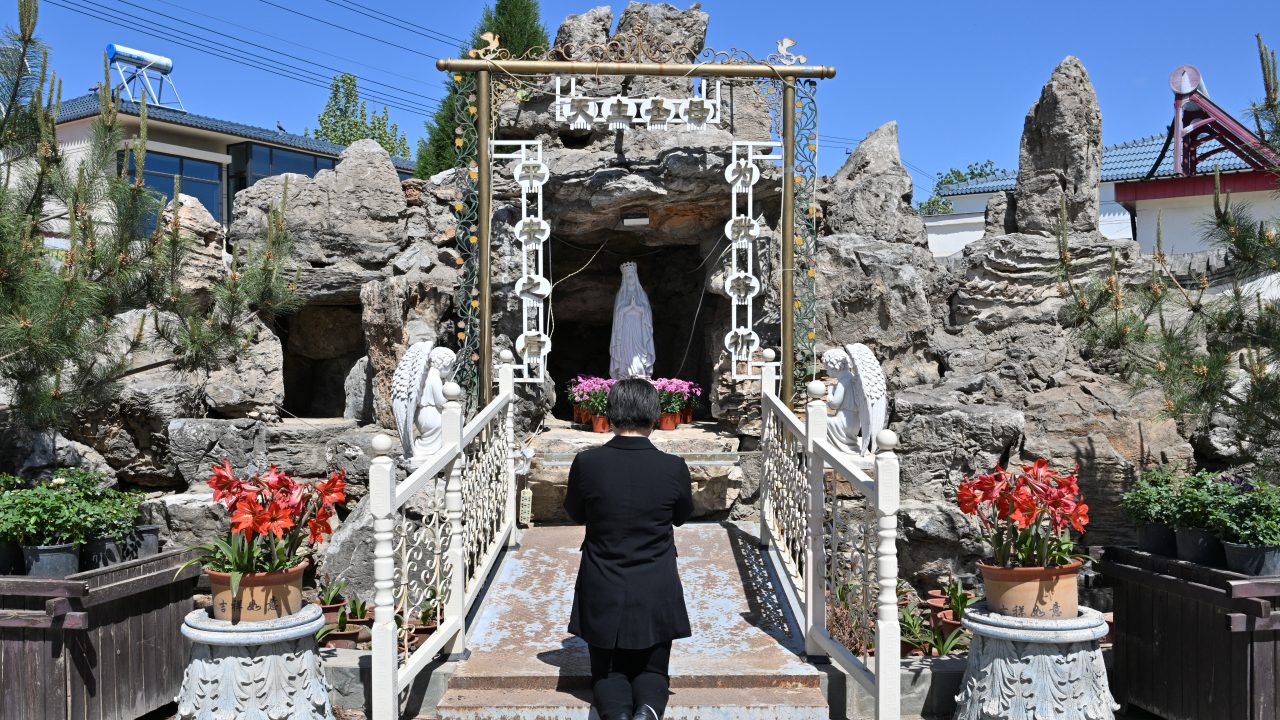
Nearly 30 pastors, preachers and members of an underground, Protestant church called Zion were arrested in China this month.
“We believe faith is not a crime,” the church said. Founded in 2007, Zion is a non-state-approved church in China and one of the largest of its kind. Its founder, Ezra Jin Mingri (金明日), was among those arrested.
This is not the first time Jin and his church have faced persecution. In 2018, Chinese authorities put a travel ban on Jin and raided the Zion church in Beijing, confiscating all materials and installing surveillance cameras. They have been “consistently harassed and abused since,” according to testimony given to the U.S. Commission on International Religious Freedom last week.
Still, the arrests this month represent “the most extensive and coordinated wave of persecution” against an underground church in decades, Bob Fu, founder of the religious rights organization China Aid, told the Wall Street Journal. The arrests took place across eight different cities, and invoked a law implemented barely two weeks earlier to restrict religious proselytizing and gathering online.
China’s constitution purports a commitment to religious freedom. Protestantism and Catholicism, along with Buddhism, Islam and Daoism, are all officially recognized by the government. But no religious idol can supersede the authority of the Chinese Communist Party. This is where the state has to negotiate between freedom and control.
China has long permitted Christian worship under state leadership. The Three Self Patriotic Movement was founded in 1954 to supervise state-sanctioned Protestantism. It now works in tandem with the China Christian Council to oversee the network of registered protestant churches in China. The Chinese Patriotic Catholic Association, founded in 1957, remains the only state-sanctioned Catholic organization in China, although there is now some cooperation with the Vatican under an agreement struck in 2018 that controversially allows China to nominate bishops for papal approval.
But officially registered churches account for only a part of Christian worship in China. A robust network of underground churches, or house churches, reject the imposition of state-directed ideology. Activists estimate that tens of millions of people, the vast majority of Christians in China, attend these underground churches.
In fact, Protestants were once one of the fastest growing demographic groups in China, which was on track to become “the world’s most Christian nation” by 2030. More recent research suggests that China’s Christian population might be leveling off, although it’s hard to tell given the real possibility that some survey respondents might be reluctant to disclose their religious affiliation.

State control over religion has intensified under Chinese leader Xi Jinping (習近平), who has made it clear that the sinicization of religion — the process of embedding CCP ideology into religious life — is the key to social harmony and stability. The government officially tightened regulations in 2018, which analysts described as an effort to compel underground churches to merge with their state-sanctioned counterparts or be gradually destroyed.
Christians in China are regularly arrested and detained, sometimes for printing and selling Christian literature and other times on cult-related charges. The underground Shouwang Church was shut down in 2019. Wang Yi (王怡), the founding pastor of the Early Rain Covenant Church in Chengdu, was sentenced to nine years in prison in 2019 for “subverting state power and illegal business operations.” Around June, China reportedly sentenced 12 members of the Golden Lampstand Church for fraud, including its pastor who was handed 15 years. The U.S. Commission on International Religious Freedom said that the CCP often targets religious leaders based on “dubious financial crimes tied to their communities’ collection of donations or selling of religious goods.”
Government officials have ordered the removal of thousands of crosses. State-sanctioned protestant churches in Qingdao were pressured to replace their worship songs with “political, secularized” hymns created by the government. Bitter Winter, an online magazine that covers religious freedom and human rights in China, tells the story of one Catholic church in Ji’an that was ordered to hang a Chinese flag at the entrance, along with a sign reading, “Follow the Party, Obey the Party and Be Grateful to the Party.” On the main interior wall, a picture of the Virgin Mary was replaced with a massive portrait of Xi flanked by propaganda slogans. In another case, Christian clergy, along with other religious leaders, were invited to a training session held by the Guangdong government that included memorizing Xi’s quotes.
Since the passage of the National Security Law in Hong Kong, religious freedoms have eroded there, too. President of Freedom House Annie Wilcox Boyajian said that churches in Hong Kong are facing increased pressure to censor political content from their sermons, and religious schools are similarly pressured to emphasize the protection of national security in their curriculums.
The CCP wants to be the ultimate source of spiritual authority. But will this be convincing to China’s millions of Christians?
Definitely not to some, and maybe not to most. An Asia Society report found that China’s urban middle class is increasingly turning toward religions least tainted by the Communist Party, like underground Christianity, to find spiritual comfort.
“God and faith will never be in the Chinese government’s control,” Jin’s daughter, Grace Jin Drexel, said this week following her father’s arrest.



Leave a Reply