As Taiwan broke for the lunar new year holiday this week, the United States’ leading populists were busy undermining the longstanding pillars of U.S.-Taiwan relations.
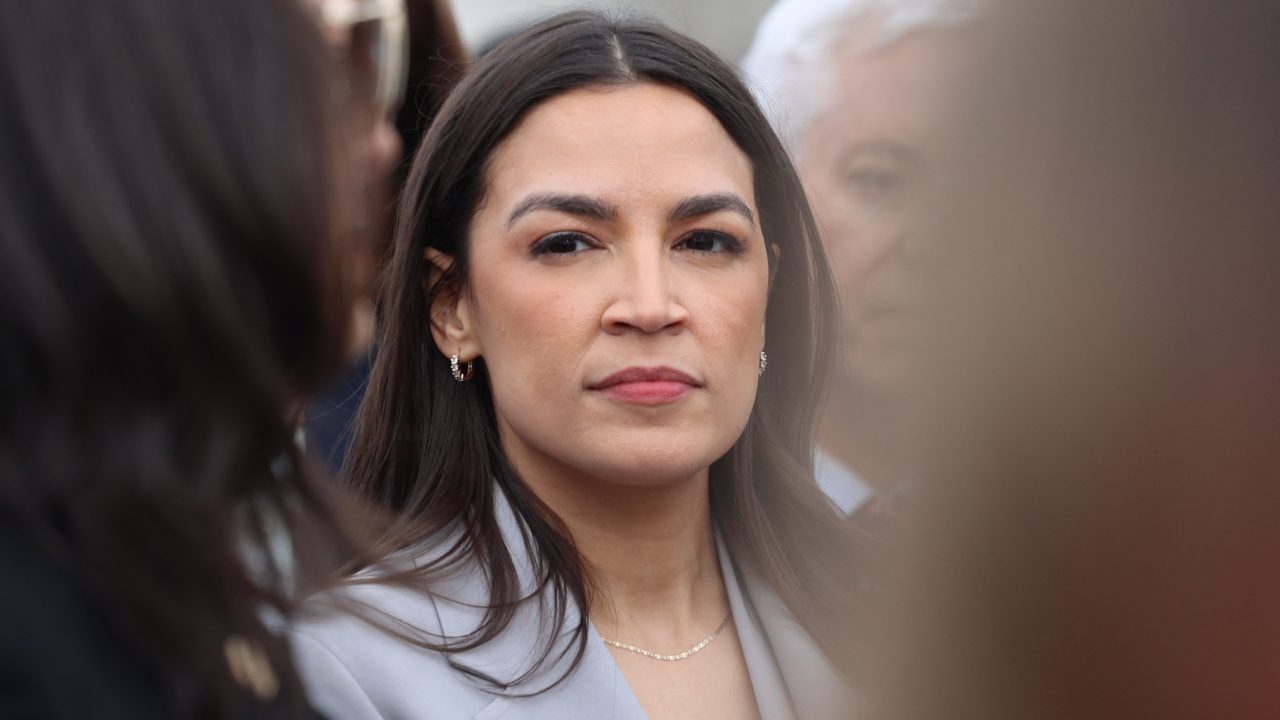
Alexandria Ocasio-Cortez, star of the American left and potential 2028 presidential hopeful, was asked at the Munich Security Conference on Friday whether the U.S. should defend Taiwan if China tries to invade.
She replied: “I think that, uh, this is such a, a, you know, I think that this is a, um, this is of course a, uh, a very longstanding, um, policy of the United States, and I think what we are hoping for is we want to make sure we never get to that point.”
The policy she was grasping for but could not describe was that of strategic ambiguity, or the U.S. government’s refusal to commit itself one way or the other on the question of defending Taiwan.
That policy was shaken somewhat during the Biden administration, when the former president repeatedly said that the U.S. would intervene on Taiwan’s behalf. Each time, Biden’s staff hurriedly walked his comments back, assuring Beijing that U.S. policy remained unchanged.
But if Biden’s responses were characteristic of a man whose career was punctuated by startling moments of transparency, Ocasio-Cortez’s response was characteristic of ignorance. It’s hard to watch the exchange and not conclude that she simply did not know what she was talking about.
Trump, by contrast, has shown more fealty to the concept of strategic ambiguity than almost anyone. And not just on the Taiwan question.
At his first presidential debate with Hillary Clinton in 2016, Clinton pressed Trump on the specifics of his plan to fight the Islamic State.
“At least I have a plan to fight ISIS,” Clinton said.
“No, no, you’re telling the enemy everything you want to do,” Trump shot back.
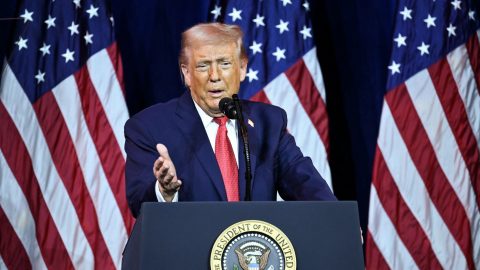
Trump struck a similar note when asked about defending Taiwan at a cabinet meeting last February. “I never comment on that,” he said. “I don’t comment on anything because I don’t want to ever put myself in that position.”
Strategic ambiguity as a policy could have been made for Trump. But that other pillar of U.S.-Taiwan relations, which assures Taipei that the U.S. will not discuss its Taiwan arms sales with China? Not so much.
If there were one of the Six Assurances — the list of principles that the Reagan administration formulated in 1982 to reassure Taiwan of the United States’ continued support — that Trump was destined to flout, it was the one that told him what he could and couldn’t discuss during negotiations with a fellow strongman. And on Monday, he did.
Trump was asked about Chinese President Xi Jinping’s (習近平) remark that “the U.S. must handle the issue of arms sales to Taiwan with prudence.” Xi’s comments had come in response to the U.S. announcement of $11 billion in arms sales to Taiwan in December, the largest on record.
“I’m talking to him about it,” Trump responded. “We had a good conversation, and we’ll make a determination pretty soon.”
Trump’s willingness to go anywhere and talk to anyone about anything is one of his genuine political strengths. But it will not always serve U.S. interests when it comes to Taiwan.
A central aspect of China’s plan to unify Taiwan is the so-called “salami-slicing” strategy. Little by little, Beijing succeeds in normalizing behavior once seen as provocative. Before long, half the sausage is gone.
Salami-slicing usually refers to real-world actions, like the militarization of the South China Sea, or the escalation of fighter jet sorties near Taiwan’s airspace.
But the same metaphor applies to diplomatic language. If Trump is willing to put arms sales to Taiwan on the table in his negotiations with Xi, then China will gladly pocket that concession. It will then seek to enforce it as the new norm during subsequent summits with subsequent administrations.
There’s a reasonable chance that Ocasio-Cortez could lead one of those subsequent administrations. Let’s hope that the pillars of U.S.-Taiwan relations will endure long enough for her to figure out what they are.





Leave a Reply