
China’s economy isn’t as insulated from the war in Iran as you might think.
Coverage has focused on the fact that Iranian oil is still heading to China, or on China’s extensive reserves and diversified energy consumption. But that isn’t how the crisis is going to bite.
It is through other countries, those that will no longer buy Chinese products, that Chinese factories are going to come under pressure.
In other words, Chinese workers will suffer with the rest of us, no matter how much energy they have.
Since the U.S. and Israel started striking Iran, 18 million barrels of Iranian crude oil have been exported to China by March 20, according to maritime risk analytics firm Windward. That’s down by just over two-thirds from the “equivalent pre-war period.”
Roughly 13% of the oil China imported by sea in 2025 came from Iran, though China imports more oil through the Hormuz Strait from Gulf countries than it does from Iran. Saudi Arabia can divert some of its output through a pipeline to the Red Sea; other countries are not so lucky.
Chinese refineries can still access a large amount of Iranian oil that was already sitting offshore in late February, according to Henry Hao (郝航緯) senior economist at Commerzbank. In email correspondence with Domino Theory, he said that in addition to this floating storage of about 48 million barrels, China was also releasing up to one million barrels a day for the next four to six weeks from its own reserves, he said, which are estimated to contain 1.1 to 1.3 billion barrels of oil.
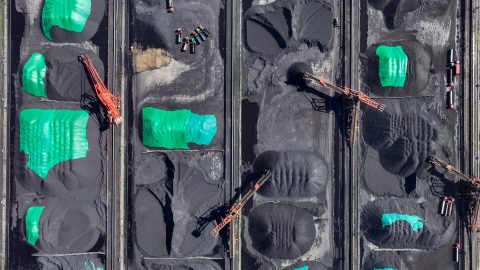
So there’s no imminent oil crisis in China, and China can also offset any reduction in the use of oil, and gas, by burning more coal.
But other sectors that could run into trouble faster. “Supply chain spikes for raw materials like helium and bromine (crucial for semiconductors/AI) also pose a risk to high-tech manufacturing,” Hao said. Caixin Global reported on March 16 that helium prices in China have risen, but still estimated that disruption in semiconductor manufacturing was unlikely in the next three months.
“What China is really concerned about is the overall energy crisis that this might be creating, and volatility and prices,” said Ilaria Mazzocco, an expert on Chinese energy policy at the Center for Strategic and International Studies. It’s not that China is directly dependent on Iran for its oil imports, she said, but it’s “very dependent on global markets.”
“If there’s a global downturn, other countries will be buying less of China’s exports, right?” she asked, before addressing the implication of her own question: “We know that exports have been one of the few bright spots in China’s economy.”
China’s whole system is based on “exporting masses of stuff to paying customers, consumers in other countries,” said Philip Shetler-Jones, who researches Indo-Pacific security at the Royal United Services Institute. He pointed out that increased costs and scarcity will also affect supply chains as well as consumers. Even if China is producing, it won’t matter if other countries “aren’t able to do their bit in the chain.”
“China’s so connected. It’s not easy to see how well insulated it can be from all the knock on effects of this,” Shetler-Jones concluded.
China may struggle to be a bystander in this coming energy crisis, and global economic slowdown. Undoubtedly it will find ways to weather its own pain, and there has been much commentary about how it can watch gleefully as the rest of the world blames the U.S. for creating the problem. But de facto Chinese allies like Pakistan are already suffering.
One of Pakistan’s two gas terminals will “run dry,” according to Pakistan GasPort, its operator. The Financial Times reports that the state-owned buyer, Pakistan LNG, has been unable to afford the cost of replacing its supply on the soaring spot market.
“I see us having one very difficult year followed by two or three difficult years to follow,” GasPort’s chair and chief executive Iqbal Ahmed is quoted as saying.
Not only will countries like Pakistan potentially slow their purchases of Chinese goods, they may increasingly wonder how much Chinese friendship is worth if Beijing simply sits back and watches their suffering.


Leave a Reply