Against the dramatic events of the Israel-Iran conflict last month, China’s reaction was muted. While the U.S. joined Israel in bombing Iran and then helped broker a ceasefire, China was largely described as sitting back.
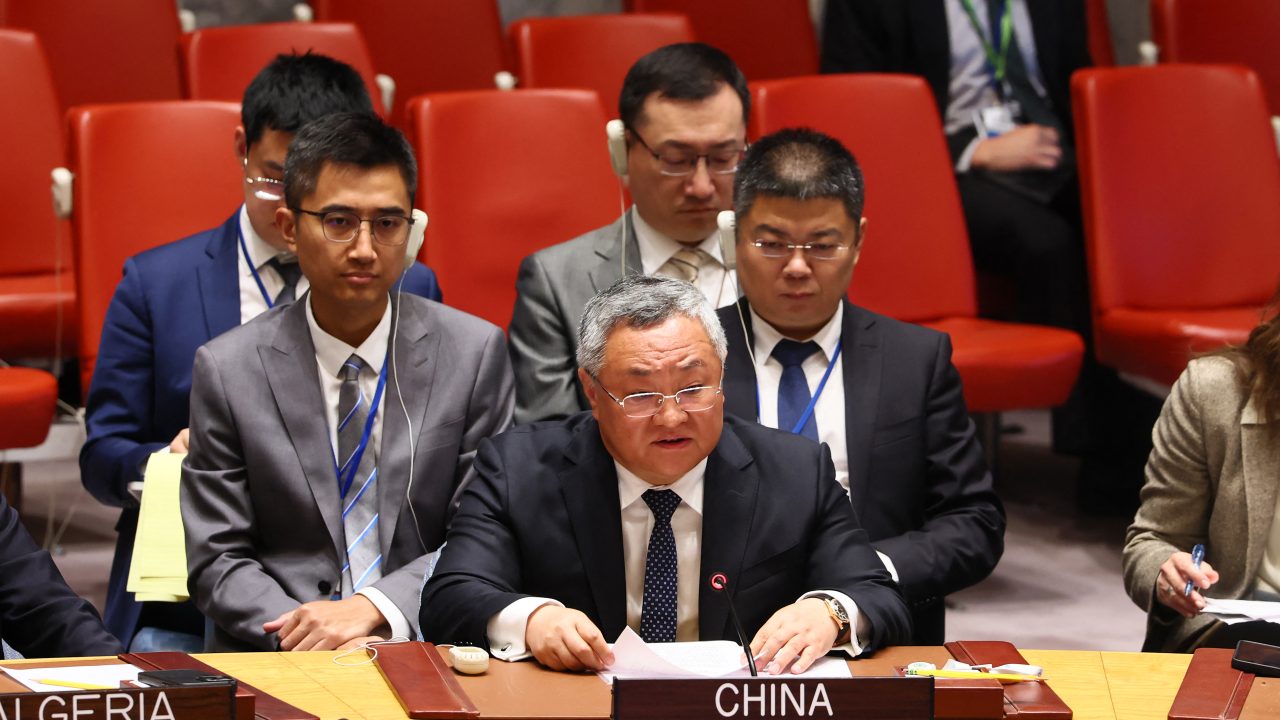
Arguably its most significant intervention was proposing a draft ceasefire resolution at the U.N. Security Council, alongside Russia and Pakistan. It came two days before the U.S. and Qatar-brokered ceasefire was announced on June 24 and thus was not actually voted on.
Aside from that, China offered statements supporting “Iran’s efforts to safeguard national sovereignty and security.” It said U.S. strikes on Iran set “a bad precedent.” It pulled Chinese citizens out of Iran. And it reportedly sent a small number of cargo planes into Iran’s airspace, though what they were carrying remains unknown. But it didn’t go further.
The explanation for a lack of more dramatic action is no secret.
China sees Iran as an economic partner of convenience, and its main aim in the Middle East is to grow economic ties. That means it doesn’t have a lot of leverage over Iran compared to that which the U.S. over Israel, and it means a focus on stability in the wider region comes before any loyalty to Iran.
“If the Middle East is unstable, the world will not be at peace,” Chinese President Xi Jinping (習近平) said on June 19. “If the conflict escalates further, not only will the conflicting parties suffer greater losses, but regional countries will also suffer greatly.”
That position translates into a particular kind of caution.
“I went to look at what some of the Chinese senior experts were saying about this and … in many places they’re talking about it not as in ‘what can China do to shape the dynamics’ but ‘what can it do to mitigate the risk to China and to mitigate the blowback,’” Brian Hart, deputy director and fellow of the China Power Project at the Center for Strategic and International Studies, told the center’s recent online panel.
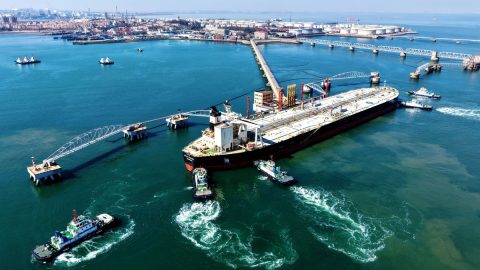
Potential “blowback” includes Iran’s threat to close off the Straits of Hormuz. Between 30 to 45% of China’s oil imports make their way through the strait in total. It purchases around 90% of Iran’s crude oil exports, and this in turn makes up about 13% of China’s overall oil imports every year. It also purchases much more oil from states such as Saudi Arabia, which passes through the same strait.
China has relationships to protect, too. Its “ultimate goal” in Iran is to prevent regime change, Hart said. But it also has substantial trade relations with a number of other Gulf states that far outweigh those with Iran such as Saudi Arabia, Bahrain, the United Arab Emirates, Kuwait, Oman and Qatar. These states have ambivalent relationships with Iran.
Put together, such dynamics make sense of an impulse toward balancing relations across the region. And until now restraint has been key to that. China has grown in popularity across the Middle East compared to the U.S. by being seen not to intervene.
“[O]ur data show that support for China is increasing in many Arab countries. We do not explore in detail the drivers of increased favorable attitudes toward China. But we know that China is investing economically in many of these countries, and I think many people like the fact that China is not trying to interfere in the affairs of their country or of the Middle East and North Africa region,” Mark Tessler, co-founder of the Arab Barometer polling organization, told Domino Theory by email last year.
On the other side of this equation, China could also directly benefit from the U.S. becoming embroiled in the Middle East, rather than being able to “pivot” to the Indo Pacific, Hart suggested.
China’s response is not guaranteed to remain so static in perpetuity, though.
The U.S. and Israel’s bombing of Iran, alongside Russia’s invasion of Ukraine and Israel’s war on Gaza, mean that the “fundamental norm against the use of force is being completely … obliterated in almost every respect,” Victor Cha, president of the Geopolitics and Foreign Policy Department and Korea chair at the Center for Strategic and International Studies, said.
“[A]nd it does raise questions about ‘is China taking a lesson for this with regard to Taiwan?’”
It also raises questions about whether Chinese support for Iran could increase over time — as it did with Russia in its war in Ukraine.
China currently sends “dual use” goods to Iran, such as the chemical ammonium perchlorate, which is used for ballistic missile fuel production. But it is “too soon” to say whether that might at some point be converted into more overt military cooperation, according to Hart. Should it happen, Cha suggested the possibility of China or Russia funnelling military resources to Iran through North Korea.
For now, one can look for reasons China might go in either direction — more intervention or less. But it has more reasons to stay out than join in.
On the one hand, it has been widely reported that Iran has been disappointed with Russia’s unwillingness to send military equipment to it in recent weeks, and it has instead begun to turn to China to request advanced military hardware.
On the other hand, China notably condemned the U.S.’s involvement in Iran for breaking the U.N. Charter and “international law.” As that alludes to, China has invested more in the “existing international order” than the likes of Russia or North Korea, Hart said, and thus has more to lose from breaking it apart. It will also continue to have incentive to balance its relationships with Iran and those it holds with other Middle Eastern countries. And it is looking to stabilize relations with the U.S. while it builds economic and technological self-sufficiency.
Things can change quickly, but it’s certainly not surprising that China has thus far chosen a watching brief.


Leave a Reply