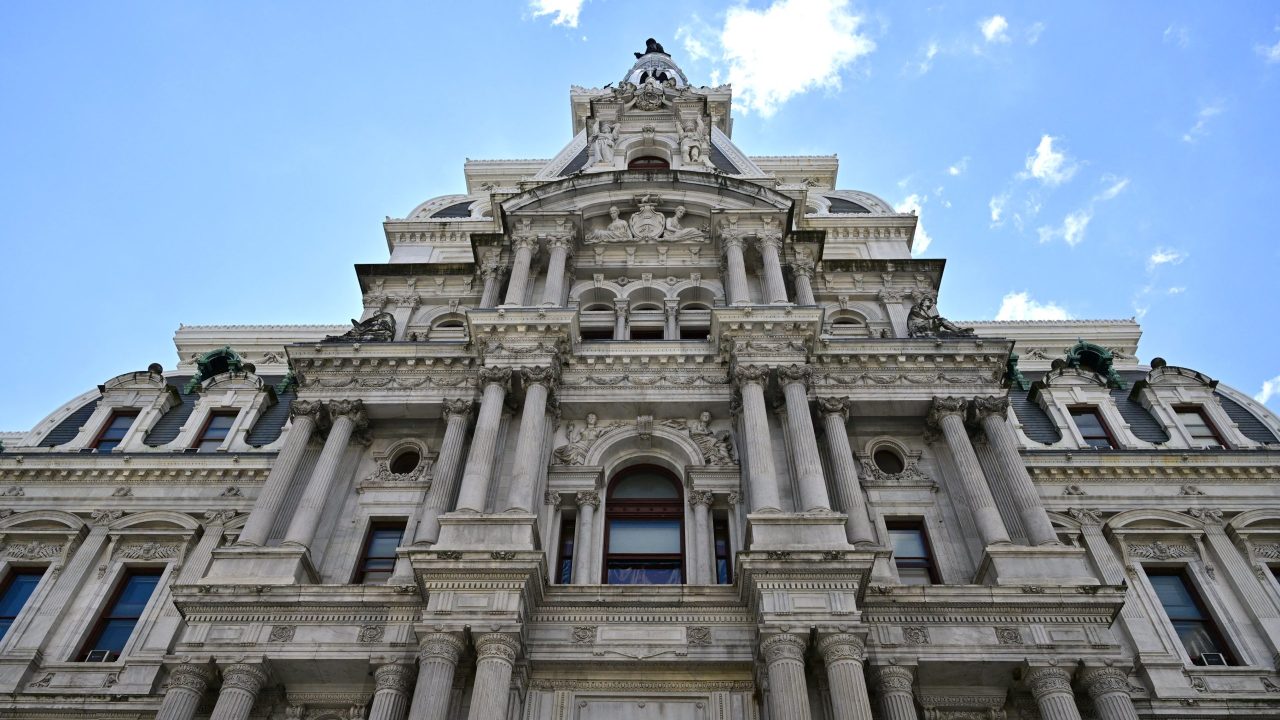
When Philadelphia’s government hosted a ceremony in which community organizations hoisted the flag of the People’s Republic of China at City Hall last year, the Chinese Consulate General in New York was “coordinating” with the event’s organizers in the background, according to documents filed with the city.
Behind the scenes, newly disclosed records show, Beijing’s diplomats played a previously unreported role in the September 30 celebration and planned to send the consulate’s top adviser on science and technology. The scope of the coordination with the consulate is not specified in the documents, and, in an emailed response to questions, the Pennsylvania United Chinese Coalition, a nonprofit group that bills itself as a voice of the state’s Chinese diaspora and spearheaded the event, described the consulate’s role as limited to attending the event. Neither the city of Philadelphia nor the consulate responded to emailed inquiries.
But the very fact of the consulate’s involvement is noteworthy. While the Pennsylvania United Chinese Coalition had organized a similar flag-raising ceremony the previous year, which consular officials had also attended, the most recent iteration of this event was the first to generate noteworthy public controversy. The newly released documents now suggest that it represented an understated victory for the consulate, which occupies a nondescript 20-story former hotel building across the street from the Hudson River.
Beijing’s outpost in New York has experienced a bruising years-long stretch in which federal prosecutors, members of Congress and the press scrutinized the diplomatic mission’s links to spies and relationships with Americans accused of unduly peddling political influence for Beijing. After federal prosecutors in 2024 brought charges against a former staffer for two New York governors who allegedly worked on behalf of the Chinese government — including by taking direction from former Chinese consul general Huang Ping (黄屏) — the consulate ended its practice of posting to social media photographs from its evening receptions which included the faces of audience members. The case ended in a mistrial last year and will be retried. Under Huang’s successor, Chen Li (陈立), the consulate has stopped publicizing many of its activities. During the same period, prosecutors also tied Beijing’s New York-based diplomats to an illicit Chinese government-blessed “police station” in Manhattan.
The flag episode last year suggested that Beijing’s diplomats in Manhattan remain capable of getting their way in the face of pressure from Washington — and of maintaining access to municipal officials, whom federal counterintelligence authorities warned are a top target for Beijing’s influence-peddling political organs.
Philadelphia City Hall disclosed documents revealing the role of the Chinese Consulate General in New York, in response to a request for government records filed under Pennsylvania’s Right to Know Law. These disclosures this year revealed for the first time the consulate’s fingerprints on the controversy.
The Pennsylvania United Chinese Coalition organized the event under a Philadelphia program which flies the flags of different countries, upon the request of community groups. The city of Philadelphia defended its support of the event at the time by describing the flag-raising ceremony as a viewpoint-neutral program, such that it must collaborate with any country’s ceremony, provided that it has an embassy or consulate in the U.S.
An event registration form issued by Philadelphia’s Office of Immigrant Affairs — and disclosed in response to the request for documents — features a field asking whether the organizers of the proposed event will “be coordinating with an Embassy, Consulate, or City Council member.”
Michael Yuming Wang (王玉明), the honorary chairman of the Pennsylvania United Chinese Coalition, ticked a box on that form which said, “Yes, I will be coordinating with” and, in pen, wrote: “the Chinese consulate general in New York.” Next to a field labeled “Cultural Significance of Proposed Date, Wang wrote: “The National Day of China (founded on 10/01/1949).”
Asked this month about the documents declaring coordination with the consulate, Wang said via email that this only indicates that the Pennsylvania United Chinese Coalition invited officials from the consulate and that other interpretations misunderstand the form. The Pennsylvania United Chinese Coalition also invited officials from federal, state and local government, he added.
“We had no clues at all until we were informed by the PRC consulate general in New York that who would attend the event. After we knew who would attend, we submitted the attendee’s names and titles to the City of Philadelphia,” he wrote in an emailed response, using the acronym for the People’s Republic of China.
“As United States Citizens, we have been trying to promote the cultural exchanges and friendship between the people of the United States and the people of China,” Wang also said. He added that when there are tensions between the two countries, Chinese-Americans suffer severe racial discrimination, physical harm and death threats.
The documents illustrate how even as Chinese Consulate-tied activities have transparently political aims, such as celebrating the founding of the Chinese Communist Party-controlled government, some American political leaders view them as merely cultural in nature. A proclamation that Philadelphia Mayor Cherelle Parker issued for the ceremony referred to “diversity,” the Asian American and Chinese-American communities, and “cultural events.”
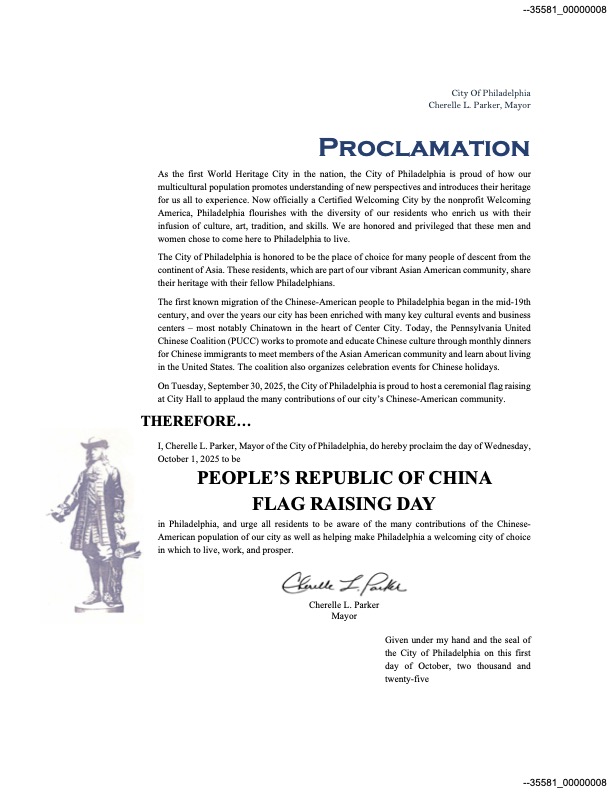
“On Tuesday, September 30, 2025, the City of Philadelphia is proud to host a ceremonial flag raising at City Hall to applaud the many contributions of our city’s Chinese-American community,” the proclamation signed by Parker states. It proclaimed October 1, 2025 “PEOPLE’S REPUBLIC OF CHINA FLAG RAISING DAY.”
But the involvement of the Chinese Consulate lends support to complaints, voiced in September, that the ceremony’s point was to celebrate not Americans of Chinese descent, but the founding of a controversial foreign government that has engaged in abuses against ethnic and religious minorities and pro-democracy figures.
After receiving approval for the event in early September, the Pennsylvania United Chinese Coalition attracted attention from members of Congress on both sides of the aisle. On September 24, Representative John Moolenaar, the chairman of the House Select Committee on the Chinese Communist Party, wrote to Parker demanding that she cancel the flag ceremony.
Moolenaar’s letter brought the flag ceremony to public attention, generating more criticism. City officials convened a conference call two days later to discuss the letter, the emails show.
Moolenaar alleged that the Pennsylvania United Chinese Coalition and another Philadelphia group “stand out as entities of concern for their ties to the People’s Republic of China (PRC) government, and especially the CCP’s United Front system,” referring to the Chinese Communist Party’s architecture of political control and influence. And he asked that the city terminate its “sister-city” relationship with Tianjin.
Moolenaar also noted that the Pennsylvania United Chinese Coalition’s leaders engage “frequently” with the consulate and “participate in political activities that appear to deliberately involve local and state officials.”
Wang denied those allegations. “PUCC is a non-profit organization, we are firmly independent rejecting any political influence,” he said in his response to questions about the documents, using an acronym for the Pennsylvania United Chinese Coalition. “We have ties with the people in China because we were born in China, but we had no ties with the ‘united front system.’”
Wang also said: “I can understand the some concerns or criticism of the event because of the fear of China’s political influence. However, the ties between the people of the United States and China shall not be cut off.”
The day before the event, Wang sent Philadelphia officials a schedule for the ceremony outlining a series of speeches by Philadelphia and Pennsylvania politicians which would accompany the flag-raising. That document was among those disclosed by Philadelphia, and it described the event as sponsored by the Pennsylvania United Chinese Coalition and the city of Philadelphia. It’s not clear whether all the listed officials attended the ceremony.
Wang’s document named Hou Lihong (侯立宏), a counselor in the Chinese Consulate’s science and technology section, as one of the anticipated speakers. Hou attended the 2024 flag ceremony, according to the Pennsylvania United Chinese Coalition’s website.
The September 2025 event, according to Wang’s schedule document, would begin with an announcement about the flag ceremony “and celebration of the founding of the 76th anniversary,” followed by the U.S. national anthem and the Chinese national anthem.
The records also show that city officials circulated correspondence in which a resident who fled political persecution in China criticized the flag-raising event: “If Philadelphia seeks to honor Chinese heritage, let it honor the stories of those who came here seeking freedom — not the flag of the government they fled.”
Office of Immigrant Affairs Director Charlie Elison, one of the officials who later spoke at the ceremony, forwarded that email to a colleague, with a note: “Sending your way for awareness — no action required.”
Other emails which Philadelphia disclosed under the Right to Know Law show that Chinese diplomats have expressed interest in facilities which contribute to the city’s role as a research and industrial hub across life sciences and other fields.
In a January 2025 email, Chencong Gong, a consul in the Economic and Commercial Office, emailed Philadelphia officials to inquire about local projects in which Chinese businesses could invest, naming sites including uCity Square, which houses research labs, and the Navy Yard, which counts among its residents several defense firms.




Leave a Reply