
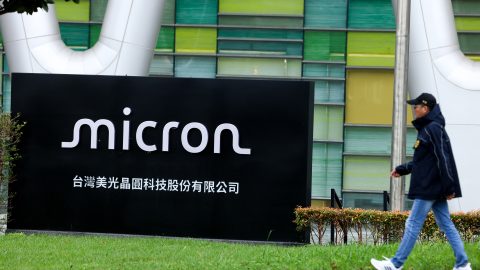
Union leaders in Taiwan are appealing to the government for help in the ongoing wage dispute between U.S. memory chip maker Micron and its labor unions in two Taiwanese cities.
The dispute centers on whether Micron is compensating its employees in Taiwan fairly, given the company’s nearly twelve fold surge in quarterly net income year over year.
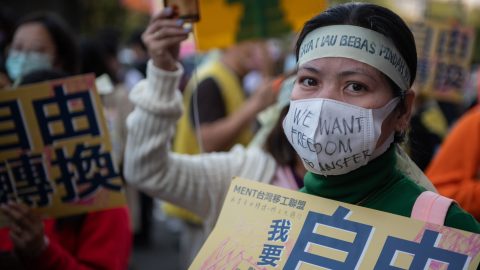
“Micron’s agreement is in dispute! Ministry of Labor, answer!” chanted the small crowd of union leaders outside the ministry today.
Micron employees have taken particular issue with the company’s profit-sharing system, which allocates bonuses based on several factors, including an ambiguous metric called “company performance.” They would like bonuses to be awarded according to a more transparent and predictable scheme that devotes 15% of operating profits to workers’ bonuses, paid quarterly. They are also asking for a one-time bonus of 83 months’ salary.
Micron’s labor union in the northern city of Taoyuan concluded a second round of negotiations yesterday without a resolution. These negotiations followed a 24-hour strike on Thursday by union leaders in Taoyuan. Micron shares fell 6.3% on the day the strike began, closing at $856.49 before recovering to $877.55 the next day.
The negotiations have played out much differently in the central city of Taichung, where a separate labor union represents the interests of around three-quarters of Micron’s workforce in Taiwan. Last week, nine representatives of the Taichung labor union signed an agreement with Micron, the details of which haven’t been released. Union members from Taichung say they haven’t been able to get in contact with their representatives, who did not consult them before accepting the deal and signed non-disclosure agreements with Micron. They are seeking avenues to repeal the decision and even re-elect their union leadership.
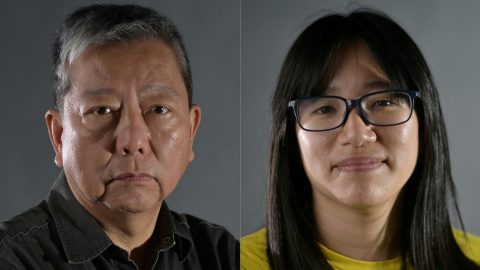
Today, the Taoyuan Confederation of Trade Unions brought those concerns directly to the Ministry of Labor. “Thousands of Taichung members are outraged. Over 11,000 workers had their mediation dropped and a secret deal signed without democratic ratification,” said Yao Kuang-tzu (姚光祖), secretary general of the union confederation. “If a Taichung worker calls the Ministry of Labor saying: ‘I never authorized this deal!’ What solution will the ministry offer to help workers revoke an unauthorized deal?”
The union confederation also asked the Labor Ministry to clarify whether unions can negotiate employee welfare funds as part of collective agreements, as well as rumors that the deal prohibits striking for more than three years, which is against Taiwanese collective bargaining law. On this last point, Chin Shih-ping (金士平), a Labor Ministry official, said that since the Taichung labor union signed a normal contract as opposed to a collective bargaining agreement, the contract could legally ban striking for more than three years.
Regarding the issue of revoking the deal, members who have doubts regarding the validity of this agreement can seek recourse through civil litigation pathways, said Chin. In response, Yao expressed concern that members apparently lack a democratic mechanism, such as petitioning, to nullify the agreement.
“Why must they [workers] go through civil lawsuits when they never authorized this deal in the first place?” said Yao, emphasizing the opposing party in any such suit would be a tech titan.
Qu Jia-chun (曲佳雲), vice chair of the Taoyuan Confederation of Trade Unions, says the Ministry of Labor complains about Taiwan’s low union density rate while in practice working against unionization. “Much of it is performative window dressing,” said Qu, who also led the EVA Air workers strike in 2019. “Viewed from another angle, isn’t the Ministry of Labor actively spearheading union suppression?”
“I’ve been dealing with the Ministry of Labor for a long, long time, and I know that they don’t want to be involved in this as a go-between for workers and companies,” said Hsin-hsing Chen (陳信行), a professor at Shih Hsin University who focuses on labor studies and the tech industry. Chen thinks the government should help make the resolution as transparent as possible.
Chen framed the dispute as somewhat of an anomaly within Taiwan’s tech ecosystem, owing to the fact that Micron — the third-largest memory chip maker globally and the largest foreign employer in Taiwan — is one of the very few big U.S. companies that has focused a majority of its production in Taiwan. At Taiwan-owned TSMC, in contrast, it is Chen’s understanding that workers are generally quite satisfied with their pay. “The only thing they complain about is [long] work hours.”
The Taoyuan union and Micron are scheduled to resume the next round of negotiations on November 6.
As for Taichung, “because they are currently in a state of leaderless chaos, nobody knows how it will evolve,” said Yao. “Another organization might form, or someone new might step up to lead. Pushed to the brink, people might act — they are already networking to recall those union officials.”
Domino Theory has contacted the Labor Ministry for comment. This story will be updated if they reply.


Leave a Reply