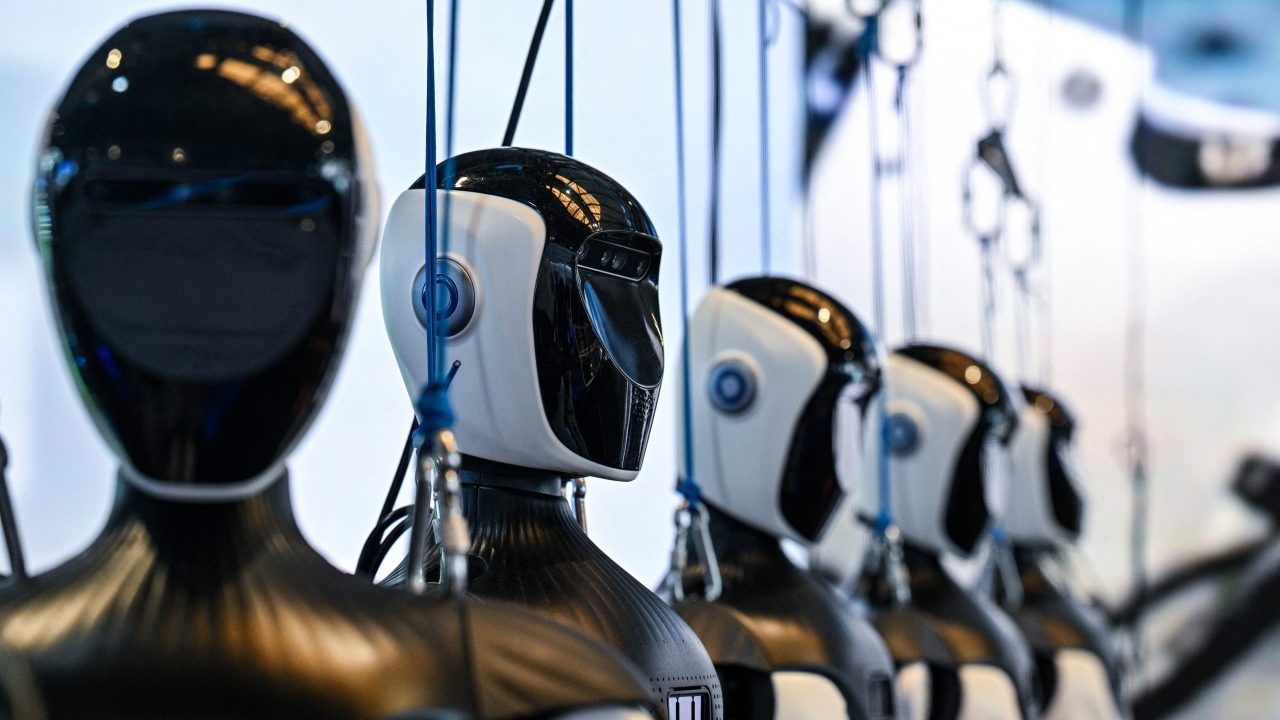
China is losing population fast. With few births and almost no immigration, staying afloat, let alone advancing, will mean leaning on technology, especially AI, to make up for a shrinking workforce. The question for other nations is whether this will work for China, and whether it might work for them too. It’s starting to look like it might.
According to U.N. projections, 17 million Chinese will turn 18 this year, while 14 million will turn 70, a generous cutoff for working age given that China’s official retirement age is still in the low 60s for men and younger for women. Ten years later, in 2036, the gap widens: 19 million people will turn 70, and only 15 million will turn 18. By 2040, 20 million will turn 70, while fewer than 10 million reach 18.
Birth and death rates drive everything, but nothing tells the story of China’s economic decline as clearly as this widening age gap. Each young worker will be supporting a growing share of retirees through government social programs. In 2040 alone, roughly 10 million more people will leave the workforce than enter it, and that assumes they are still working at 70. Labor-intensive, low-value export industries cannot survive as the pool of Chinese workers rapidly shrinks.
Footwear and garment manufacturing have already largely left China for lower-cost countries. Whether China is replacing those jobs is questionable. High youth unemployment and falling foreign investment are among the few clues China’s opaque economy offers about opportunities for new workers.
Unless China finds a new comparative advantage to replace its old one, mass labor, it will continue a slow downward spiral. I’d argue this demographic decline means it will shrink in nearly every other category as well: GDP, wealth creation, even military strength. So far, no technological breakthrough has let China make up for its lost population.
The question is whether it can make that leap now that AI has arrived. Investor and tech leader Marc Andreessen has often argued that widespread adoption of AI will offset the coming population decline in the U.S. That optimism would apply to China as well. But unlike the U.S., which still enjoys a growing worker population, China, like nearly every nation in East Asia, must either raise productivity through technology or struggle.
This is no knock on the Chinese people. They are saddled with the Chinese Communist Party, and developing AI isn’t the same as pouring workers into factories. Still, what I hear from OEM and chip manufacturers in Taiwan, as well as friends in Hong Kong, is encouraging news for China: Chinese industry is finding ways, in field after field, to offset population losses with advances in technology, and AI.
The U.S. faces a different problem set. With continued immigration, will American companies double down on labor-intensive processes, or will they modernize by adopting more technology, especially AI?
What Andreessen’s optimism leaves out is what happens if the U.S. keeps importing workers. What if, as in American agriculture, business models continue to favor cheap labor over investment in technology?
That is the risk. By continuing to bring in immigrants and allowing them to be paid substandard wages, the U.S. may remove the very pressure that pushes businesses to adopt AI and other technology that makes them more productive and less dependent on workers. China, with no population cushion, may have no choice but to automate. Will the U.S. match China’s push, or will continued high immigration keep it wedded to labor-intensive, ultimately less productive industry?
With AI, are Chinese embracing Joseph Schumpeter’s “creative destruction” while Americans are attempting to build political dams to block it?
Plato wrote in “The Republic” that our needs are the real creator of things, or as the popular saying goes, “Necessity is the mother of invention.” China must innovate with AI. The U.S. doesn’t feel the same pressure, and our politics are making matters worse.
We have seen this before. America didn’t lose the semiconductor industry to Taiwan because we lacked the engineers, the skilled workers, or the know-how; we invented the chip. Yes, Taiwan played to win: TSMC was launched with heavy government backing, and Taipei treated chipmaking as a national priority. But that is exactly the point. While Taiwan was rolling out the welcome mat, a non-technical political class in the U.S., driven by the environmental movement, made building and running fabrication plants so slow, costly and legally risky that American companies couldn’t compete even when they wanted to. Taiwan said yes while we said no, and today the world’s most advanced chips are made a hundred miles off China’s coast.
AI is shaping up to be a repeat. The same kind of leadership that is banning gas leaf blowers and handing landscapers rakes now meets data centers with suspicion, and at small-town meetings across the country, residents who couldn’t explain what a data center does are voting to keep them out. Of course, those same residents still expect Claude to draft their emails and ChatGPT to plan their vacations. They may be in for a surprise: AI doesn’t live in the cloud, it lives in data centers, and the ones they voted down were the ones that keep it running.
If that pattern holds, the U.S. will lose the AI race not to better engineers, but to China and Asian nations that see their survival at stake, while we indulge in the comfortable politics of a country that thinks it can afford to say no.




Leave a Reply