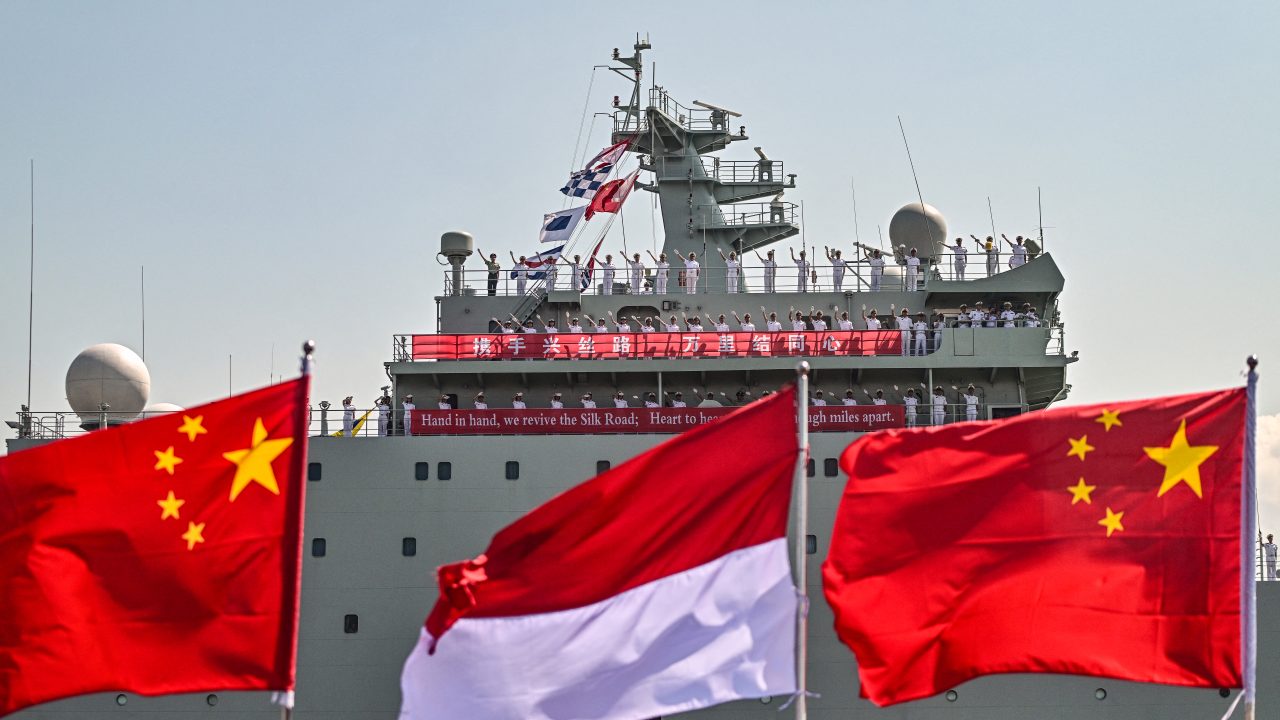
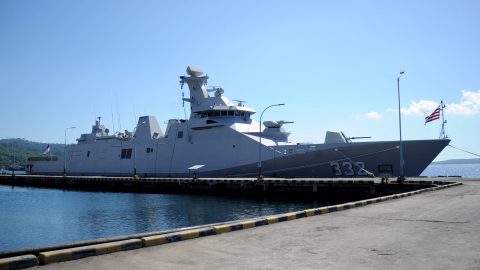
The recent passing exercise between the Indonesian navy ship KRI I Gusti Ngurah Rai and the Chinese navy ship Honghe in waters to the east of Taiwan represents a substantial development in Indonesia’s policy toward Taiwan. Operationally, the exercise may indeed have been insignificant. The concern lies not in what Indonesian and Chinese ships practiced, but in what their interaction communicates politically.
Like a majority of countries in the world, Indonesia implements its own “One China” policy, which states “Taiwan is an inalienable part of China” and notes its support for “peaceful reunification.” Such nuance is critical to avoid Indonesia’s “One China” policy being construed as supporting Beijing’s hypothetical violent takeover of Taiwan. However, in a leaked phone call with Indonesia’s defense minister in November 2025, President Prabowo Subianto underplayed this nuance by stating that “what China wants to do to Taiwan is its own internal affair,” thus acquiescing to Beijing’s political rhetoric against Taiwan. Indonesia’s naval exercise with China in the waters east of Taiwan means that Indonesia may have also unwittingly supported China’s military and pseudo-military attempts against Taiwan, thus undermining its support for a peaceful unification.
A clarification by the Indonesian navy initially worsened matters even further due to its proposition that a passing exercise is a “universal naval tradition conducted when transiting through another country’s maritime area.” If Indonesia considers such an exercise appropriate while transiting through the waters east of Taiwan, it risks allowing Beijing to portray military activity in those waters as internationally accepted. Indonesia’s explanation may be operationally innocuous, but Beijing has nevertheless exploited the interaction politically by allowing it to portray military activity around Taiwan as part of exercising its sovereignty in the waters east of Taiwan.
Even when a further clarification was issued declaring that a passing exercise is normal when “transiting a territory,” the fact that it exercised with a Chinese navy ship inside Taiwan’s exclusive economic zone, or EEZ, means that it has de facto contributed to the normalization of China’s naval activity in Taiwan’s proximity.
This is the first known time that China has invited a foreign navy vessel to exercise with it in the waters east of Taiwan. Previously, only the Chinese navy or coast guard were involved, as such operations were designed to normalize China’s military presence around Taiwan. Indonesia’s involvement in such an exercise risks giving China’s efforts implicit international legitimacy.
Indonesia’s participation is significant in another dimension: its status as a non-aligned country in the U.S.-China great-power competition, which underlines that Indonesia does not take sides with either superpower. While China regularly holds exercises with Russia, Moscow’s participation doesn’t provide Beijing with the same diplomatic symbolism because Russia is already understood as a strategic partner of China against the West. Indonesia’s status as a non-aligned state means that Beijing can portray the participation of a neutral Southeast Asian country as evidence that its military activities around Taiwan have international support beyond its immediate international geopolitical circle, such as Russia.
One may argue that such a naval passing exercise is part of hedging in Indonesia’s foreign policy, as Indonesia also conducted passing exercises with the Japan Maritime Self-Defense Force and the U.S. Navy’s Seventh Fleet. Yet, such a comparison is not apples to apples. The exercises with the U.S. and Japan took place in uncontroversial and uncontested waters, either in Japan’s EEZ or the high seas. If Indonesia conducted such an exercise with a Chinese navy vessel inside China’s uncontested waters, such as a few dozen nautical miles off Hainan or Guangdong provinces, or the high seas, there would be no problem. Instead, the exercise with the Chinese navy vessel took place in waters that are geopolitically volatile, thrusting Indonesia into the geopolitical complexity of the cross-strait conflict.
Lastly, Indonesia’s exercise with China did not go down well with the authorities in Taipei, who promptly sought clarification from Jakarta. Despite the lack of formal diplomatic ties, Indonesia and Taiwan have close relations in the education and labor sectors, with nearly 400,000 Indonesians living in Taiwan, which has become the top destination for Indonesians working abroad. Further souring relations with Taipei could mean that, at worst, consular processes for Indonesians in Taiwan or those wanting to go to Taiwan may not be as straightforward as before. Worse, in the event of a Taiwan contingency, Jakarta would need to work with Taipei, and such close cooperation in the middle of a crisis should be rooted in maintaining good relations in the present; worsening relations with Taipei because of Indonesia’s naval exercise is a step backward.
Indonesia should not be blind to the risks of an armed conflict over Taiwan. The livelihoods of the nearly 400,000 Indonesian citizens are directly at risk of being caught in the crossfire. Additionally, TSMC is vital to the functioning of the increasingly digitized Indonesian economy and its industry.
Jakarta, therefore, must understand that it has a direct interest in upholding peace and stability in the Taiwan Strait and stop committing acts or introducing rhetoric that acquiesce to Beijing’s forceful political, economic, military or pseudo-military moves and policies against Taipei.
Trystanto Sanjaya is a Visiting Fellow at the Norwegian Institute of International Affairs in Oslo focusing on regional security in the Indo-Pacific, the geopolitics of Southeast Asia, and Indonesia’s foreign policy. Views expressed are his own.

Leave a Reply