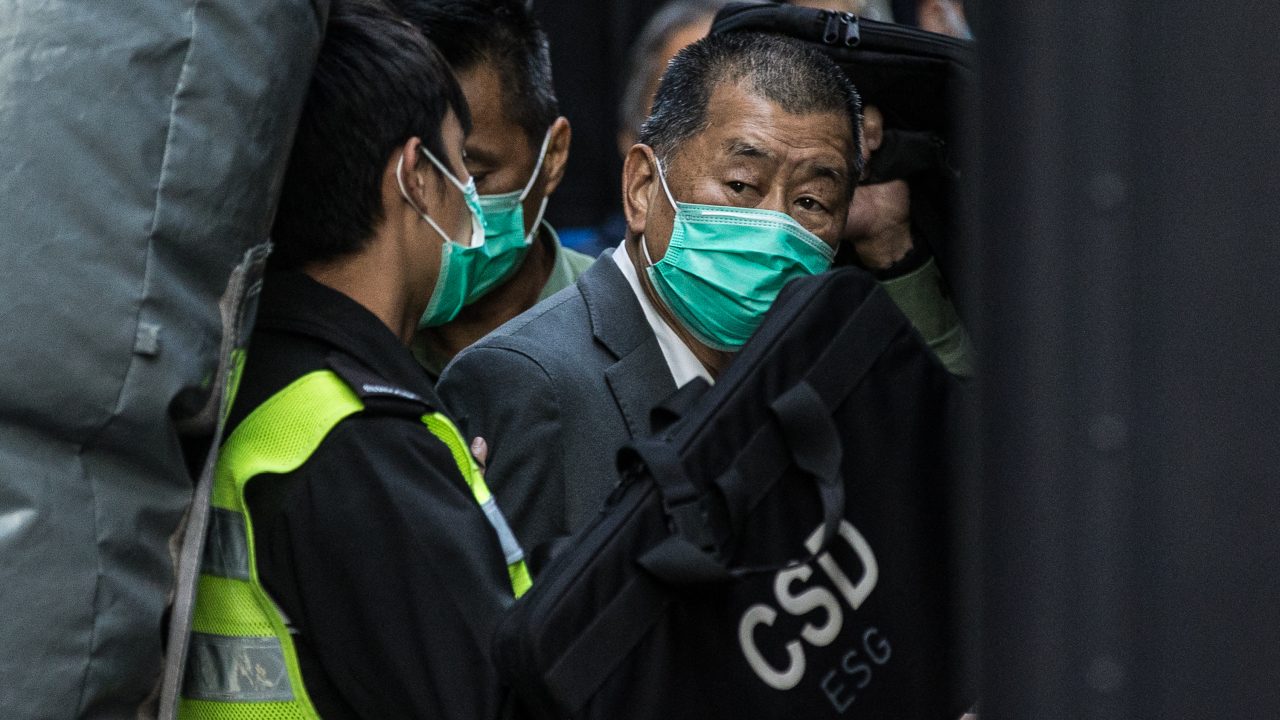
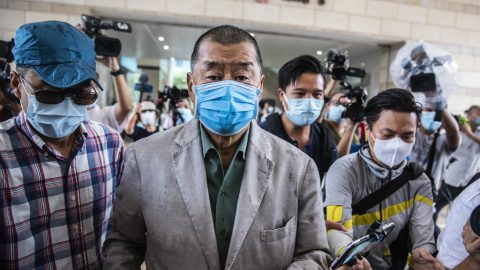
On Friday, a bipartisan group of five U.S. Congressman wrote a letter to the Nobel Peace Prize Committee in Oslo nominating Jimmy Lai (黎智英), along with five others who have stood up for human rights in the face of the Chinese government, for the award.
“Mr. Lai has endured harsh custodial conditions — including prolonged solitary confinement, restricted exercise and daylight, and limited access to independent medical care — that pose grave dangers to his health,” the Congressman wrote.
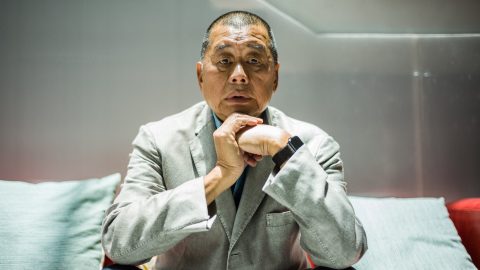
That Lai, who was sentenced to 20 years in prison by a court in Hong Kong Monday, would become the subject of such a letter highlights a stark reality facing Beijing: The media mogul and pro-democracy activist strikes a far more galvanizing figure as a prisoner in Hong Kong than he would as a free man in the West.
And the threat Lai poses to Beijing is only compounded by the possibility that he could die behind bars, just like the most recent Chinese-born man to win the Nobel Peace Prize, Liu Xiaobo (劉曉波).
History shows that dissidents who are granted compassionate release tend to see their leverage quickly dissipate once they settle into lives of comfort abroad. It’s the people who continue to struggle in the belly of the authoritarian beast — the Alexei Navalnys, who stood up to Putin’s regime, or the Li Wenliangs (李文亮), the Wuhan doctor who tried to ring the alarm about Covid-19 and later died of the disease — who garner the most international sympathy and attention.
The pitfalls facing Beijing are intensified by Lai’s Catholic faith. Amid the violent typhoons of Hong Kong, Lai’s daughter Claire Lai (黎采) has said that her father has often returned to his drenched cell to find that his Bible is the only thing that stayed dry. “We’re very grateful that Our Lord and Our Lady continue to watch over him,” she said.
That’s not the sort of story that a magazine can verify. But it is the sort of story that could help build the case for Lai’s canonization as a saint of the Catholic Church.
Lai gave generously to local Catholic bishops in Hong Kong and helped rebuild churches in China that were destroyed during the Cultural Revolution.
When it became clear in 2020 that Lai’s media empire would become a casualty of China’s new national security law, Lai’s aides repeatedly gave him the chance to flee. But Lai stayed behind, choosing courage over comfort.
The ensuing five years have taken a toll on Lai and his family. But they have also transformed him into a man whom Pope Leo XIV personally prays for, whose likeness still graces the T-shirts of politically conscious young people across the Chinese-speaking world.
Now, with Lai on his way to becoming a martyr, Beijing faces a choice: help accelerate that transformation, or save Lai, and themselves, while they still can.




Leave a Reply