In the land where mere mentions of the numbers six and four are to the Chinese Communist Party what daylight is to a vampire, a live broadcast with Li Shufu (李書福), the well-connected billionaire chairperson of Chinese automotive giant Geely, was censored after he uttered the fateful digits aloud during an interview.
Six and four, of course, correspond to the month and day in 1989 when Chinese troops massacred pro-democracy citizens in Beijing’s Tiananmen Square, a forbidden topic in China’s dictatorship. Li was briefly describing how the incident shattered the business environment of the time, particularly for a refrigerator brand that was unfortunately named “June Snow.” Thus, he had to be briefly silenced, even though the purpose of his interview was not to talk about history, but to celebrate Geely’s world-first invention of autonomous drifting on its vehicles, apparently a product of in-house artificial intelligence.
Thus, China managed to transform what ought to have been a victory in a sector much vaunted by its president, Xi Jinping, into yet another encapsulation of why it is essential to de-power its present government: The accumulation of advanced technology under the forever rule of an expansive regime that murders its own people and covers up the crimes is terrifying.
Tiananmen reared its head even more uncomfortably in another video, this time shared by the official Bilibili account of the People’s Liberation Army Rocket Force, in which a serving member proudly showcased a “Defender of the Capital” medal that had been awarded to her father, a former soldier himself, for the services he had provided to the state during the massacre.
On the one hand, the sharing of the video demonstrates how dangerous the Tiananmen taboo is to China: In the absence of a full public discussion of 1989, the army essentially reserves the right to commit mass-murder again one day. On the other, however, prior to the video being removed, it attracted several negative comments. The memory cannot be erased despite the information blockade, and many of those who do know what happened see the incident for what it was.
Between oblique and abruptly hushed references to human slaughter that occasionally permeate day-to-day life, other collective memories created for its people by the Chinese Communist Party include student days in which the necessity of holding an opinion must be weighed against the potentially horrendous consequences of speaking it aloud.
In interviews with The Guardian, several Chinese people who study in the U.K. and attend protests there to demand change back at home describe a pattern of intimidation that includes being watched and tracked by strangers, receiving intimidating phone calls from China, being pressured by peers or facing threats directed at their families. Their lives are presumably made no easier by quiet visits to British universities by the Chinese ambassador, who reminds students to “keep in mind general secretary Xi Jinping’s earnest teachings, adhere to patriotism and serving the country.”
Since last year, the U.K. government has put in place a “freedom of speech tsar,” Arif Ahmed, under the 2021 Higher Education (Freedom of Speech) Act, whose role is ostensibly to ensure that a plurality of voices can be heard on campus. Against the backdrop of allegations earlier this month from an associate professor at University College London, Michelle Shipworth, that she had been stood down from a course after it contained a statistic — that she had challenged — about China displaying the second highest prevalence of modern slavery in the world, Ahmed warned that higher education establishments may be required to terminate contracts with foreign countries if such arrangements are weakening freedom of expression.
While this may afford Chinese students at least a modicum of freedom to be exposed to opinions other than the Chinese Communist Party’s when on British soil, nothing can protect them when they go back home. There, this month, like every month, the news of yet another disappearance surfaced, this time that of Hu Shiyun (胡士雲), a professor at Japan’s Kobe University, who returned to visit his mother country in August last year and has not been heard of since. It was accompanied by the familiar steady stream of prison sentences handed out to human rights defenders, religious practitioners, reform advocates and others who have committed no wrong.
According to the rights protection network Weiquanwang (維權網), for example, a Hainan teacher named Wu Kongda (吳孔大) received three years and six months on incitement to subversion charges. He had a history of promoting democracy and human rights, not to mention making his opinions known to authorities, and was detained last year after discussing prisoners of conscience on WeChat.
Joining him for extended stays in the brutal Chinese penal system are Lian Changnian (廉長年), Lian Xuliang (廉旭亮) and Fu Juan (付娟), three members of the Christian Church of Abundance in Xi’an, who, following a crackdown on religious freedom, are each facing prosecutor requests for five-year sentences under dubious charges of fraud; Dong Liping (董麗萍), Ma Yanhua (馬艶華) and Yang Suxia (楊素霞), who were imprisoned separately for between 12 and 42 months due to their adherence to Falun Gong, in Yang’s case a punishment that ultimately traces back to her innocuous choice to place materials promoting the spiritual practice on a car; and Quan Shixin (全世欣), a Beijing anti-corruption, pro-Hong Kong and human rights activist, who has been condemned to jail until September 2025 after she gave an interview to Voice of America last year.
Allegations of torture and mistreatment in detainment surround most of these people, and, as a human rights defender with known health problems, Quan’s situation in particular reminds of Cao Shunli (曹顺利), a Chinese activist who died in prison in 2014 after authorities allegedly obstructed her access to medical care.
On March 22, following repeat calls in the first half of the same month for an investigation into her death, China unsuccessfully attempted to block a tribute to Cao at the United Nations Human Rights Council in Geneva by the NGO International Service for Human Rights. Cuba, North Korea, Russia and Venezuela all moved to support its obstruction.
China repays states for co-alignment variously. Its “no limits” partnership with Moscow was this week bolstered by Beijing’s propaganda outlet Global Times serving Russia’s narrative that the recent terrorist attack in its capital city may be connected to the United States of America and Ukraine, against the latter of which it is attempting to justify a war of invasion. Making no reference to obvious use of torture, the Global Times’ English-language service tweeted that the Russia’s “investigation and interrogation” of terrorism suspects reveals a “complicated” situation and implied possible involvement from Washington and Kyiv.
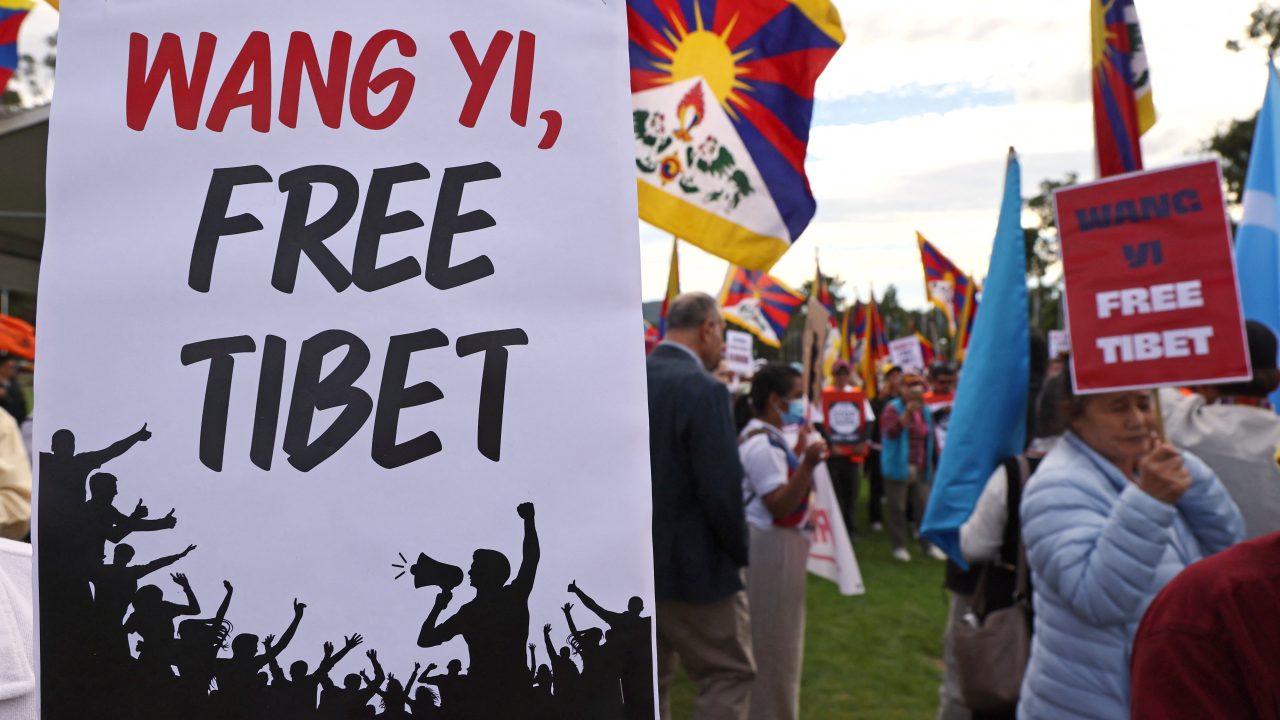
Beijing also sought to keep the Maldives, one of its more recent allies, happy with the March delivery of one million bottles of glacial meltwater from colonially occupied Tibet. For years, civil society organizations have highlighted how Tibetan pastoralists are being removed from their traditional lands to facilitate resource exploitation by Chinese companies, including for bottled water.
Extraction of water is reportedly exacerbating environmental degradation and conflict in tandem with a flurry of dam construction that saw major protests earlier this year in Dege County, currently part of China’s Sichuan province. Radio Free Asia revealed on March 25 that hundreds of protesters arrested during that incident have now been released, but not before suffering deprivation of water, overcrowding and sometimes severe beatings in custody. Moreover, the wider picture suggests that not all of the detainees have been set free; some remain unaccounted for; several younger monks have been sent to government schools since the demonstrations; and restrictions on movement in Dege are still in place.
Meanwhile, far from gifts of water, other countries that are not regarded on quite such friendly terms by Beijing like New Zealand, the U.S., U.K. and members of the European Union have instead been the victims of widespread cyber-attacks. Attributed to two entities known as APT 31 and APT 40, which are considered to be affiliated with the Chinese state, the attacks focused on targets such as the British Electoral Commission, companies of strategic importance, dissidents, journalists, parliamentarians and other politicians critical of China.
Although the attacks have occurred over a period of years, they have only been comprehensively exposed to public scrutiny in the past few days. Incidentally, several of the countries breached by the hacking spoke in support of the aforementioned tribute to Cao Shunli.





Leave a Reply