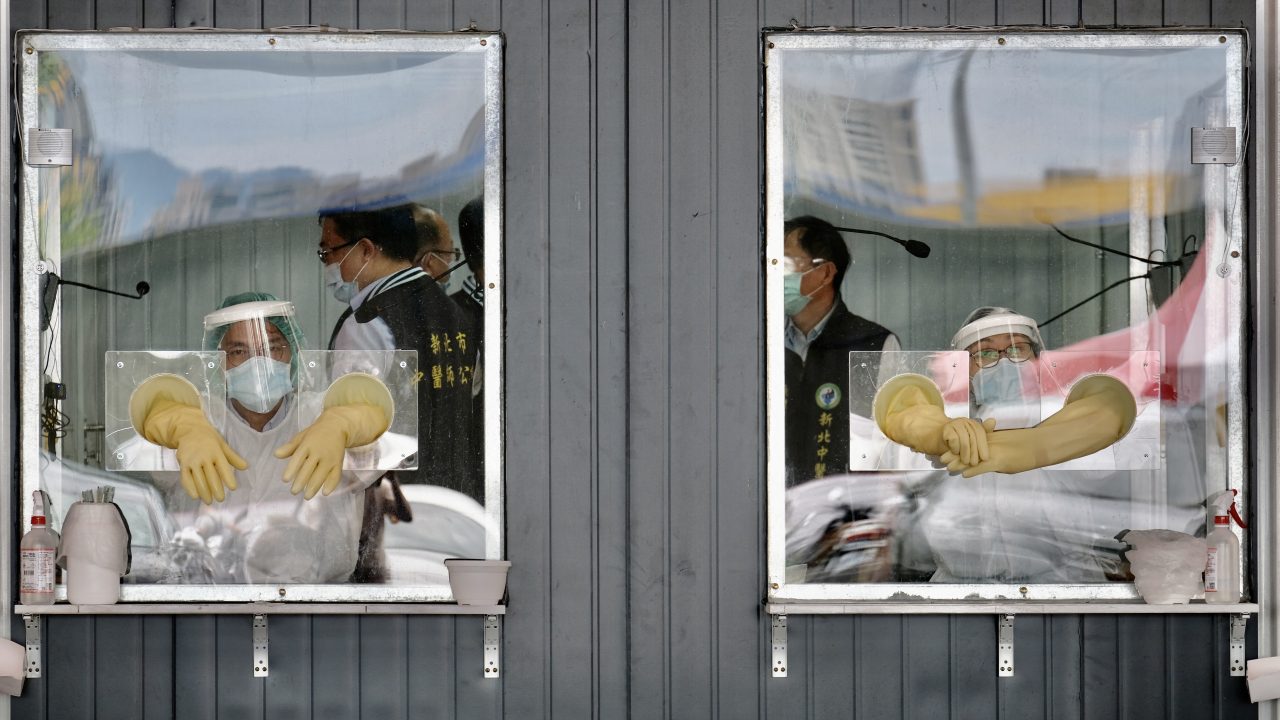
Since at least the 1960s, when Hong Kong newspaper Ming Pao alerted of deadly flu cases in Guangdong Province, a pattern has emerged: News of a disease outbreak in China is stifled one way or another by Communist Party rule, but information creeps through to the wider world via Hong Kong or Taiwan, where people have the cultural, linguistic, experiential and even familial ties to decode what is happening on the ground in China.
Avian flu demonstrated this in more recent times: During the 2000s, experts such as Guan Yi (管軼), a scientist at the University of Hong Kong, evidentially contradicted official Chinese Communist Party narratives about the pathways and prevalence of the virus, thereby keeping the world informed about the likely state of play in China, where such openness would have been decidedly more risky. News of SARS broke into the wider global consciousness in 2003 through Hong Kong media, too. In those days, it was still just about safe enough to reveal such information from the city.
Then, on December 31, 2019, came arguably the most fateful example of all: Taiwan notified the World Health Organization’s (WHO) focal point of an “atypical pneumonia” for which patients had been isolated in China, a sign that it could be passing from human to human. Rumors about the illness were soon swirling among Hong Kong’s pro-democracy community as well, and, alongside Taiwan’s increase in border monitoring, these were among the first indications to those further afield that well over 10,000,000 people were set to die from the COVID-19 virus, about which China was still withholding knowledge and threatening doctors with arrest.
Now, in December 2023, history is echoing, and sufferers of pandemic-induced post-traumatic stress disorder may wish to cover their ears. Following a report by Taiwanese news outlet FTV, the WHO has pressed Beijing for information about a new outbreak of disease. As a result, it has become known that pneumonia clusters are currently pulsing through China, and Taiwan is raising its guard again.
A statement by Chinese authorities, forwarded to the rest of the globe by the WHO, has reassured that “there has been no detection of any unusual or novel pathogens or unusual clinical presentations.” However, in an article for Foreign Policy that alleges yet another Beijing cover-up, practicing clinician and associate professor for New York’s Icahn School of Medicine at Mount Sinai Annie Sparrow warns that focus on pathogen novelty could be distracting from the real danger: The pneumonia is displaying resistance to the only antibiotics known to be safe for children.
At the same time, China has heightened the sense of COVID-era deja vu by projecting an image of control that does not seem entirely consistent with the underlying situation, stating via the WHO that “the rise in respiratory illness has not resulted in patient loads exceeding hospital capacities,” while reports emerge in the background of “swamped” pediatric units and beds lining Hebei hospital corridors. It also transpires that elevated hospitalization rates among children with mycoplasma pneumonia have been evident since May.
At this point, it is vital to temper panic. Most experts agree that the key factors behind China’s present outbreak are almost certainly lowered immunity due to years of extreme COVID-19 prevention combined with cyclical flux in disease prevalence, and the situation is therefore not a matter for undue concern. However, it is equally vital to highlight the importance of monitoring further developments, and the global community’s weakening ability to do so in the face of Chinese Communist Party aggression, not only for the current flare-up, but for the future as well.
For Hong Kong is already being sucked into China’s information black hole and can no longer be relied upon to convey accurate information to the outside world, given the risks its citizens would have to take to do so. Taiwan could very well go the same way, without concerted international commitment to prevent its potential forcible absorption under Beijing rule. And the Chinese diaspora overseas, who are also a vital source of information about matters like nascent pathogen spread, are increasingly being silenced by intimidation even on the supposedly safe soil of democratic countries.
Indeed, although outspoken voices still bravely remain in Hong Kong’s scientific community, room for academic freedom is shrinking on all sides; critical institutions are being remodeled to accommodate Beijing loyalists; under government pressure, hospital staff are disbanding organizations that could once speak for them collectively; an anonymous social media group where Hospital Authority employees from the city could previously share their experiences has been shuttered; and the next generation of epidemiologists, medical experts and workers at all levels is being groomed to give fealty to the Communist Party above all. Even more severe treatment can be expected in Taiwan if the People’s Liberation Army one day invades, and few words will escape if Beijing goes full Xinjiang-mode on its neighbor.
That will leave the world with little shield but the WHO, which, as we have seen, is reliant on more open parties like Taiwan, Hong Kong and the Chinese diaspora to let it know when people behind the Great Information Wall of China are getting sniffly. As an agency of the same United Nations that confirms the names of Chinese dissidents at Beijing’s request, it has disastrously amplified Chinese Communist Party disinformation once or twice in recent years and needs all the dependable support and oversight it can get if it is to rebuild global trust and fulfill its extremely fraught role at the forefront of disease prevention.
Thus, a very serious public health risk is percolating: China is both stiffening its grip on information flow and stepping up its influence over international institutions, which means that whenever the next virus or other disease rampages through the land, it will be covered up just like the last and the one before that. Concurrently, the CEOs of the world’s most powerful companies are applauding its dictator-president, bending narratives to his will and promoting “reunification” between Beijing and Taipei on his behalf, while governments almost universally put business ahead of human rights, turning a blind eye to the destruction of Hong Kong and denying Taiwan its sovereignty.
This is corroding humankind’s ability to inform itself of existential threats. On this matter, at least, one can hardly say we have not been warned.





Leave a Reply