
In May, the Chinese Nationalist Party (KMT) and Taiwan People’s Party (TPP), which control Taiwan’s Legislative Yuan, pushed through a series of amendments expanding the legislature’s oversight powers. Protesters supporting the Democratic Progressive Party (DPP), which controls the executive branch, took to the streets. They feared KMT and TPP legislators would use the expanded powers to harass their political enemies and suppress opposition in the legislature.
The amendments were passed on May 28. Lawyers representing the DPP, Presidential Office, Executive Yuan and Control Yuan petitioned the Constitutional Court for a constitutional interpretation and temporary injunction. On Wednesday (July 10), legal representatives for both sides introduced their arguments in a preliminary hearing before the Constitutional Court.
Given the high stakes involved, the hearing drew significant attention. The purpose was to hear the opinions of the relevant sides and determine the scope and necessity of issuing a temporary injunction.
According to the Constitutional Court’s recently published outline of the controversial amendments, issues include whether there are significant and obvious procedural flaws in Taiwan’s legislative process within the full text of the newly added and amended articles of the Law Governing the Legislative Yuan’s Power (立法院職權行使法), as well as Article 141-1 of the Criminal Code.
After a nearly three-hour long hearing, the judges had yet to issue a final verdict on the matter, which will require approval from more than half of the 15 Constitutional Court justices. The next hearing will be held on August 6.
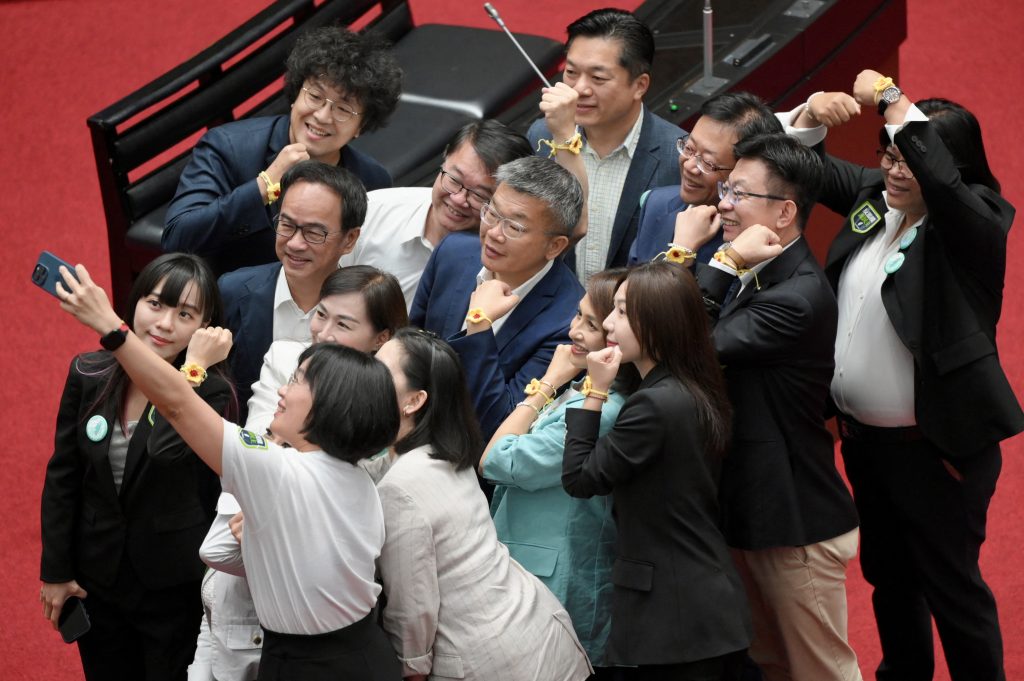
Representing the petitioners at the hearing were DPP party whip Ker Chien-ming (柯建銘), DPP Legislator Chung Chia-ping (鍾佳濱) and DPP Legislator Wu Szu-yao (吳思瑤). The legislature was represented by KMT Legislator Wu Tsung-hsien (吳宗憲), KMT Legislator Weng Hsiao-ling (翁曉玲) and TPP Legislator Huang Kuo-chang (黃國昌).
Prior to the start of the hearing, the TPP’s Huang Kuo-chang spent seven minutes asking Chief Justice Hsu Tzong-li (許宗力) to clarify potential misunderstandings regarding the Legislative Yuan’s right to notification as stipulated in the Constitutional Court Procedure Act (憲法訴訟法). Huang pointed out that the Legislative Yuan, as the respondent, had yet to receive any petition documents. He questioned whether the proceedings were categorized as emergency measures and hearing opinions as per Article 43 of the Constitutional Court Procedure Act or if they were preparatory procedures for oral arguments.
Judge Hsu stated that, according to procedural rules, preparatory proceedings can indeed be conducted for temporary injunctions. He noted that all petitions had been published online, including the full text of the petitions, and relevant agencies had already reviewed the case files. He then started the proceedings.
President Lai Ching-te’s (賴清德) legal representative Hong Wei-sheng (洪偉勝) began by emphasizing that principles such as separation of powers, responsible politics, transparency and democracy are crucial foundations that maintain the constitutional order and are significant public interests protected by the constitution.
Hong stated that amendments requiring the president to give a state of the nation address and answer questions before the Legislative Yuan, and requiring the approval of presidential appointments by the legislature, have serious flaws that violate transparency and democratic norms. He argued that these violations contradict constitutional provisions, disrupt the semi-presidential system Taiwan practices, undermine the separation of powers, and undermine the constitutionally mandated loyalty of officials to the government branches in which they serve. Hong warned that the expanded oversight powers could ultimately lead to gridlock in the operation of the five branches of government.
Hong added that, considering the potential for irreversible damage to the public interest and the urgent necessity to protect the constitutional order and fundamental principles (the amendments took effect on June 26), the court’s approval of a temporary injunction was a necessary step to balance various interests and safeguard order.
As the legal representative for the Executive Yuan, Lino C.H. Lee (李荃和) pointed out that the newly amended law imposes numerous restrictions and obligations on government nominees for positions requiring legislative approval. Apart from mandatory declarations to the legislature, these include fines and giving the legislature the option to delegate review processes to unelected third parties.
Lee emphasized that an even more serious and pressing issue is how the new oversight amendments could slow down the process of appointing new officials. Legislators could repeatedly demand additional information from nominees and conduct multiple reviews, potentially paralyzing personnel appointments via indefinite review procedures.
Lee also highlighted concerns regarding expanded powers to compel individuals to appear before the legislature for questioning and potentially face criminal charges if they are held in contempt of the legislature. These include prohibitions on counter-questioning, concealing information and providing false information, all of which Lee argued lack clear definitions. Although exceptions to the scenarios he outlined exist, they require the chair’s approval. The amendments introduce punishments such as fines, disciplinary actions and criminal charges for contempt of the legislature.
The DPP’s legal representative, Chen Peng-kwang (陳鵬光), argued that the oversight amendments could cause irreversible and significant damage to the independence of the five branches of government. He noted the potential harm to national security, national defense secrets, diplomatic confidentiality, criminal investigation secrecy and the operation of the executive branch, as well as the protection of fundamental human rights.
Lee Yuan-de (李元德), the legal representative of the Control Yuan, said that the Legislative Yuan has already established a “Special Investigative Committee” on Mirror Media’s application for a license to broadcast news and is on the verge of forming another special committee on imported eggs. Lee told the judges that the Legislative Yuan could at any time produce binding investigation reports on cases like these, thus potentially constraining the Control Yuan’s investigations.
Lee concluded that, aside from a temporary injunction from the Constitutional Court, there is no other way to prevent a potential overreach of powers from the Legislative Yuan under the enhanced powers granted to it by the oversight amendments.
The Constitutional Court is scheduled to hear an oral argument on August 6 regarding whether there are clear flaws in the legislative process of the reformed amendments government the legislature’s power, and whether the reformed amendments are unconstitutional.







Leave a Reply