In an op-ed for Domino Theory published immediately after Trump’s victory in November, I argued that more than anything else, Taiwan needed to know whether the cast of China hawks that now surround the new U.S. president were serious in their stated desire to defend Taiwan.
Many of this group are “prioritizers.” They are people like Vice President JD Vance, who had long called for reducing or withdrawing support for Ukraine so that the U.S. can fully focus on the Indo-Pacific.
But people have long feared that they are secretly isolationists who would abandon Ukraine under the pretext of supporting Taiwan, then turn around and abandon Taiwan for some other “ally,” or simply for America itself.
Knowing whether this fear is correct is arguably the most important security information for Taiwan in President Lai Ching-te’s (賴清德) term. He needed to know that answer on November 6. But four months later, I don’t think anyone in Taipei is sure, except those who have convinced themselves it’s all over.
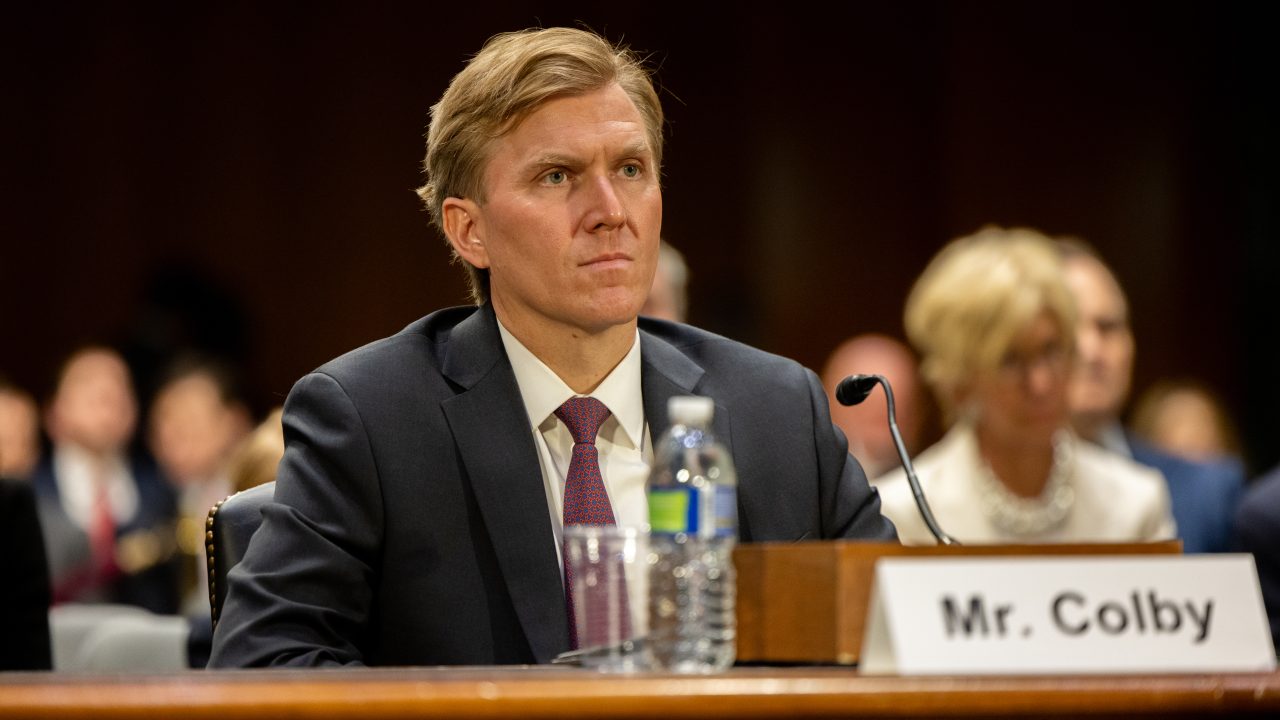
Elbridge Colby is Donald Trump’s pick for undersecretary of defense for policy. Colby also served in the Department of Defense in Trump’s first term. In the intervening four years, Colby became well known in Taipei for his vocally held positions that America needed to focus on countering China, and that Taiwan was not doing enough to defend itself. He has had fantastic access here, but at times appears to lack an appreciation of Taiwan’s domestic situation.
As a vociferous advocate of taking on the P.R.C. in the Indo-Pacific who has become shaky on whether that means defending Taiwan, Colby might be more of a canary in the coal mine for Taiwan than a defense hawk against China.
Yesterday Colby went before the Senate Armed Services Committee for his nomination hearing and he ruffled feathers here in Taiwan by saying the following:
“Taiwan is very important to the United States, but as you said it’s not an existential interest.”
Colby also said that the military balance in the Taiwan Strait had deteriorated dramatically and raised the concern of the U.S. engaging in a futile and overly costly effort that would destroy its military.
He again criticized Taiwanese defense spending and said it wasn’t fair that American servicemen and women should suffer if American allies were not pulling their weight.
This has raised fears, again, that Colby wants to abandon Taiwan. But there is a lot more going on here.
Colby’s hearing took place against the backdrop of the events of the last days, weeks, and months.
Days in which Vance and Trump scolded Ukrainian President Zelenskyy in the White House. Weeks in which America has voted “against” Ukraine and with Russia on a U.N. Resolution marking the third anniversary of Russia’s full-scale invasion of Ukraine. Months in which Trump and his officials made extraordinary statements threatening to annex Canada and parts of Denmark, both NATO allies.
It’s important to remember that everyone expected the Trump administration would try to force Ukraine to accept an agreement with Russia that would be far less than Kyiv would hope for. No one thought that would be edifying. What has shocked many of America’s allies, not just in Taipei but in democratic capitals across the world, is the way in which many in the administration and especially Vance appear to have enjoyed doing it.
This has sent shockwaves through Europe as the continent countenances the idea of going it alone against a Russian security threat. But there is no “going it alone” for Taiwan. It has no other security offering or partner. It must dance with the U.S. or submit to China.
The months since Trump’s election have made it harder to believe that America even cares about dancing anymore. That’s driving people in Taipei to a level of analysis and reaction to things like Colby’s hearing, and Trump’s own comments last week, that otherwise wouldn’t be reached.
There is a cold hard truth that Taiwanese are going to have to live with for the next four years: Far more than with other American presidents, strategic ambiguity is real. They just won’t know if the U.S. will come if called.
But actions, as they say, speak louder than words. Trump’s State Department is carrying on business as usual in East Asia. When Trump met Japanese Prime Minister Shigeru Ishiba, they made a joint statement emphasizing peace in the Taiwan Strait and opposing “any attempts to unilaterally change the status quo by force or coercion.”
Marco Rubio, the Secretary of State, recently emphasized that the U.S. would not abandon Taiwan. The State Department removed language opposing Taiwanese independence from its website, in a move that did anger China. The U.S. has explicitly lifted the freeze on security aid to Taiwan, after it cut back such spending globally.
Global Cooperation and Training Frameworks, multilateral conferences supported by the U.S. that intended to alleviate Taiwan’s international isolation, are still happening. Taiwan appears to have been invited to participate in joint exercises in Thailand, although this was walked back with a series of non-denials.
Although its security implications are still being digested, on Monday TSMC announced it would spend $100 billion in America, making it the largest foreign investor in U.S. history. And Taiwan is looking for a way to make a huge and early arms purchase. Colby himself yesterday echoed Trump’s call for Taiwan to increase defense spending to in the ballpark of 10% of GDP (which needless to say is not going to happen).
Readers should of course watch Colby’s hearing themselves, or read his written responses. There is much more to absorb.
But if you thought that his comments about American existential interests would be a simple green light for Beijing, you might want to look again before pulling away. According to Colby:
“President Trump has said that China would not attack Taiwan under his watch, and if confirmed I would make it my particular business to give him the military strength to back that up.”
Colby seems sure to be confirmed. The question is whether as part of Pete Hegseth’s Defense Department he can deliver on giving Trump the options he says he wants to.



Leave a Reply