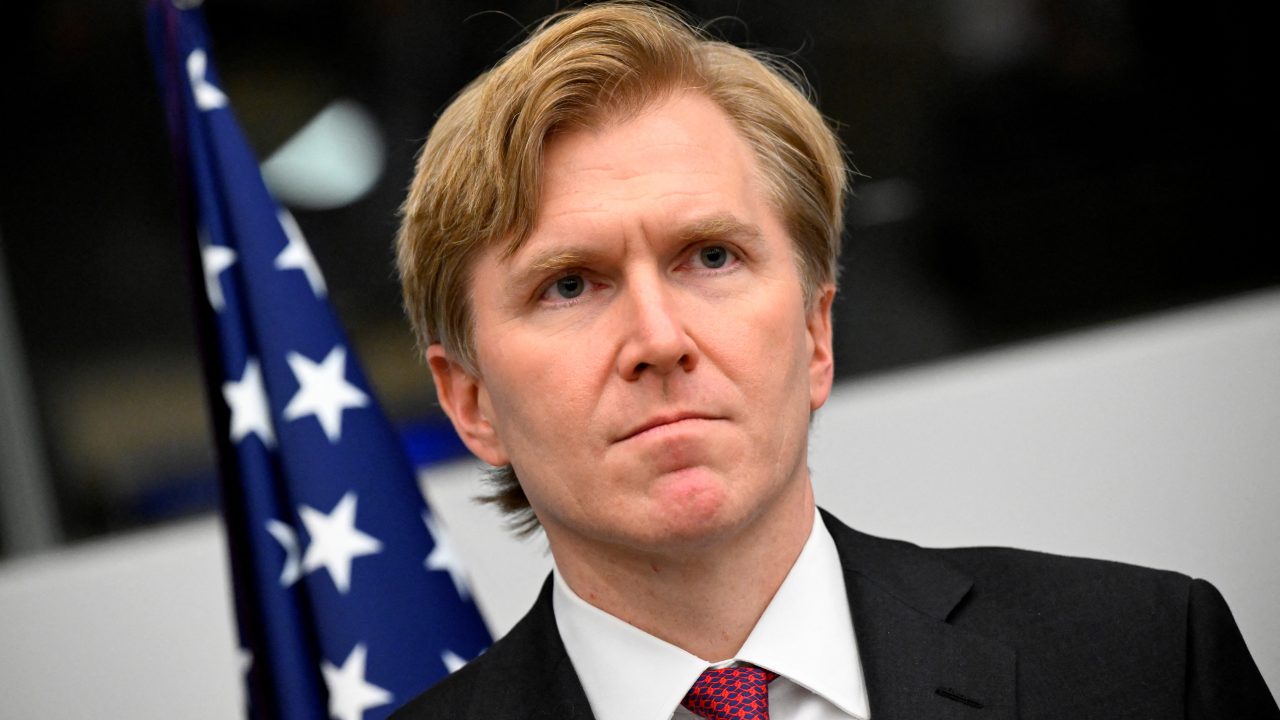
There was a moment of levity at the Munich Security Conference on Friday, when George Yin (尹麗喬), a researcher from National Taiwan University rose during a panel on Indo-Pacific security to question U.S. Under Secretary of Defense for Policy Elbridge Colby on the Trump administration’s support for Taiwan. “Happy Valentine’s Day,” Yin began. “I want to talk about tough love.”
“That’s an excellent opening,” Colby interjected.
It wasn’t a bad two-word summary for the U.S. approach to the conference, which saw Secretary of State Marco Rubio invoke shared cultural heritage in an attempt to reassure European leaders of American support for the continent. In Munich last year, Vice President JD Vance shocked those same leaders by claiming that their insufficient commitment to that heritage was a greater threat to Europe than Russia.
Colby, the highest-ranking U.S. defense official to attend the conference this year, was there to remind the world that the Trump administration are realists. “The real emphasis on ideology, and this bloc confrontation and adversarial alignment approach is not ours,” he said in response to a Chinese professor who asked a question shortly before the man from National Taiwan University.
The ‘tough love’ question was a reference to the controversy over Taiwan’s proposed $40 billion special defense budget, which the main opposition Chinese Nationalist Party (KMT) has repeatedly blocked. Earlier this month, the Taiwanese parliament went into recess for Lunar New Year with no resolution in sight.
The U.S. has remained eager to sell weapons to Taiwan under the second Trump administration. In December, it approved an $11 billion arms package focused on Taiwan’s asymmetric defenses, an approach to deterring China that Colby has long championed.
Vocal support from bipartisan members of Congress has also continued to be a bright spot for Taiwan, which is used to diplomatic slights on the world stage. (Taiwanese officials are usually not invited to the Munich Security Conference, which is attended mostly by countries who maintain formal diplomatic ties to China.)
But the decision by KMT lawmakers to stall Taiwan’s defense spending has drawn the ire of U.S. lawmakers.
“Friends of Taiwan: I stand with my colleagues in Congress urging the Legislative Yuan to back President Lai and fund his FULL defense budget proposal,” Republican Congresswoman Anna Paulina Luna wrote on X Friday. “The threat from Beijing is real and growing. America stands with Taiwan, but Taiwan must stand strong. The world is watching.”
Attached to Luna’s post was a letter, addressed to Taiwan’s opposition leadership and co-signed by a bipartisan group of 32 U.S. legislators, calling on Taiwan to pass the defense budget.
“We commend Taiwan for making important progress in strengthening its military readiness, reserve force, and asymmetric defense capabilities,” the letter said. “Nevertheless, we fear that without significant increases in Taiwan’s defense spending at levels reflected in President Lai’s proposed special budget, this progress will be insufficient.”
The refusal to consider President Lai Ching-te’s (賴清德) defense budget has coincided with the KMT’s recent effort — under the leadership of its new chairwoman, Cheng Li-wun (鄭麗文) — to establish closer ties to Beijing.
In early February, the KMT sent a delegation of party officials and academics to China for what it referred to as a “think tank forum” with the Chinese Communist Party (CCP). Many analysts suspect that the real purpose of the trip was to lay the groundwork for a meeting between Cheng and Chinese President Xi Jinping (習近平).
On Sunday, the KMT said that it would pursue legal action against a prominent local newspaper for reports claiming that Beijing had instructed the KMT to block the defense budget in exchange for favorable treatment.
Some members of Congress, however, have appeared to endorse that theory. “It doesn’t take a genius to figure out what’s going on here,” Senator Dan Sullivan of Alaska wrote on X earlier this month.
Responding to the question about tough love in Munich on Friday, Colby appeared hesitant to rock the boat ahead of Trump’s own planned trip to Beijing to meet with Xi, which is scheduled for April.
“Our position on Taiwan remains the same,” he said. “It’s a very sensitive issue in our relations all around and particularly with the People’s Republic, so I won’t comment in any way on what’s going on in Taiwan.”




Leave a Reply