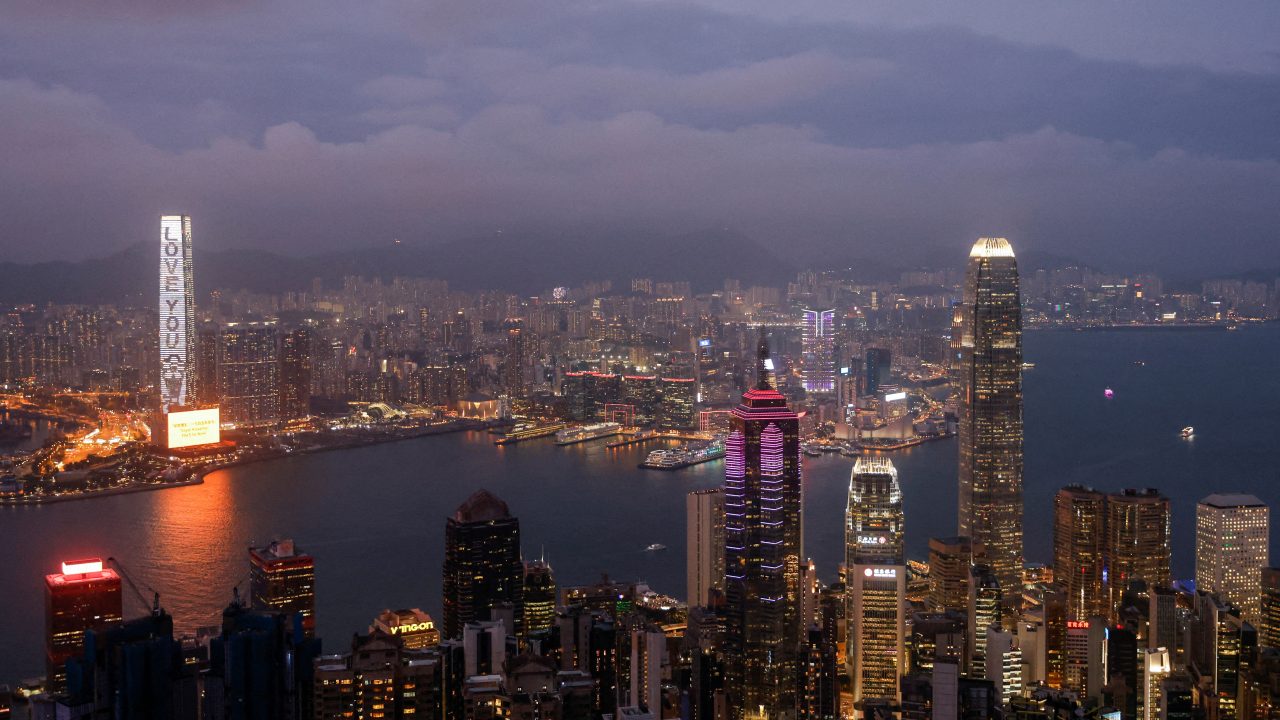
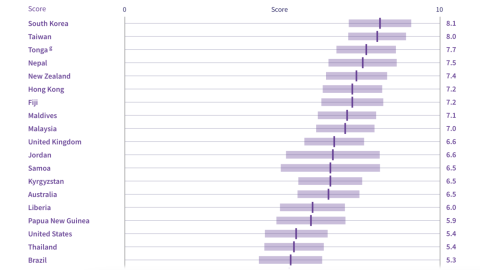
China is often held to be an exception to the rule that economic performance and human rights are inextricably bound. In fact, it proves the rule: Its annual GDP growth and contraction rate over the years carries signatures of its human rights environment.
The massive overconcentration of power, media manipulation and distortion of economic fact during Mao Zedong’s Great Leap Forward and Cultural Revolution are charted by wild oscillations and year-on-year GDP collapses of up to 27%. Over the past four decades, the post-Tiananmen and “Zero COVID” periods exhibit the slowest growth. Since 2013, there has been a general decline in fortunes, which coincides with restricted freedoms under current China president Xi Jinping.
The relationship goes both ways: Although rights have never been properly codified or respected by Beijing, the reform period from the late 1970s that has formed the backbone of Chinese economic expansion was, in essence, a granting of greater freedoms, and a sizeable portion of China’s resources have in fact been distributed by market forces in the West, which emerge from comparatively free information flow in an electoral context. The precursor to Beijing’s strategic takeover of the solar-power industry and the key to its future profitability, for example, have been a climate change debate that could not take place freely under its own watch.
Hong Kong has been a vital interface making it possible to square the circle between China’s restrictive environment and the freer global one. While news with implications for business decisions has always been censored in China and data discredited even by the country’s former premier, Hong Kong held a broad media ecosystem and discussion forum in which thorough analysis could be undertaken. Until recently, listings on its stock exchange required disclosure of risks related to China’s policy, business and legal circumstances, for instance.
Alongside the perceived impartiality of its courts, its large port and a business-friendly regulatory environment, these qualities made Hong Kong a natural clearing house where the obvious economic opportunities afforded by China could be sifted according to their viability, and the city was able to enrich itself by mediating the flow of investment, goods and services between the mainland and the outside world. On this basis, it has achieved an economy valued at $383.5 billion or nearly $51,000 per capita.
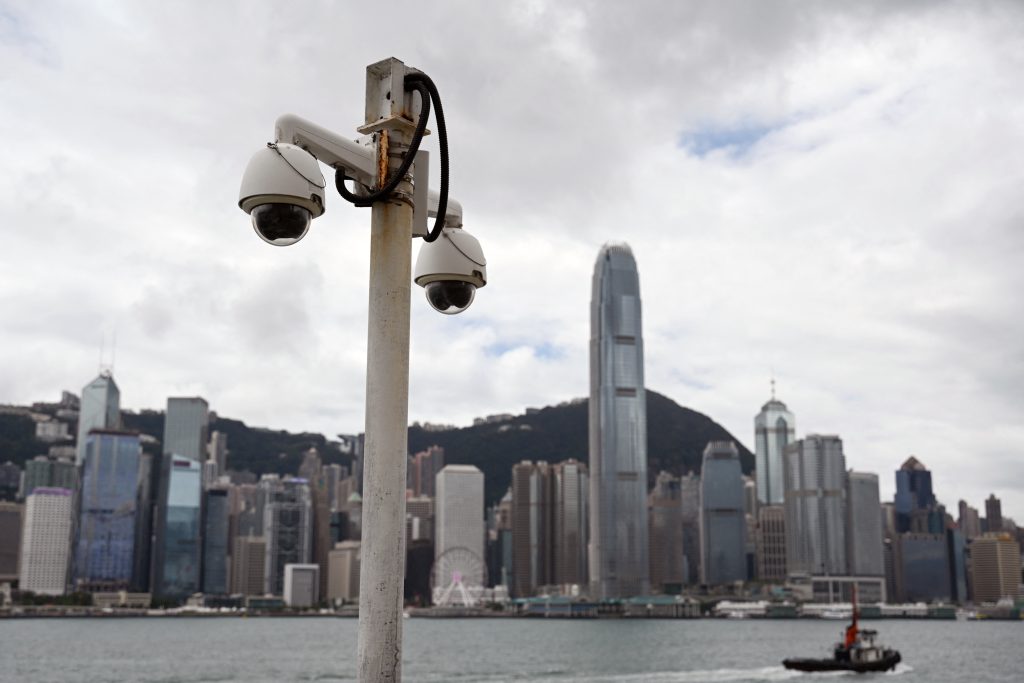
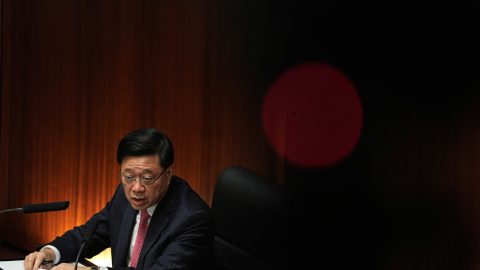
However, it follows that, as Hong Kong’s human rights fundamentals have declined, its economic outlook has done so also. This has been exacerbated by the specific manner of their corrosion. Police chiefs like John Li Ka-chiu (李家超) and Chris Tang Ping-keung (鄧炳強), not figures from the economic sphere, have been selected for the most influential leadership roles, and their rhetoric has been threateningly anti-foreign, messaging that does not align with the city’s globalized financial and trade role.
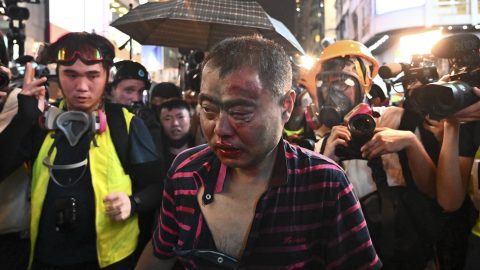
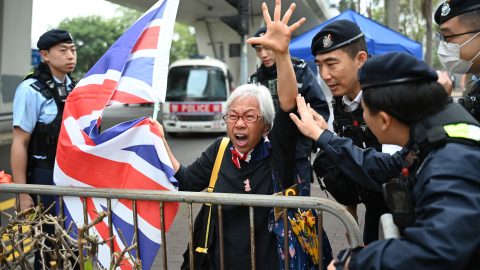
Their policies have been economically harmful. All-in harmonization with China’s excessive quarantine regime was not only ineffective, but it also alienated the business community that regularly traveled in and out of Hong Kong. Combined with city authorities’ violent reaction to pro-democracy protests in 2019, it contributed to negative growth rates in three out of four years to 2022 and drove tens of thousands of often skilled workers away from the city.
The reputational fallout from Hong Kong’s management of both COVID-19 and the pro-democracy movement has resulted in the collapse of inbound tourism, which the Hong Kong Trade Department Council considers to be one of four core industries, too. With 34 million visitors in 2023, Hong Kong remains well below the 65 million it posted in 2018, when tourism accounted for 4.5% of GDP. It is further relying more heavily on travelers from mainland China who spend less money during shorter visits.
The downturn and its precipitants have created new costs for image rectification, which comprise of seven-figure payments to overseas PR firms and an expensive program of mega-events to resurrect the city’s allure. Results have been patchy: Hong Kong is losing out to Asian rivals for attracting the top names that pack the strongest economic punch like Taylor Swift. February’s authoritarian reaction to a football match involving Lionel Messi led to a $5.5 million loss for organizers and reinforced concerns that the city does not provide a safe space for performers. And luxury brand Dior has canceled a high-profile fashion show set for later this year.
Some $1.66 billion has meanwhile been expended on national security from 2020 through 2023, and $3.5 billion apportioned for policing in 2024-25, according to a budget released on February 28. Given the frequent deployment of these resources towards the prevention of dissent as opposed to more conventionally recognizable categories of crime, which are rising in frequency, the expenditure is not likely to translate into economic gains such as by making consumers feel safer.
Rather, amid a government deficit forecast to hit nearly $13 billion over the next couple of weeks, money for policing and security precludes subsidies for electric and transport as well as funds for consumption vouchers, all of which could support spending during an economically turbulent period. Far from stimulus, a 3% hotel tax is to be reintroduced from 2025 to help balance the government’s books, perhaps running contrary to previously mentioned efforts aimed at reviving tourism.
Moreover, as businesses around the world embrace newfound niches that have emerged through consumption based on personal values, Hong Kong is eliminating its homegrown, democracy-advocating “yellow circle” economy through the application of politically discriminative law and inspection controls, distorting its free market and causing the closure of small businesses. This is a direct outcome of its pivot to a police-oriented economy.
Indeed, legislation passed and pending under the police chiefs’ rule has created new categories of crimes with unclarified boundaries, unpicked rule of law safeguards such as judicial independence, reduced the legal space in which the media can operate and stands to criminalize various forms of communication between people inside and outside of Hong Kong, an essential for business in a global financial hub. Because universal suffrage does not meaningfully exist and the conditions for protest are unfavorable, there is no longer any check upon these policies or broad accountability for their consequences. Economic drag is therefore inevitable.
The trials of the billionaire magnate Jimmy Lai (黎智英) have brought these issues from the abstract to the concrete for the business world. Following his long-term support for the democratic movement, 2020’s National Security Law has been used to imprison him personally, dissolve his media empire and freeze his assets, pushing more than a thousand staff out of the work for which they are qualified and sometimes towards occupations that generate lower economic value. Currently, Lai is in court facing charges of conspiring to collude with foreign forces and publishing seditious materials, evidence for which rests upon reframing everyday activity in his industry as criminal.
Warning signs from these kinds of punitive activities by authorities have not gone unheeded in business circles. The law firm Latham & Watkins has become the latest to silo its Hong Kong operations, denying staff in the city automatic access to data outside Greater China. Day-to-day workflow will inevitably slow and costs increase as a result, but Hong Kong police will be denied entry to global databases in the event of a raid. Latham & Watkins’ decision is expected to influence the legal profession more widely for those firms that still see Hong Kong as viable amid a local downturn in the demand for their services.
Other companies are either quitting the city completely or less conspicuously scaling back their operations. Since 2018, the year before wide-scale protests, multinationals have been sidelining Hong Kong. Excluding those with central head offices in mainland China, the number with regional headquarters in the city for which official data is available has declined almost across the board, even from countries like France which had shown a nearly continuous upward trend since the early 1990s. The number of staff employed by regional headquarters has nosedived to an even greater degree — 33% from 2018 to 2023.
Standard barometers of Hong Kong’s economic health convey these trends. House prices have shrunk by nearly a fifth compared to their historical high in 2021. The Wall Street Journal reports an even bigger crash in the superluxury category. The Hang Seng Index fell 13.8% during 2023, part of a four-year backslide that is the worst in its half-century history, as initial public offerings are choosing alternative locations to list in increasing volumes. The total value of retail sales for 2023 was down 16% on 2018, too.
While some of the underperformance is attributable to the persistent economic malaise in mainland China, Hong Kong leaders’ decisions to chain their economy and human rights policy ever more tightly to Beijing is reflected in the data. Plus, demand for property in particular is not helped by the falling volume of expats and the emigration of families escaping the new legal regime.
For the future, the specific history and geography of Hong Kong will prevent it from disappearing into total irrelevance, even as mainlandization of its culture and law erode the competitive advantages it once held over rivals like Shanghai or Shenzhen. However, government plans such as for the simultaneous new-build mega-projects Northern Metropolis and Lantau Tomorrow look to have some features in common with the inflated GDP growth that was led by provincial over-construction in China, a major contributor to its present employment, property, deflation, debt and investment woes.
The lowest fertility rate in the world, again a partial product of the constricted space for freedom of thought and expression in the post-2019 landscape, will not brighten prospects.


Leave a Reply