
The defense ministers of the U.K., Italy and Japan met on Sunday to discuss, confirm and announce the next steps in the Global Combat Air Programme, or GCAP, including the establishment of a permanent office in London. Meanwhile at an airshow in Tokyo last week, an interesting model of the GCAP aircraft was on display, although this is only a conceptual design.
Why are three countries from both sides of the globe cooperating to build a new fighter jet?
GCAP will develop a sixth-generation fighter jet. Currently the most advanced fighter jets operated by Russia, China and the U.S. and many of its allies are fifth-generation, characterized primarily by high levels of stealth. The most numerous example is the F-35. All three GCAP countries operate or will operate the F-35.
Exactly what will make a fighter “sixth-generation” is not clearly defined since none yet exist. However, it is currently understood that it will be some mix of the following: advanced engines; increased stealth; integrated AI; ability to fight in the electronic spectrum; improved pilot to vehicle interface; and being part of a “system of systems,” which is usually understood to be a combination of large crewed and uncrewed aircraft and smaller uncrewed aerial vehicles. From the interviews conducted for this article I think it unlikely that GCAP will have an uncrewed capability, however. It’s also helpful to note that the F-35 is expected to integrate into these future systems of systems.
Italy joined an existing British effort to develop a sixth-generation fighter jet in 2019. At the time that project was called Tempest or FCAS, for Future Combat Air System. Japan joined the multinational effort in 2022, effectively bringing in and merging its own F-X project to create GCAP. A companion piece to this article explores the convoluted history of GCAP and where those names fit in. British BAE Systems, Italian Leonardo and Japanese Mitsubishi are jointly the industrial lead on the project.
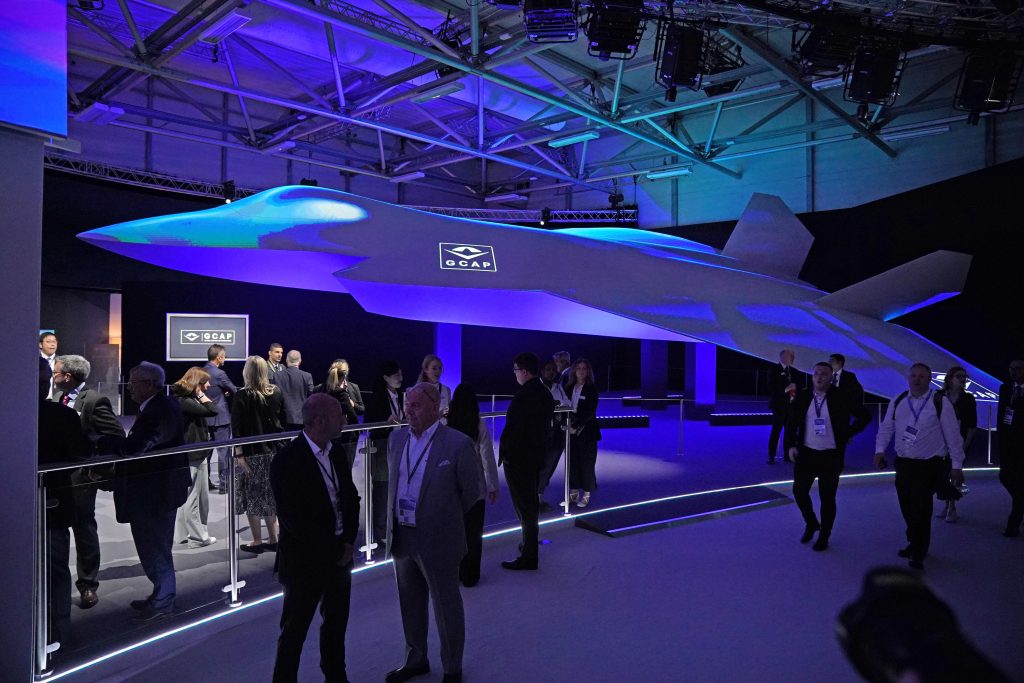
Some of the motivations for joining GCAP are shared by all three countries. The U.K. and Italy currently operate the Eurofighter Typhoon and Japan the F-2. These will need to be replaced in the coming decades. The new aircraft is expected to be significantly larger than the Eurofighter and the F-2, with two advanced engines and a large delta wing. It will have a long range and large internal payload capacity. As a fighter, it must be capable of establishing air superiority, but it’s also expected it will have ground attack capabilities. However, like the F-35 before it, it’s possible that the new aircraft will not prioritize maneuverability.
If they didn’t develop a new aircraft domestically, they would all likely have to buy a next-generation jet from the U.S. While all three were happy to purchase the F-35, there are political, economic and strategic reasons to also buy domestic. Countries which can afford to generally want to maintain their own aerospace industries, and this means government support in most cases.
Furthermore, the cost of new systems is getting more and more expensive as technology improves. It is very likely that the U.K. and Italy at least wouldn’t be prepared to absorb this cost alone, necessitating international cooperation. The U.K. identified this need in its Combat Air Strategy in 2018.
When the U.K. and Italy signed the statement of intent in 2019, it was pointed out Italian company Leonardo was already a part of the Tempest program, separate from its national government. The U.K. was also likely suffering from a lack of other dance partners, since Germany, France and Spain were (and are) collaborating on a separate sixth-generation fighter effort.
The addition of Japan from a British perspective took a little longer. Peter Watkins, the former Director General Strategy & International in the U.K.’s ministry of Defense, told me that it goes back to 2014. “Shinzo Abe came to London and met Prime Minister David Cameron. And basically, he wanted, Japan wanted, a closer defense relationship with the U.K.” Japan was looking to diversify away from being solely reliant on the U.S. as a defense partner. Smaller projects were established first, like a new air-to-air missile, before the GCAP announcement.
James Bosbotinis is a British defense analyst. He suggested that aerospace industrial opportunities would also have been a driving force, focusing on “the fact that you could collaborate with Japan [which] would obviously have the money and resources to put into a next-generation program.” Furthermore, he expects that Japan will make a “sizable order” to replace its F-2 fleet. That’s an additional attraction for existing partners looking to generate jobs in their domestic industries.
For Italy, joining the Franco-German-Spanish project instead of the British one could have been an option. However, Fabrizio Coticchia, an expert in Italian defense policy and a professor at the University of Genoa, told me that “Leonardo [the Italian defense firm] has a huge relationship with the U.K.” It wasn’t really a choice at all, especially given that Leonardo was already a part of the U.K’s own effort.
But Coticchia also suggested a political motivation that might elude non-Italian observers: “Italy always aimed in recent decades to use the alliance with the U.K. to try to disentangle the strict relationship between France and Germany within the European Union.” He said that Italy viewed Brexit as “a huge setback for Italian foreign policy because Italy lost a possible leverage, possible ally to contrast the French-German connection.” Thus, pursuing joint programs with the U.K. takes on an additional dimension.
And as for Italy welcoming in Japan, not only did Coticchia point out “the huge technological advancement of Japan as a country in military terms, despite all the political constraints that we know about,” but he said that GCAP is “a way to develop Italian foreign defense policy through the channel of multinational alliances.” Domino Theory reported on increased Italian engagement with Japan last month.
While Italy and the U.K. may be more focused on the prospect of high-intensity war in Europe in the aftermath of the war in Ukraine, Japan has taken its security more seriously for much longer. This may surprise readers who are aware of Japan’s “pacifist constitution” reputation, but by sheer numbers the Japanese armed forces outweigh most European counterparts, including the U.K. and Italy.
One consequence of this is that when looking to replace the aging F-2 fighter, Japan prioritized entry of service date above all else. GCAP was always intended to be ready for 2035, and this fit Japan’s timeframe. Other programs are either scheduled for later maturity or have unclear timelines.
Beyond this, there was another consideration driving Japanese decision-making. According to Sadamasa Oue, a retired Lieutenant General of the Japan Air Self-Defense Force: “We have no freedom to modify the F-35, no room to install Japanese domestically developed missiles to the F-35. We do not want to have such a restriction on the F-X. So we originally tried to develop F-X independently by ourselves.” For Japan, having sovereign control over GCAP and being able to adapt the aircraft in the future and integrate new systems is clearly very important. Being an equal member of a Japanese-Italian-British program is better than being the junior partner in a U.S. program in this regard.
Japan also considered the operational role of GCAP and the similarities between the U.K. and Japan. To maintain its stealth, the F-35 can carry its missiles internally, which limits its payload. Oue says that “GCAP needs to have quite [a large] amount of payload and also range, because Japan is a small island, but 3,000 kilometers from north to south.” Arguably, GCAP will perform similar missions whether over the East China Sea or the North Sea.
Because GCAP is still in its relative infancy, British Director General Peter Watkins said he doubts they have made any manufacturing decisions yet. However, he suspects that it will follow what he calls the “Eurofighter model,” where individual complex components will be made in one country, avoiding separate production facilities, but final assembly will be done by all three countries domestically. He said this presents an opportunity, where “if the Japanese wanted, if they wanted to make a little tweak to add something that the others didn’t have, then they could do it.”
Of course, this is in the future. A GCAP demonstrator will not even fly until 2027. Before all of this there are questions to be answered. The U.S. Air Force is reportedly rethinking the acquisition of its own sixth-generation fighter. When the Labour government was formed after the U.K. general election, it launched a Strategic Defence Review that must at least consider whether continuing with GCAP is the right choice.
Analyst James Bosbotinis said a U.K. withdrawal is unlikely: “[T]he reputational costs alone would be immense. The impact on U.K. air power, U.K. defense, the aerospace industry would be substantial.” Lieutenant General Oue said Japan is not concerned. “The U.K. and Italy have a very good experience for this international joint development. Japan is the only country which has never been involved with this international development.”
There may be other tensions, too. Japan chose GCAP in part because of the 2035 readiness date. But it wouldn’t be the first time if a “European” military development program was delayed. How will the participants react if differing priorities lead to disagreements on whether to stick to the 2035 date? Bosbotinis thinks this could be a hidden positive. He said that “having a very tight schedule being pushed by one of the partners, and arguably the partner with the greatest financial resources available” may well help to keep discipline in this regard.
Bosbotinis also thinks that “if GCAP can be delivered in 2035, it will be realistically the only sixth-generation aircraft in town.” This means that potentially the GCAP countries would be able to tap into the lucrative export market from other states wanting to upgrade their own air forces.
For now, GCAP needs to clear the development hurdles in front of it and get wings in the air. It would be quite something though, if a renaissance in British and Japanese air power were to start in Italy.



Leave a Reply