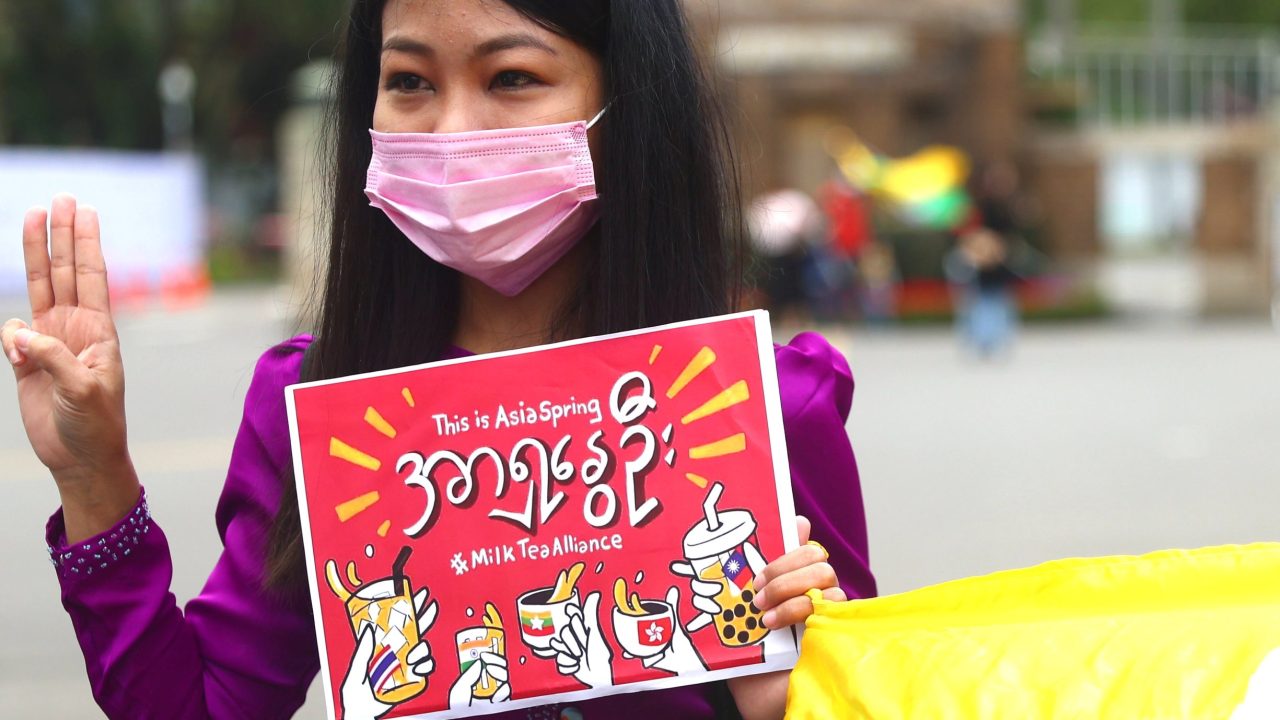
Five years ago, netizens in Taiwan, Hong Kong, Thailand and later, Myanmar, converged over internet drama and a love of milk tea. The result was an unprecedented pan-Asian pro-democracy movement that rebelled against Chinese repression and fostered solidarity among the region’s various pro-democracy movements.
The drama unfolded like this: In April 2020, Thai-Chinese actor Vachirawit Chivaaree seemingly referred to Hong Kong as a country, prompting Chinese nationalist backlash in the comments. Netizens in Thailand, Hong Kong and Taiwan came to the actor’s defense, responding with memes, satire and sarcasm. At some point, internet users recognized that a commonality between these places was a love of milk tea. Within the first year, #MilkTeaAlliance had been tweeted 11 million times. Offline, activists were photographed holding up Milk Tea Alliance signs at local pro-democracy protests in Myanmar, Thailand and elsewhere.
Quinton Temby, assistant professor in Public Policy and Management at Monash University in Indonesia, published an article in 2021 about how the Milk Tea Alliance revealed China’s critical soft power gap: China’s military and economic power might influence policy at the state level, but it wasn’t winning hearts and minds in Southeast Asia. In a highly diverse region, the motif of milk tea symbolized something the Milk Tea Alliance countries had in common: burgeoning anti-authoritarian and anti-China sentiment. “I think it would probably be a mistake to dismiss it as just a meme … It was solving a particular [collective action] problem in an interesting way,” Temby told Domino Theory.
While the Milk Tea Alliance may not be raking in the views and likes on social media anymore, the movement is still active, albeit quite amorphous. Domino Theory spoke to several activists associated with the movement to get a sense of how the geopolitical and online contexts have shifted since 2020. In sum, four trends have made it difficult for the Milk Tea Alliance to sustain momentum and go viral again: a shift in global attention to conflicts in other regions; China’s growing soft power influence; the tightening control of freedom of speech in participant countries; and an exodus from Twitter/X to various other platforms. Even so, the Milk Tea Alliance created a network of activists across Asia and the diaspora that hadn’t existed before — and this is the movement’s quiet legacy.
Shift in Global Attention
Chiayo Kuo (郭家佑), founder and president of the Taiwan Digital Diplomacy Association — an organization that created memes for the Milk Tea Alliance and worked to amplify the movement from Taiwan — told Domino Theory that the Covid-19 pandemic helped fuel the movement because everyone was online. But after the pandemic, there was less of an appetite for online social media campaigns because people were focused on rebuilding community in person, said Kuo, adding that funding has been harder to come by since then. While the Taiwan Digital Diplomacy Association used to have 14 full-time staffers, they now only have four.
Milk Tea Alliance Myanmar (Myanmar_MTA), an Instagram account that is run by a group of Hong Kongers, wrote to Domino Theory that since the military coup in 2021, it’s become harder to draw international attention to the crisis in Myanmar because other humanitarian crises are capturing the spotlight, particularly the wars in Gaza and Ukraine. The group thinks that since the impact of Myanmar’s faltering economy isn’t being felt globally, people aren’t paying attention.
China’s Growing Soft Power
Another major geopolitical shift affecting the appeal of the Milk Tea Alliance is that China is not as vulnerable to populist anti-China sentiment in Southeast Asia as the frenzy around the movement in 2020 may have led us to believe. China’s products, like BYD electric vehicles, are doing well in the region, which Temby thinks is having a cultural impact, helping China to bridge its soft power gap. China has also effectively dodged criticism for controversies like its role in the Covid-19 pandemic.
Capitalizing on the fear of U.S.’s retreat from the region under President Donald Trump, Chinese leader Xi Jinping (習近平) embarked on a tour of Southeast Asia last month “to make the appeal to Southeast Asian countries that America is not a reliable partner, and … to come into the Chinese free trade mold,” said Temby.
The fear of the U.S.’s retreat is fueled in part by Trump pulling $60 billion in U.S. foreign aid funding, which has had a significant impact on NGOs in Asia. However, Xun-ling Au, team lead of the Milk Tea Alliance Calendar Project, says that the decentralized structure of the Milk Tea Alliance also makes it resilient to these shifts in U.S. funding. “It turns out that actually very, very few bits of any of the named bits of the alliance actually ever had any funding at all from anyone,” said Au.
Freedoms Are Getting Squeezed
Across the region, a contraction of freedoms has led to overt crackdowns and in turn, self-censorship. “Over the last two years, the amount of people that have been jailed for … sharing a post or commenting on a post in both Thailand and Hong Kong has been massive,” said Au, adding that since the height of the Milk Tea Alliance in 2020 and 2021, he has observed many accounts associated with the movement go dark. Governments in the region also seem to have become more adept at suppressing pro-democracy activism online, said Au. For example, while multinational social media companies typically won’t agree to fully take down an account, Au thinks these platforms have become more amenable to geo-locking — i.e., hiding an account in a particular region — at the request of governments.
In Myanmar, Au said activists on the ground often have to deal with regular internet shutdowns. The organizers of the Myanmar_MTA account told Domino Theory that since none of them live in Myanmar anymore, it’s become much harder to get timely updates and fact check information coming out of the country. It takes them weeks to draft posts. As a result, they have trouble reaching many people because the algorithms prioritize frequent posters.
In some cases, escalating repression has increased solidarity among Milk Tea Alliance countries. In particular, activists from Hong Kong and Thailand are coalescing around Myanmar. MeMee Nitchakarn, a Thai feminist activist and leader of the Milk Tea Alliance Thailand instagram account (milkteatha), uses the platform to amplify the voices of local Burmese activists, advocate for Burmese refugees in Thailand and counter Myanmar-related disinformation in Thailand. Nitchakarn said she uses the Milk Tea Alliance name, as opposed to a more specific label, because it has become a symbol for transnational solidarity. Au gave another perspective on this, pointing out that the crackdown on political activism in Thailand has created a situation in which it might be safer for activist groups like Milk Tea Alliance Thailand to post about Myanmar than to criticize their own government.
On the other hand, Ming-sho Ho (何明修), a professor at National Taiwan University who specializes in political sociology and social movements, thinks that increasing Chinese repression in Hong Kong has eroded support for Hong Kong’s pro-democracy movement in Taiwan. While there was a massive outpouring of sympathy for Hong Kong among Taiwanese in 2019 and 2020, as Hong Kong’s freedoms have been undermined by the national security laws, this has given way to “a more guarded suspicion of Hong Kong,” said Ho.
Platform Dispersion
A final shift has taken place online. Since the Milk Tea Alliance took off on Twitter in 2020, social media platforms seem to have become more antagonistic to social activism. Part of this has to do with state repression but the problem is also technical. For example, new features coded into X’s algorithm, like link suppression, make it more difficult to do political activism, according to Au. Link suppression is essentially the downranking of posts that have links to external sites in them. Au also noted that activists tend not to trust Meta. Last year, the advocacy group Accountable Tech produced a report arguing that Meta’s decision not to recommend content about politics on Instagram or Threads could reduce the reach of activist accounts on those platforms.
Au explained that there have been multiple waves of exodus away from Twitter/X in recent years (one of these waves being when Musk bought Twitter and changed its name to X). This has caused the movement to fragment as regional groups settle into their preferred platforms — Taiwan and Hong Kong like to use Threads, Myanmar likes to use Facebook and the rest of Southeast Asia is generally divided between Facebook, X and Instagram. Milk Tea Alliance accounts now have to operate across multiple platforms to reach different regional audiences, which is difficult to do with limited resources. Additionally, when activists switch platforms, “finding [them] again isn’t always easy, especially for individuals that don’t use their names,” said Au.
Despite these difficulties, and the fact that the viral buzz around the Milk Tea Alliance died down long ago, Au says that the connections that were formed between individuals and activist groups during that intense moment of virality in 2020 remain, even if it’s largely out of the public eye. “There will be other triggers in the future where all of these groups kind of come back together … It probably won’t be tagged ‘Milk Tea Alliance,’ someone will come up with something more relevant to the time and whatever’s going on. But I think you’ll see another wave of this cross-context solidarity occurring,” said Au.
A reignition of the alliance in the future would certainly prove the endurance of the network that was created in 2020. Let’s just hope the trigger is not an invasion of Taiwan.





Leave a Reply