Jimmy Lai Case July Conclusion
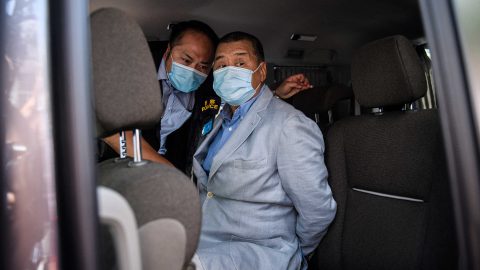
Apple Daily founder Jimmy Lai’s (黎智英) national security trial will conclude with closing arguments from both sides at the end of July. Three judges set a tentative date of July 28, with eight days then scheduled for the hearings.
Faced with a life sentence on two different charges under the same national security law, 77-year-old Lai has denied trying to influence foreign policy in Hong Kong and defended the idea of “delivering freedom” through pro-democracy newspaper Apple Daily.
Hong Kong Government Warns Against External Intervention
Last week, a Hong Kong government spokesperson warned “external parties” not to intervene in the Jimmy Lai trial, days after U.S. Secretary of State Marco Rubio said getting Lai out of prison was a “priority.”
“Advocating for some people or organisations of a certain background to be free from the consequences of their illegal acts is equivalent to bestowing them the privilege to offend the law, which completely contravenes the spirit of the rule of law,” the spokesman said.
Marco Rubio had told conservative podcast host Hugh Hewitt: “We’ve raised [Lai’s case] in every possible form and [the Chinese government] know that it’s important to us, and I think there are other countries as well that are very involved in raising this issue. And that needs to happen, and we’re going to continue to raise it.“
U.K. Prime Minister Kier Starmer has also said securing Lai’s release is a “priority.”
China Daily Says Lai Case ‘Not About Press Freedom’
Chinese state media outlet China Daily said in an article last week that the Lai case is “not about press freedom” and is instead “about the rule of law and the consequences of endangering national security.”
The editorial added that “The West’s efforts to paint Lai as a victim serve only to expose its own hypocrisy. After all, these same governments have stringent national security laws of their own and have shown no hesitation in enforcing them when their interests are at stake.”
Article 23 Used to ‘Normalize’ Repression
The Safeguarding National Security Ordinance, known as Article 23, has been used to “normalize” repression in Hong Kong, according to Amnesty International.
In a statement released a year after Article 23 was introduced, Amnesty said the new national security law, which supplemented 2020’s National Security Law, has “squeezed people’s freedoms and enabled authorities to intensify their crackdown on peaceful activism in the city and beyond.”
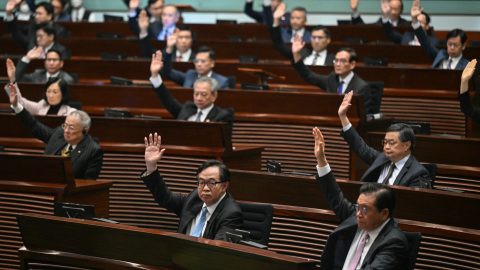
Article 23 allows the Hong Kong government’s Committee for Safeguarding National Security to define national security, national secrets and espionage, rather than the courts. It includes sentences of up to life imprisonment for treason, insurrection, sabotage and mutiny,
Amnesty’s analysis found 16 people have been arrested for sedition under Article 23, with five officially charged under the law, and 11 released without charge. None had engaged in violence.
Hong Kong Journalists Association Hotel Cancelations
The Hong Kong Journalists Association had two hotel reservations cancelled for its annual dinner, forcing its fundraising auction online. The Regal Hongkong Hotel cancelled one reservation on February 13, two days before the event was scheduled, citing “water leakage causing unstable power supply.” But a Hong Kong Journalists Association reporter found a Valentine’s Day matchmaking event at the venue the next day. A second booking, for February 24, was then cancelled by Eaton HK, with no reason given.
Calls for Hong Kong Activist Protection
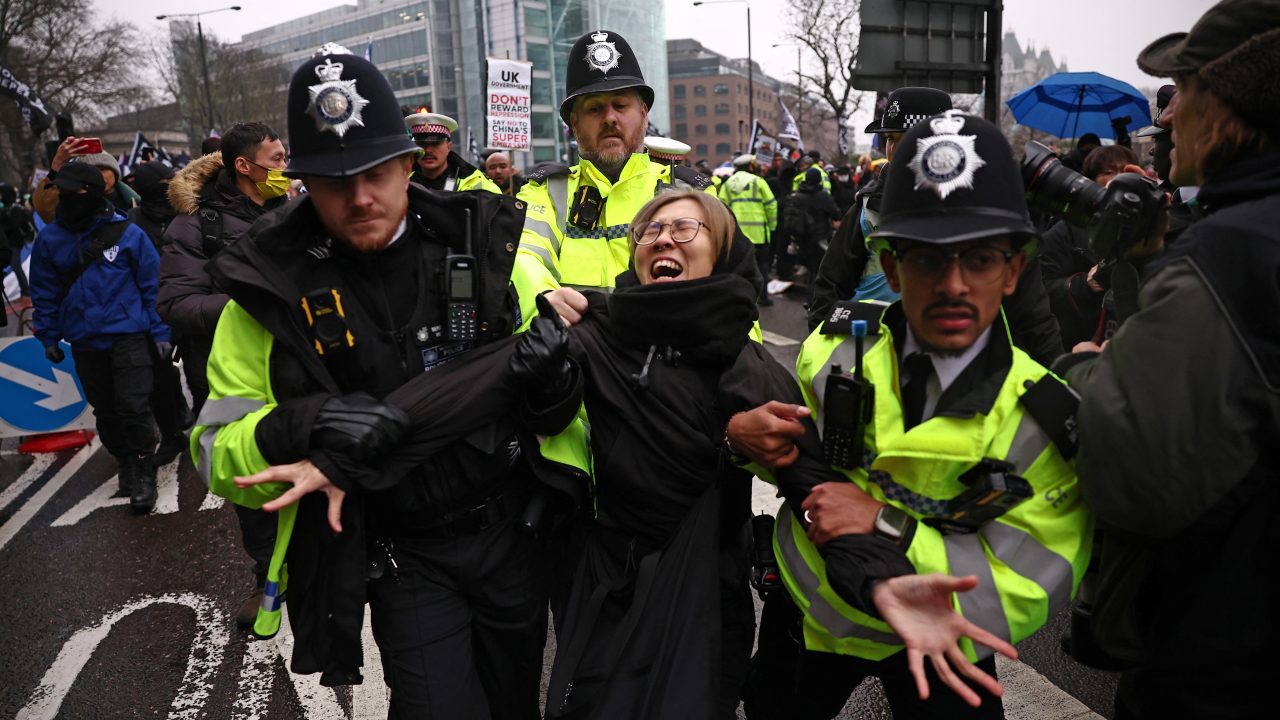
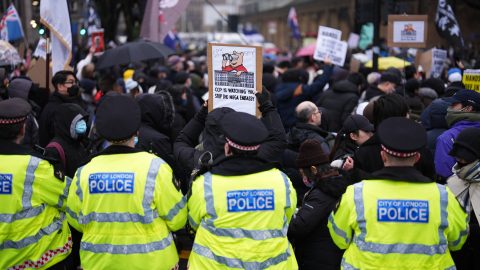
Amnesty International has co-signed a letter with a number of Hong Kong activists and other rights groups calling on Prime Minister Starmer to “develop a national strategy that provides effective and systematic protection for Hong Kong activists in the U.K.”
Nineteen year-old Chloe Cheung (張晞晴) became one of six activists to be newly listed as wanted in December, which brought the total of exiled Hong Kongers with arrest warrants and bounties against them to 19. They say they have faced harassment in person and online since then.
Carmen Lau (劉珈汶), an activist working with the U.S.-based NGO Hong Kong Democracy Council, told a recent Committee for Freedom in Hong Kong Foundation webinar she felt “very disappointed” in the U.K. government and police response to the targeting of Hong Kong activists.
“The counter-terrorism police shared with us a so-called ‘blue book’ — guidance for a targeted person under the counter-terrorism team,” Lau said. “But] it’s nothing related to transnational repression and whenever things happen the police suggest … just call the 999 [U.K. emergency number].”




Leave a Reply