
A roundup of human rights issues in Hong Kong. Includes updates on the U.K. prime minister saying the release of Jimmy Lai is a priority and intimidation of Hong Kong activists in Japan.
British Prime Minister Says Jimmy Lai’s Freedom a ‘Priority’
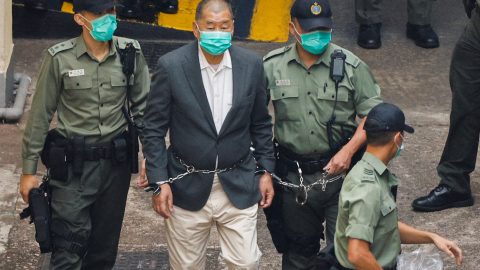
British Prime Minister Sir Keir Starmer has said securing the release of Jimmy Lai (黎智英) from prison in Hong Kong is a “priority” for his government. Starmer was responding to a question from Conservative opposition leader Rishi Sunak in parliament. Sunak asked if Lai’s imprisonment ran counter to the 1984 Sino-British Joint Declaration on the Question of Hong Kong, which transferred power over Hong Kong to China.
Lai is the founder of pro-democracy newspaper Apple Daily. He has been in prison since December 2020 and faces a trial for conspiracy to collude with foreign forces and conspiracy to publish seditious publications. His lawyers say he has been mistreated in custody.
Jimmy Lai Prisoner of Conscience
At the beginning of this month, Amnesty International declared Lai a prisoner of conscience. Lai received the designation alongside two human rights lawyers, Chow Hang-tung (鄒幸彤) and Ding Jiaxi (丁家喜), who are being detained in China.
“The ongoing detentions of Chow, Ding and Lai demonstrate the continuing failure of the authorities in China to uphold their international obligations, and their prosecution lays bare the cowardice of state officials who cannot accept criticism, whether from international experts or from their own citizens,” Sarah Brooks, Amnesty International’s China director, said.
23,000 Denied Entry for ‘Suspicious Aims’
Around 23,000 people were denied entry to Hong Kong between January and September this year — about 0.07 percent of total arrivals. Hong Kong’s Director of Immigration Benson Kwok (郭俊峯) told a local radio show that a watch list of individuals who were a threat to national security has been compiled and around 85 percent of those rejected were believed to have “suspicious aims.”
“Hong Kong welcomes genuine visitors. But we have the duty to guard the southern gate of our country. We will strictly inspect [the visits] of unwelcomed individuals and bar them from entering when needed,” Kwok said.
British Foreign Secretary Urged to Bring Up Hong Kong
British Foreign Secretary David Lammy was urged to bring up the situation of political prisoners in Hong Kong on his visit to China this week. A letter from a group of British parliamentarians, seen by The Guardian, said “Beijing is testing the UK’s resolve [and] seeking to establish new parameters for engagement.”
Separately, almost two dozen civil society and human rights organizations from the U.K. issued a statement calling on Lammy to “raise concerns about the Safeguarding National Security Ordinance [known informally as Article 23 legislation] in Hong Kong.” The statement says the ordinance’s extraterritoriality clauses allow it to be used as a threat against Hong Kongers in the U.K. under the British National (Overseas) visa scheme, “an act which can credibly be described as transnational repression.”
Passed in March this year, the Safeguarding National Security Ordinance added to 2020’s National Security Law and allows the Hong Kong government’s Committee for Safeguarding National Security to define national security, national secrets and espionage, rather than the courts.
Intimidation in Japan
People from Hong Kong and mainland China who act in ways the Chinese government deems “unfavorable” while in Japan are being targeted by Chinese authorities, according to Human Rights Watch. The rights group interviewed 25 people and said the majority have had Chinese police contact them directly or their relatives back home, pressuring them to end certain activities in Japan, including holding events to raise awareness about crimes against humanity in Xinjiang.
Permission Required for Cloud and Messaging Services
Civil servants in Hong Kong will be required to secure authorization from their heads of departments if they wish to use cloud storage and messaging services on office computers, starting this month. Restricted services include WhatsApp Web, Gmail, Google Drive and WeChat. The restriction comes under the Government Information Technology Security Policy and Guidelines, which were updated in April. Security concerns have been given as the explanation for the change.
YouTube Deletes U.K. Hong Kongers Channel
The U.K.-based group Hong Kongers in Leeds says it had its YouTube Channel deleted on September 30, hours before the Chinese National Day. The group said it made video content “grounded in the real experiences and voices of silenced [Hong Kongers]” and that it was “outraged and deeply concerned by this act of censorship.”
YouTube allegedly told the group that its channel had violated its spam, deceptive practices, and scams policies, which it denies. “We question the timing of @YouTube’s decision to censor our platform. We also question whether it is intended to stifle our ability to address key issues on a politically significant date,” Hong Kongers in Leeds wrote on X.
Hong Kong Democracy Council, a U.S.-based Hong Kongers group, said its channel was “also deleted for months earlier this year.” It added that “Many others’ pro-democracy contents which [is] deemed ‘politically sensitive’ had been ‘yellow labeled,’” meaning content can run limited or no ads from all advertisers.


Leave a Reply