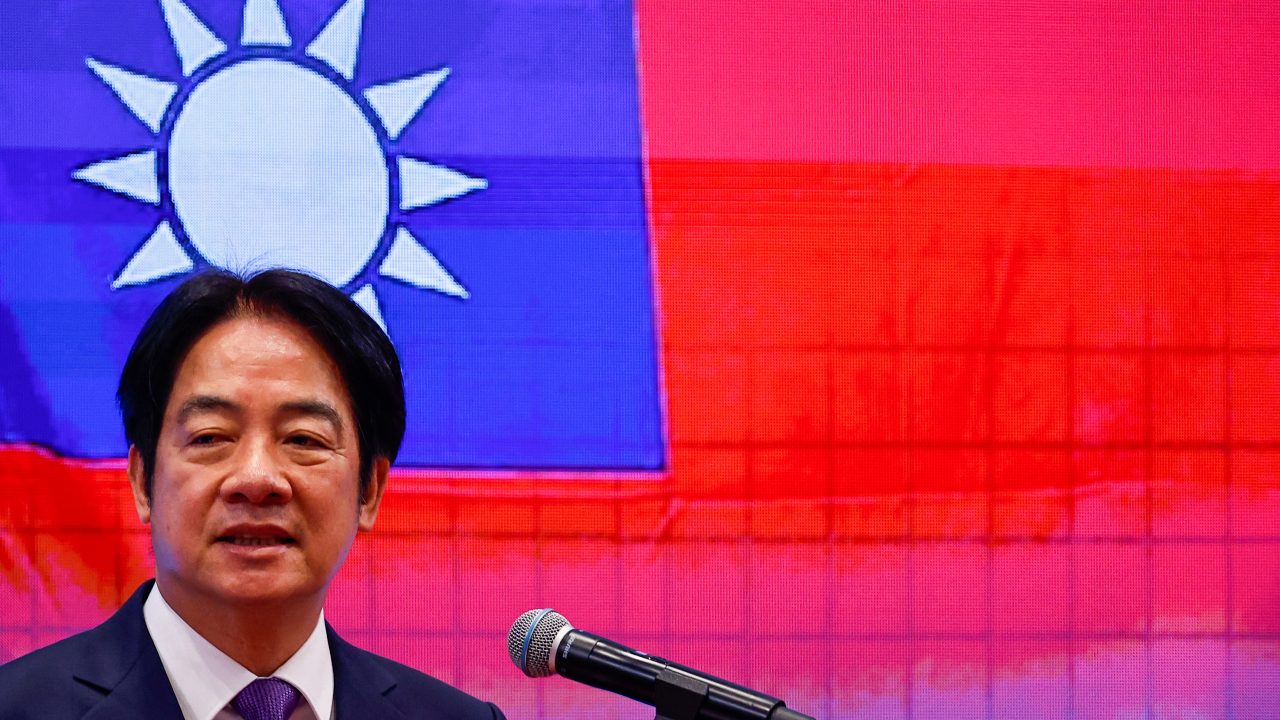
Who is Taiwanese president Lai Ching-te (賴清德)?
What phrase do journalists reach for to describe him?
If you regularly read coverage of Taiwan in the news, you already know. It is Lai, the “self-described pragmatic independence worker.” I invite you to Google this phrase if you doubt me.
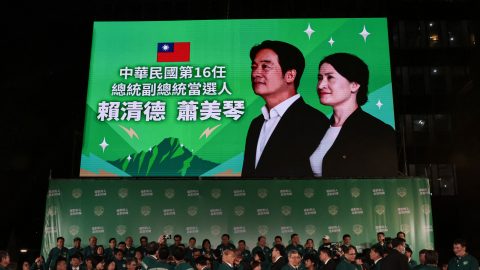
The perception that Lai is stronger on Taiwanese independence than his predecessor has haunted him ever since he became a candidate for president. It has stuck with him since he won the election. Somehow, Beijing seems to hate him even more than they hated his predecessor Tsai Ing-wen (蔡英文), which is saying something.
But there is also a perception in Washington that Lai is less reliable than Tsai, that he is less risk averse. More than almost anything, trust between the Taiwanese and American administrations is key to Taiwanese security. This perception is damaging to that.
University of Colorado Denver professor of communication Stephen Hartnett pointed out that Lai wants to distinguish himself from Tsai, but that he can’t do so in a way that rocks the boat. Lai’s problem is that Tsai was “very good in her communication, very stable, very prudent.” Hartnett says Lai’s set of possibilities is very narrow and that this is a “unique position in the modern world.”
In his view, Lai is both a prisoner of circumstance and of his own choices. He can’t help but be compared to Tsai and he doesn’t want to be seen as the same. But if Tsai was stable, Lai can’t portray himself as unstable, right?
Obviously not. But there are plenty of world leaders who have made a career out of making dramatic, bold moves that surprise their opponents and allow them to seize political ground. That doesn’t feel like a good look for Lai diplomatically, and doesn’t match the reserved personality he projects in public either.
People within Lai’s sphere push back on this stereotype about him. Kolas Yotaka was spokesperson for both Lai and Tsai during Tsai’s second term. She really doesn’t see a difference between them in terms of substance and wonders why the press is so eager to show a contrast. The difference she sees between Lai and all presidents since 1996 is that Lai is more direct and she thinks he is more obvious with the public.
After an email exchange with Domino Theory last year, Yotaka addressed international media in Taipei at a Taiwan Foreign Correspondents Club event on January 2. She repeated her message, asking reporters to “take out the stereotype” that he is an independence worker or activist. But the question is, if not as a pragmatic independence worker, then how does the Democratic Progressive Party (D.P.P.) want the international audience to view Lai?
In our correspondence with Yotaka and another D.P.P. figure, Michael Hsiao (蕭新煌), who is currently a senior advisor for the New Southbound Policy to President Lai, I noticed some themes about how they described him. Yotaka said that he is “a decisive person but is also moderate and careful.” She also emphasized that he “fully empowers and respects his staff.”
Hsiao said that Lai has “a strong mind and a sense of mission and determination. That does not prevent him from engaging in effective communication and mutual persuasion. But once he has made up his mind, it is rather hard to change him. His determination is quite well known.”
It seems then, that at least for his people the projection of Lai is that he is careful and considerate when making decisions but strong and fixated on carrying them out once they are made.
After his remarks on Lai’s character, Hsiao deployed a new stereotype: Lai the doctor.
He said that Lai is “a life-saving physician, he has to make urgent decisions quickly and with his own judgment.” This metaphor for Lai’s communication or leadership style was used twice during Hsiao’s answers to our questions.
It’s worth noting here that Lai didn’t actually practice medicine for more than a couple of years. He did however complete a masters in public health at Harvard after he got his doctorate.
I find it curious that Lai being a doctor isn’t something that has been made more of in English-language media. It’s obviously very well known in Taiwan, where being a doctor is an especially valued profession, but I would be curious to know how many Domino Theory readers were aware.
It might not be the last time you hear it, though. Lai will be hoping to follow Tsai’s example and govern for eight years. He’s going to need some kind of image to break through for him.

Leave a Reply