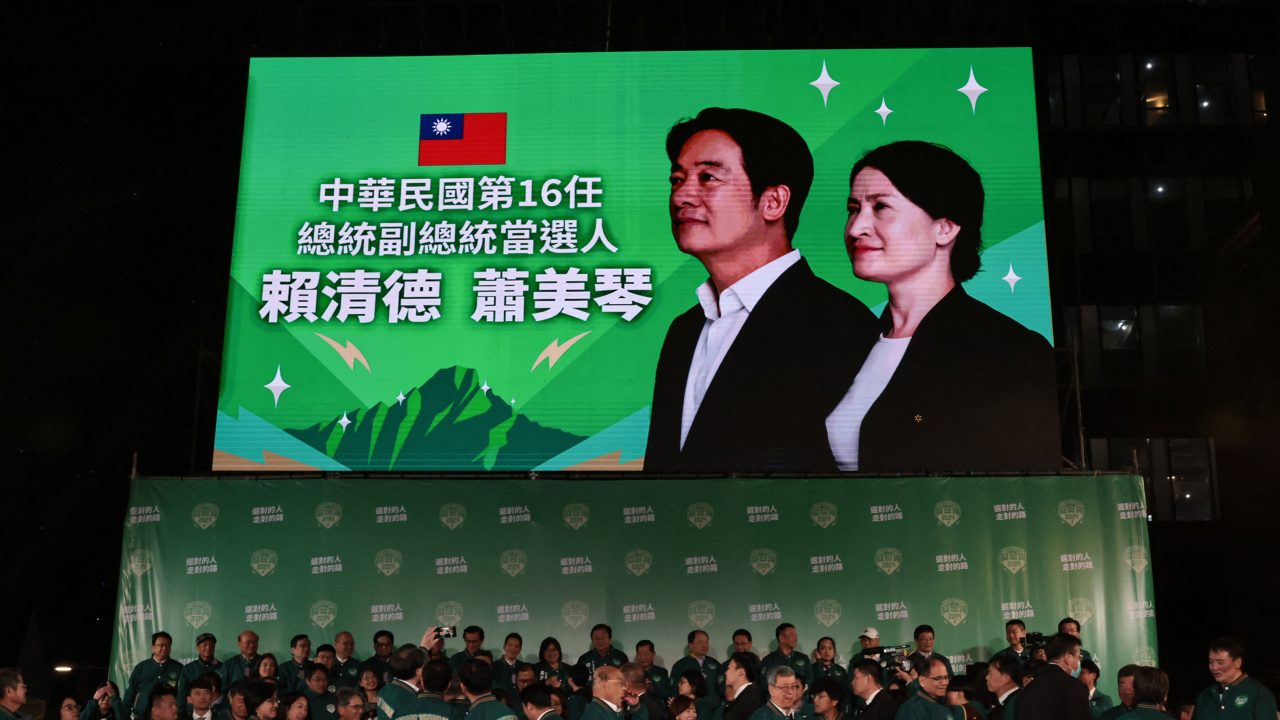
Taiwan’s January election results indicate an appetite for change. The Democratic Progressive Party (DPP) lost its majority in the legislature and narrowly retained the presidency after the two major opposition parties, the Chinese Nationalist Party (KMT) and the recently established Taiwan People’s Party (TPP), failed to form a joint presidential ticket.
The rise of the TPP has prompted suggestions that Taiwan has become a three-party system, as voters look outside of the status quo for answers. “Many TTP voters are annoyed with the DDP’s focus on foreign policy at the cost of domestic issues,” Zenobia Chan, politics research fellow at University of Oxford, says, having interviewed 300 voters at rallies in the run-up to the election.
As Lai Ching-te (賴清德) enters the presidency he looks set to extend the policies of DPP incumbent Tsai Ing-wen (蔡英文), but he faces mounting pressure to address concerns around high property prices, low salaries and energy policy, while balancing cross-strait tensions.
Cost of Living
In 2023 average real monthly salaries decreased for the third year in a row, as the salary increases secured under Tsai Ing-wen were reversed in real terms by inflation.
Meanwhile properties in Taipei are some of the least affordable around the globe when compared to income, ranking higher than London, Singapore, New York and San Francisco.

Both issues were key talking points before the election, while real estate firms provided more donations than any other sector to the DPP’s campaign, accounting for 25% of their total, as well as 22% of the KMT’s. In his campaign Lai pledged to boost public housing construction, raise property taxes for multiple homeowners and increase the minimum wage.
A higher minimum wage would be welcomed, but while opposition KMT candidate Hou Yu-ih (侯友宜) campaigned on a 20% increase, Lai declined to provide a figure. The recent increase earlier this month of 4% barely exceeds inflation.
More importantly, an increase would not impact many voters. As Mei Hsu (徐美), professor of macroeconomics at National Taiwan Normal University explains, “The hike in the minimum wage is mostly relevant to Taiwan’s 750,000 foreign workers, while white-collar Taiwanese will continue to suffer from inflation and lower wages compared to nearby Hong Kong, Singapore, Japan and Korea.” If inflation eases, however, the gains in salaries made under Tsai will begin to be felt.
On housing, the Ministry of the Interior reports that Tsai’s 2017 target of 200,000 new social housing units will be reached in 2024. The DPP is now targeting an additional 1 million units by 2032. Lai insists that Taiwan is on course to meet the demand of the 800,000 households in need of rental accommodation, but the plan takes for granted his reelection in 2028.
“I anticipate that the DPP and TPP will find common ground in addressing high housing prices,” says Darson Chiu (邱達生), a research fellow at the Taiwan Institute of Economic Research. “Ultimately, though, these issues are deeply ingrained structural problems which voters shouldn’t anticipate any elected person to dramatically alter.”
The Five Shortcomings
In the run-up to the election, all three major party candidates stressed that they would address what are known as the “five shortcomings,” referring to a shortage of sufficient land, water, electricity, talent and labor.
Taiwan imports 97% of its energy and almost 70% of its food. There was public outcry at the beginning of the year at a shortage of eggs, while spring droughts left farmers unable to water crops as semiconductor manufacture was prioritized. Reflecting the sense of a year of scarcity, “shortcoming” (缺) was recently voted character of 2023 in a poll by United Daily News.
To address energy the DPP has pledged to invest 900 billion New Taiwan dollars ($28.8 billion) in renewables by 2030 and achieve net-zero by 2050. It also plans to phase out nuclear power, however. Lai’s opponents contend that the DPP’s notion of a “nuclear-free homeland” runs counter to its net-zero commitment, with the TPP’s Ko Wen-je calling instead for focus on the “steady development” of renewables.
This month the DPP eased residency restrictions for high-level professionals and streamlined the process of securing the right to work. As the shortage of labor is forecasted to worsen this year, progress is being made toward an agreement which would allow Indian workers into Taiwan.
“So many of Taiwan’s issues with labor shortages are structural in nature,” says Zoe Weaver-Lee of the East-West Center, “Immigrant workers face complicated visa and tax systems and archaic banking practices with limited resources in other languages.” Once over these hurdles migrants have no clear pathway to citizenship. “There are so many stories of foreigners working in Taiwan, starting families, speaking the language, paying taxes, only to stagnate in the ‘permanent alien’ status.”
To the disappointment of migrant worker groups, Lai has not addressed the brokerage system, where migrants must go through brokers who often charge exorbitant fees to find work. Ko proposed replacing this system with government-to-government direct-hiring, aiming to safeguard migrant freedom as well as lower their cost of entry.
The International Economy
Taiwan’s reliance on overseas markets means Lai must work hard to further its international position. The Ministry of Foreign Affairs has expressed hope for membership of the Comprehensive and Progressive Agreement for Trans-Pacific Partnership, a bloc accounting for 13.5% of global GDP, as this year Taiwan-friendly Canada becomes chair.
Vice president-elect Hsiao Bi-Khim’s (蕭美琴) close ties with the U.S. bode well for the U.S.-Taiwan Initiative on 21st-century Trade, set to finalize this year. “The deal has already shown promise,” says Weaver-Lee, “under Lai we can expect further progress.”
China remains aggressively opposed to the DPP’s international outreach. Earlier this month it imposed tariffs on 12 Taiwanese petrochemical products, further eroding Taiwan and China’s quasi-free trade agreement, the Economic Cooperation Framework Agreement (ECFA).
“The gradual phasing out of the ECFA’s preferential tariffs by China is concerning,” says Chiu. Trade groups have called for active engagement with China in response. Investment into the country fell 33.9% year on year in 2023, however, indicating the unease of Taiwan’s industry.

China aside, the outlook for 2024 looks broadly positive. Academia Sinica, a Taipei research institute, predicts 3.02% growth this year, up from 1.34% in 2023, as demand for consumer electronics and tourism further recovers from the pandemic. TSMC stock is surging, leaping 6% in one day this month, as tech stocks globally are fueled by optimism for artificial intelligence.
This may cheer Lai’s first year in office, as he continues Tsai’s push for a diversified, international Taiwan. He will hope as much. If Taiwan’s quality of life doesn’t improve, however, he will face a harder race in 2028.





Leave a Reply