Taiwan wants to spend $8 billion dollars on new weapons from the U.S. But will the president be able to loosen the purse strings held by parliament?
Yesterday Domino Theory published an article about the contradiction between Taiwan’s president Lai Ching-te (賴清德) saying he will increase defense spending to over 3% while at the same time the Legislative Yuan with its opposition-led majority has effectively cut this year’s budget. Today, we consider what Lai might think is the solution.
Reuters reported this morning that Taiwan is considering a multi-billion dollar arms purchase, citing anonymous sources familiar with the situation.
One of the sources said that they “would be very surprised if it was less than $8 billion. Somewhere between $7 billion to $10 billion,” and that it would include coastal defense cruise missiles and HIMARS rockets, which suggest Taiwan wants to focus on munitions for systems it already has.
This arms purchase would likely get Taiwan above 3%, if you assign it to this year’s spending. When the money for such a deal would actually be spent is perhaps a different question, but if the point is to show that Taiwan is spending more, this kind of “accounting” works well enough.
The defense budget for 2025 was proposed to be 647 billion New Taiwan dollars, or $19.8 billion in today’s exchange rate. That is equivalent to 2.45% of Taiwan’s projected GDP for 2025. But the Legislative Yuan cut or froze NTD 98 billion ($3 billion) of that, effectively reducing the budget to NTD 549 billion ($16.8 billion). That is 2.08% of GDP.
If the Lai administration wants to spend more than 3% this year, it needs to spend at least an additional 0.92% of GDP or NTD 243 billion ($7.4 billion). A notional figure of not less than $8 billion is thus right in the ballpark.
Most of the other defense freezes from the Legislative Yuan are allocated for operational expenses. That seems damaging to the day-to-day challenge of meeting the People’s Liberation Army at sea and in the air as it pushes towards Taiwan’s territory. It’s possible that Lai’s administration will also seek to redress that, as well as other items like the continued funding of the indigenous submarine program.
This spending would need to come in the form of a “special budget.” This mechanism is intended for extraordinary circumstances, including for national security reasons. I think the administration will be able to argue that meeting the new geopolitical and security reality that is Trump’s presidency qualifies for this.
But a special budget still needs to be approved by the Legislative Yuan.
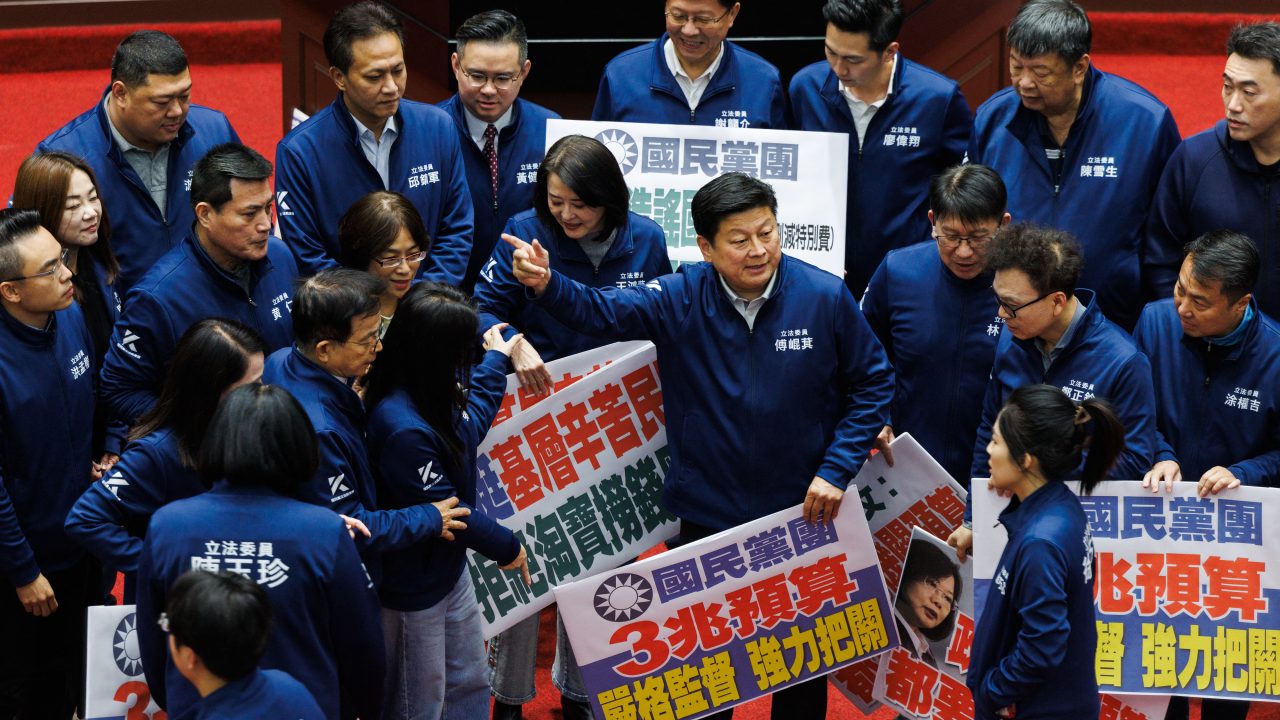
Thus, the same body that cut the regular defense budget would effectively be able to veto this special budget uplift. Yesterday’s article discussed why the Chinese Nationalist Party (KMT) would choose to do that. Now we consider why Lai will seemingly try to go ahead anyway.
The noise in Taipei is that Lai thinks he can pass the special budget. We know that his party, the Democratic Progressive Party (DPP), doesn’t have the votes in the Legislative Yuan to do so.
So one of the following must be true:
Lai doesn’t think the special budget can pass but wants to show he tried.
Lai thinks he can force the KMT to back down because this is a matter of national security.
Lai thinks the DPP can leverage KMT opposition to the special budget to win more of the recall battles that are coming.
Even if Lai can marshall public concern over national security, it is doubtful that the KMT would bow to that alone. But perhaps the threat of losing recall battles would be enough to push the party into negotiations with Lai. Veteran Taiwan journalist and political commentator Courtney Donovan Smith outlines a theory for this in his weekly column.
The war between the Executive and Legislative Yuans will likely define Lai’s first term, absent Chinese military action against Taiwan.
A battle solely over military spending is perhaps the most favorable terrain that Lai can pick.
It’s not at all clear to me what is going to happen, but I think Lai has been preparing for some time to attempt to break the opposition in the Legislative Yuan here, on national security grounds.
Because if he doesn’t, not only will he not be able to pass a special budget this year, he likely won’t be able to prevent continued budget cuts and disruption for the next three years.
And in that case, Taiwan is going to have to tell the Trump White House, “Thanks, but no thanks.”




Leave a Reply