
This week’s roundup of human rights issues in China focuses on the disappearance of hundreds of Taiwan nationals in China, a U.N. update on Xinjiang two years after its highly critical report and the supply of weapons into Sudan against international law.
Hundreds of Taiwanese Citizens Disappeared Over Last Decade
Hundreds of Taiwanese citizens have disappeared in China over the past ten years, according to rights groups in Taiwan speaking last Friday. The Taiwan Association for Human Rights and others said 857 people from Taiwan have been forcibly disappeared or arbitrarily arrested in China. They called for their immediate release.
Democratic Progressive Party (DPP) lawmaker Puma Shen (沈伯洋) said Taiwan’s government could do more in negotiations to get citizens back. “Government officials … should call on China for more appropriate handling of [such] cases,” Shen said. “If that doesn’t happen, then we should cut off communication [with China].” He said the threat of cutting off communication would act as a deterrence.
U.N. Xinjiang Report Two Years On
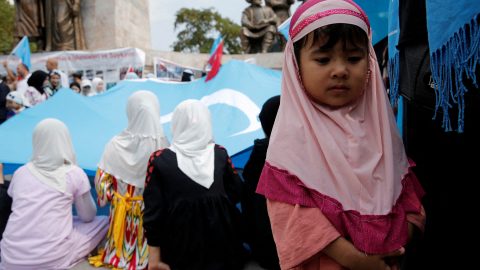
Two years on from the U.N. report which said “large-scale arbitrary deprivation of liberty of members of Uyghur and other predominantly Muslim communities” had taken place in Xinjiang, the Office of the United Nations High Commissioner for Human Rights (OHCHR) said that “many problematic laws and policies remain in place.” It called on Chinese authorities to “undertake a full review, from a human rights perspective, of the legal framework governing national security and counter-terrorism and to strengthen the protection of minorities against discrimination.”
Human Rights Watch said China persists in committing crimes against humanity against Uyghurs and other Turkic Muslims in the region. Noting that “hundreds of thousands of Uyghurs and other Turkic Muslims remain wrongfully imprisoned,” the NGO added that U.N. member states have a “responsibility” to follow up on the original report’s “grave conclusions.”
China Response
Chinese Foreign Ministry spokesperson Lin Jian (林劍) said “China is willing to engage in constructive exchanges and cooperation” in response to the U.N.’s Xinjiang update. However, he added that human rights should not be “politicized.” “We believe that the OHCHR needs to fulfill its mandate in a just and objective manner, respect countries’ sovereignty, respect facts, conduct constructive dialogue and cooperation with countries,” Jian said.
China’s longstanding position is that the restrictions in Xinjiang are counterterrorism measures.
Sudan Weapons Supply
Fighting between the Sudanese Armed Forces and the Rapid Support Forces is being fueled by weapons from China, alongside Russia, Turkey and the United Arab Emirates, according to Amnesty International. The rights organization said in a report released at the end of July that weapons and equipment were being imported in “large quantities” into Sudan and then sent into the Darfur region. Specifically, advanced drone jammers, mortars and anti-materiel rifles manufactured in China are alleged to have entered the country.
Amnesty said war crimes had taken place in the conflict and as China is a party to the Arms Trade Treaty it has “legal obligation not to authorize any transfer of conventional arms when it is known these are ongoing.”
New British Prime Minister Talks
On August 23, new British Prime Minister Keir Starmer told Chinese President Xi Jinping (習近平) he “hoped the leaders would be able to have open, frank and honest discussions to address and understand areas of disagreement when necessary, such as Hong Kong, Russia’s war in Ukraine and human rights,” according to a statement released by his office. Starmer, a former human rights lawyer, told Xi there was no change in the U.K.’s Taiwan policy.
Tibet Disappearances
On August 30, the International Day of the Victims of Enforced Disappearances, the Tibetan Centre for Human Rights and Democracy highlighted that even limited official statistics reveal between 53,000 and 90,000 people were subjected to the residential surveillance at a designated location system (指定居所监视居住) between 2013 and 2021.
The organization called on the U.N. and “civil societies around the world” to “urgently press China to end all forms of enforced disappearances and to create conducive conditions for victims and their family members to pursue truth, justice and repatriation.” It added the Chinese government should immediately ratify the International Convention for the Protection of All Persons from Enforced Disappearance.





Leave a Reply