
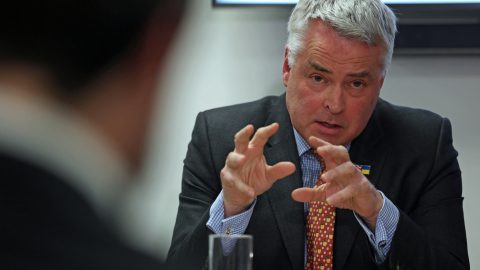
Malcolm Byrne is an Irish senator and the IPAC Irish co-chair. He attended the Inter-Parliamentary Alliance on China (IPAC) Summit in Taipei in that capacity. He was elected in 2020 and previously served as a local Councillor in Wexford, including time as chair of Wexford County Council. He is a founding member of IPAC and active on human rights issues.
Can you tell us a little bit about your background and what you were doing before politics?
So I’m a graduate of law but I have worked for a variety of organizations. But immediately before going into national politics, I was head of communications and public affairs with the Higher Education Authority, which is the regulatory and funding body for higher education in Ireland. I suppose I’ve always had an interest in foreign policy areas, but I’ve been involved in local governments before being elected to the Oireachtas, or national parliament. So when in Leinster House, I suppose I had been speaking a little bit around foreign policy issues.
I would have had particular concerns because my philosophy, which I think very much underpins Irish foreign policy, is you show commitment to democracy, human rights and the rule of law, and that there’s an obligation on all countries to do that, particularly on democracies. And I’ve been to China twice and have also met with various groups here who had an interest in human rights in China. I’ve also got a strong interest in technology and technology regulation.
So I would be looking at the Chinese Communist Party’s approach. And when I was asked when the Inter-Parliamentary Alliance in China was being established, and a discussion about an Irish chapter being set up, I was very happy to join.
You and [fellow IPAC Co-Chair] Barry Ward co-sponsored this human rights motion at the beginning of this year that was debated in your house [the Seanad], and I detected — and correct me if I’m wrong — but it seemed like that was probably something that perhaps had been discussed at IPAC the previous year?
Well yes and no. There was a cross-party motion debate on China previously, raising a lot of the concerns, and there are a growing number of concerns in Ireland around whether it’s the treatment of the Uyghur community, whether it’s the treatment of people in Tibet, what’s been happening in Hong Kong, the misuse of technology, the treatment of Christian minorities, the treatment of Falun Dafa, obviously a lot of the tensions with Taiwan and the implications that that has for geopolitics and indeed the global economy. And then I think in Ireland as well the detention of the businessman Richard O’Halloran certainly grabbed a lot of attention here, particularly when his wife went on international television and talked about what had been happening.
A number of us had been very concerned about what was going on for quite a while that Irish trade and European trade with China was continuing to grow. Trade is a positive thing, [but] there was a fear that we weren’t paying as much attention to what was happening with human rights. I think a really important moment was when Micheal Martin, who’s our deputy prime minister and foreign minister and also my party leader, last year delivered a really important speech at the Royal Irish Academy which set out Ireland’s future policy relationship with China. And that was critical I think in many ways in articulating this is the state’s approach. We’d heard it in bits and pieces, but this was a clear speech by our minister of foreign affairs and former prime minister saying this is Ireland’s attitude, which is as I outlined: We want a positive relationship with China, we’ve huge respect for China, but there are core principles around democracy and human rights in the rule of law that are not negotiable.
Can you sketch out a little the Irish political context, because Ireland has a very specific history, and I wonder how that impacts the way that you would view a relationship with China?
Ireland is a militarily non-aligned country, so we’re not a member of NATO. Since independence the country has always tried to follow a pretty independent foreign policy line, but as a country we’re deeply committed to multilateralism, so very strong and enthusiastic members of the European Union. Irish people tend to think Brexit was a crazy idea. From an economic, social and political perspective, why did Britain vote for such a thing?
[We are] very, very committed to multilateralism. Ireland is the only country, for instance, that has contributed troops to every single U.N. peacekeeping mission since 1960, since the peacekeeping missions started. It’s something of which as a country where we’re very proud, and we’ve always believed in the importance of dialogue and getting parties around the table. Part of that is sometimes shaped by the experience in this island, which has been one of conflict, particularly in the north. One of the greatest political achievements on these islands in recent decades has been the Good Friday Agreement, which, as part of a peace process, led to much improved relationships and peace on these islands. So I think that’s where, as a country, we’re coming from.
On the trade side, we’re very committed to open trade. You know, Ireland relies very heavily on international trade, on overseas investment, foreign direct investment. So for instance, yes, the United States, and indeed China, but the U.S. in particular has huge levels of foreign direct investment in Ireland. But we’d also point out that Ireland is the ninth-biggest investor in the United States. So there are as many people employed by Irish companies in the U.S. as there are by U.S. companies in Ireland. And in recent years, trade between Ireland and China has grown. So, we want to have that good relationship.
There’s a huge respect as well, I would argue, in Ireland for music and culture and those traditions. I often point out, we’re the only country in the world that has a musical instrument as our national symbol. And that’s something that we’re very proud of, something that is important to us and something that we recognize. So in that sense, you’ve got to remember that people in Ireland have a huge respect for ancient Chinese cultures and traditions. There’s also, I suppose, because of our history where there have been efforts to stamp out our culture and our traditions, we certainly take a poor view where minority cultures and traditions such as, for instance, the Tibetans, where you start to see the Chinese Communist Party trying to stamp out Tibetan culture and language and tradition. So I think that very much shapes where we’re coming from.
Ireland will almost always, but certainly in general, work with our European partners. So there’s a very strong support for the European Union here. And in terms of any of those big global decisions, there’s always been discussion with our EU partners, and we work in concert with them. But again our attitudes to China, it’s very much shaped by our history and our values.
I’m going to attempt a risky question now. Risky for a British journalist, I guess. You have an island off the coast of a large expansionist neighbor who had invaded and colonized it, and I wonder …
When you’re dealing with a bigger neighbor, you could draw … I mean, you can learn from history, but you shouldn’t be a prisoner of it.
I think the circumstances of China and Taiwan are slightly different to Irish history. And certainly now relations aren’t perfect between Ireland and Britain, but in no way do we feel that there’s going to be an imminent invasion.
And indeed, even though there are disagreements on policy, there’s still good working relations between Ireland and Britain. I mean, Brexit was the most upsetting thing to have impacted on Irish-British relations in the last few years, and there may have been … I’ll put this diplomatically, there may have been one or two prime ministers whose level of understanding and knowledge of British-Irish relations and indeed diplomacy more generally wouldn’t have been too strong. But I think with the new Labour government in the U.K., there has been a bit of a reset in relations, and certainly all indications are quite positive. Irish people don’t like the idea of living under a totalitarian regime that tries to oppress our culture and individual rights and identities.
This is a very, I’m afraid, a very online question, but I think it’s genuinely something our readers will be interested in. Claire Daly and Mick Wallace, sort of enemies both of Taiwan and of democracy more generally, how is it that they were both Irish? Is there something there, or is that simply bad luck?
When they were elected in 2019, they would have been very much seen as anti-establishment figures in Ireland but wouldn’t have really voiced many opinions around China or other issues. A lot of people were surprised by their support for China, for Russia, for Iran over the last number of years. They certainly wouldn’t have reflected Irish public opinion.
And I think the fact that they weren’t re-elected probably says something. And to be honest, I think the prime reason that they weren’t is, even among anti-establishment voters, they’re not going to gain traction by supporting totalitarian regimes.
About the Varadkar comments at the beginning of this year and the misquotation of him on Ireland’s One China Policy? Can you give me a review of what happened there?
Well I obviously can’t speak for [former Irish prime minister] Leo Varadkar, but I think the clearest articulation, because it was quite comprehensive, is that speech by Micheal Martin that I mentioned to the Royal Irish Academy, which I think was May of 2023.
So, we recognize, obviously we recognize China, and we want to have strong relations with China. We also want to have good relations with Taiwan. I think the presidential election in Taiwan got a bit of news coverage here. In the future, I think Ireland’s relations would be defined by what approach the EU, collectively, decides to take. Our approach would be we will respect Beijing and we’ll engage with them. But we will also say, hang on, you need to de-escalate in terms of military activity. You need to respect human rights and the rule of law. That applies to China. And that applies to other countries, whether it’s Taiwan, or Xinjiang, or Hong Kong or Tibet, or indeed with the treatment of minorities.
This interview has been edited for clarity and conciseness.




Leave a Reply