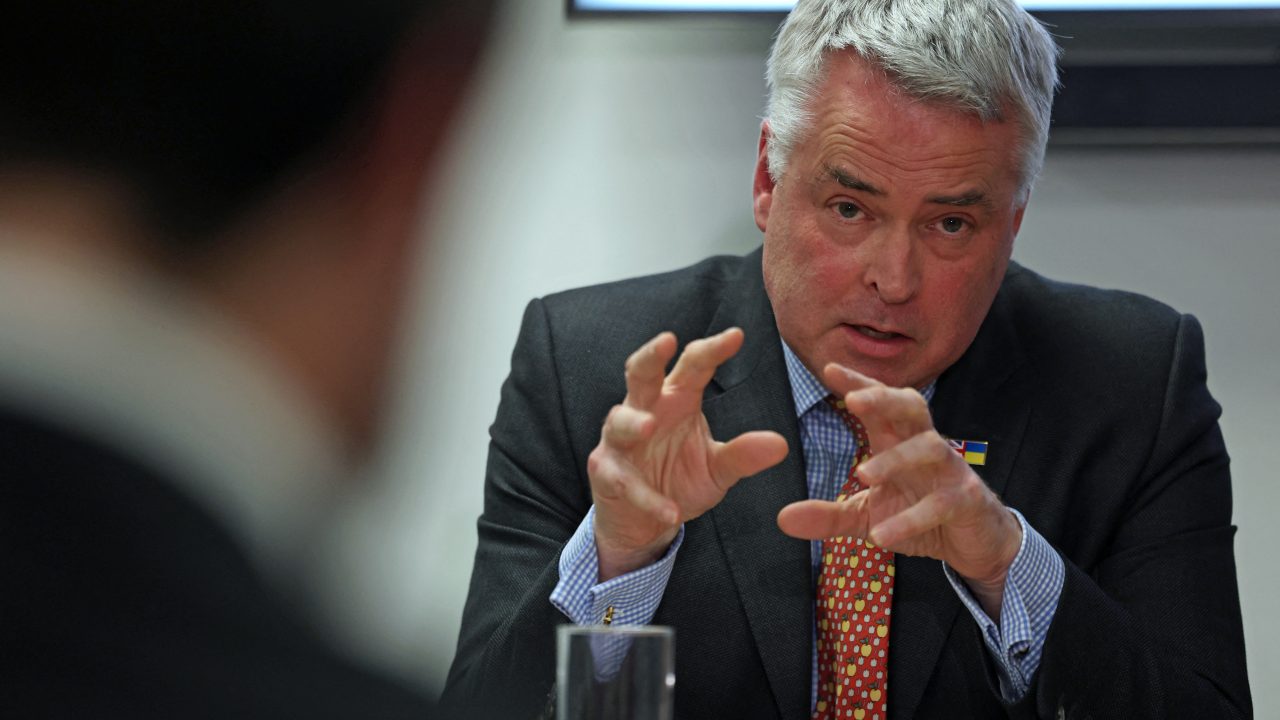
Tim Loughton was a U.K. member of Parliament (M.P.) until the July 2024 general election. He attended the Inter-Parliamentary Alliance on China (IPAC) Summit in Taipei in that capacity. During his time in Parliament, he served as parliamentary under-secretary of state for Children and Families as well as joining the Tibet All-Party Parliamentary Group. He joined IPAC in 2020 and was sanctioned by China in 2021. In April 2024, he was deported from Djibouti, which he alleges was because of Chinese pressure.
Can you briefly introduce your background: where you grew up and what were you doing before politics?
I was born in Sussex in England, went to university in England and then I worked for a merchant bank in the City of London for 16 years. I’d been doing politics on a voluntary basis for much of that time. I stood for Parliament first of all in 1992 in a strong Labour seat. I was a Conservative candidate and then I was selected for a Sussex seat, near where I came from, in 1997, so I was an MP between 1997 and 2024. I’d just stood down before the recent election and during that time I was shadow children’s minister and then children’s minister for about half of my time in Parliament.
My interest in China comes from my interest in Tibet, which precedes my being in politics. I joined the Parliamentary group for Tibet in Parliament, I became the chair of that and became very vociferous in standing up, particularly for Tibetans, but against China’s human rights abuses, for which, just over three years ago, I was eventually sanctioned by the Chinese government along with four other M.P.s and two members of the House of Lords.
I’m a member of IPAC, the Inter-Parliamentary Alliance on China, which was formed four years ago to really coordinate M.P.s and legislators from around the world to call out China’s human rights abuses and the tactics they’ve used against nationals outside of China as well as in it, and to make sure that they are not invading themselves into our infrastructure projects. So that’s my background in China.
So were you one of the founding members of IPAC then? Were you there from the beginning?
Yes. Luke de Pulford was appointed as the first director of IPAC, and there were several U.K. M.P.s who were amongst the first members including me and Iain Duncan-Smith, who has been in Parliament since 1992 and became the chair of what is effectively the U.K. branch. Importantly, though, this is a really cross-party initiative, so we have members from all the parties, and I’ve been out here with Labour M.P.s, Conservative M.P.s, Scottish National M.P.s, and we’ve also got Liberal Democrat members and Greens as well.
I guess this wasn’t your first IPAC summit. Have you attended the other ones in different cities?
Yes, we were in Prague last August and before that, the previous December, we were in Rome. There’s also been a meeting in Washington and I’ve been in other international things to do with Tibet that brought parliamentarians from around the world together, too.
Could you briefly compare the different summits? This one was very Taiwan-centric for understandable reasons. For example, what was the main topic in Prague?
This has gradually evolved. So we’ve now got many more additional members. Taiwan has now become a member. So this was the biggest summit we had by far. Twenty-five countries represented and new countries including the Solomon Islands, which is a sensitive area for China at the moment. We’ve got several South American countries. We had a really interesting summit in Rome where we were discussing China’s involvement in national infrastructure projects around the world and how we should be flagging this up, as a result of which many of us have been emboldened to put down amendments for legislation, to force government’s hand, to be much more scrutinous of China’s involvement in contracts. We have legislation now that effectively bans China-owned companies from large sensitive infrastructure projects in the U.K.
We were trying to coordinate more what we do in individual parliaments, and so this summit was for sharing best practice about what we’ve achieved individually and how we can leverage that even more to coordinate action between the same environments at a similar time. And one example where this worked really well, two years ago we passed motions calling for a diplomatic boycott of the Beijing Olympics. We passed a motion in the U.K., they passed a motion in the U.S., the European Parliament passed a motion around a similar time, as a result of which many countries had a diplomatic boycott of the China Olympics. And that really annoyed China, but it had a much more multiplied effect, and that was partly because of the work that IPAC had done.
Are you optimistic that this Model Resolution on 2758 is going to have some impact? Will it get passed by individual parliaments of member states?
It’s that sort of method that we found to be quite successful, and that’s really why IPAC has worked well and brought people together, because we can multiply our effort by doing it.
[In April 2024 Tim Loughton was detained at Djibouti airport when he attempted to enter the country. After several hours he was told he was not welcome and was put on a flight back to the UAE. He says that he has been placed on a “blacklist” by China.]
You mentioned elsewhere that you came to understand after the Djibouti incident that it was China related. Can you point to what it was that flagged that up?
Some interesting briefings with our foreign office and with some of the government officials in Somaliland.
And are you aware of this blacklist? Do you know how far it extends?
No, and that is our problem. So we have had confidential talks with government officials in France and others, in that there is the fear that we, the sanctioned M.P.s, could be on an Interpol red notice list. Effectively China could have us arrested if we visit a country where they have reciprocal arrangements. I think for EU countries, there would not be a problem. But the more remote countries, then potentially there is a problem.
The new Labour government is going to hold a China audit. What kind of course do you hope they set for U.K.-China relations?
We’ve been calling for a long time to have a proper China audit. What is China’s influence, not just on national procurement contracts, but in our universities and our schools, in local authority relations, businesses and so on? So it’s welcome. Our fear is that actually it may be watered down and used as an excuse for not doing anything about China. The Labour government is going to be focused on, supposedly, economic growth. And clearly making it more difficult for U.K. companies to do business with China, or for China goods or services coming into the country, doesn’t help growth on the face of it. That’s why it’s very important we find alternative sources for lots of our stuff.
So the fear is that that will take precedence, that they’ll still go ahead with some contracts and say, “Oh, but of course we’re doing this audit, so until we’ve done the audit, we’re carrying on as normal.” It’s really important that IPAC-supporting members on both sides of the house [U.K. Parliament], and as I said we had two Labour M.P.s here at this conference, hold the government to account that they are not going to loosen up on the way we scrutinize the business that we do with China and this review isn’t just extended into the long grass and just becomes an excuse rather than a real solution.
Are you optimistic that the U.K. can tackle the China issue on a cross-party basis?
Yeah, this is why again IPAC is important, because it’s brought together all the different parties on this. And actually the fact that five parliamentarians have been sanctioned has brought greater unanimity. That they’re all Conservative [M.P.s] doesn’t really matter, there’s a Labour peer [Member of the House of Lords] as well, Helena Kennedy. I mean, it’s been a great recruiting sergeant, being sanctioned, and it’s really blown up in their faces. And so Parliament retaliated by banning the Chinese ambassador to London from being able to come to Parliament, which has caused great annoyance. There’s been great pressure. The planning application for the new mega Chinese embassy was refused. Again, it was the pressure that we brought that helped on that. So I would hope there’s not going to be a difference of emphasis, because this transcends party differences here.
Was this your first trip to Taiwan?
I’ve been wanting to come for ages. And the opportunity came up, which is why it was a really good idea to have the IPAC conference in Taiwan, because symbolically it’s really important to us.
How should the U.K. approach its Taiwan policy?
Ultimately, we would obviously like Taiwan to be recognized. The same with Somaliland, as well, although Somaliland is a much smaller player in all of this. I understand it sets precedents and poses some problems, not insurmountable problems. But I think the way forward, and this is one of the things we were talking about in IPAC, is to regularize Taiwan’s status in certain international institutions. And I think we can start, have started, to push for that. They should be members of WHO, there should be more official engagement between OECD, G7 and Taiwan. It’s crazy they’re competing in the Olympics as Chinese Taipei.
I think we’ve got to be much bolder in saying they need to be recognized as a special status country. Now, it’s going to be a long haul to get to the country of Taiwan independently, but that’s obviously the goal. But I think you can do it incrementally and challenge people and say, “Well, why should Taiwan not be members of this organization?” And lobby. If you’ve got countries acting in unison to do that, we can each embolden each other to say, “Well look, they’ve done it in America, or they’ve done it in Australia, but why is the U.K. different, or vice versa?”
There’s a bit of a hope here in Taipei that the U.K. might help Taiwan to join the Comprehensive and Progressive Agreement for Trans-Pacific Partnership (CPTPP). Do you think that is realistic?
I do, and that, again, is a really good example [of Taiwan and an international organisation], where there’s a strong case for why they should be part of it. I think this is a strong economy in its own right, which will contribute hugely. It would be a great advantage to us, being part of the same trade organization as well as all the others who are already in it. So that should be an early priority to try and push for better as well.
At the summit yesterday you sort of introduced the Jimmy Lai (黎智英) section at lunch. Do you have some personal connection to Jimmy Lai?
Because he’s got a London-based legal team, we’ve seen quite a lot of them. We’ve hosted, and I’ve chaired meetings in Parliament, with the legal team giving briefings. [Jimmy Lai’s son] Sebastian Lai’s (黎崇恩) been to Parliament several times. He’s met the speaker of the House of Commons. They’ve been to previous IPAC conferences as a good opportunity for them to lobby lawmakers to challenge China at every opportunity.
I mean, the nonsense, and it was at last, slightly ironically, David Cameron who acknowledged that Jimmy Lai is a British citizen. Because the Foreign Office were going along with this complete nonsense that China’s putting out that he was dual nationality at best. He’s never held, never had, a Chinese passport. He’s never been a Chinese citizen. He, as is his son, they
are British subjects and should be subject to the same protections that we would afford anybody else and yet weren’t, until more recently when the government at last realized that they’re being suckered by China on that one. So the Jimmy Lai case is a really important case, sort of totemic, of how effectively he’s been prosecuted for being a journalist. And the implications for free speech and other journalists around the world are considerable if they get away with putting him in jail, as most probably they will.
What are you going to do next, now that you are out of politics?
You don’t leave politics, but I will find new platforms to do it. I chair the Conservative Party Human Rights Commission for example, and we’ve done a lot of work on China. I’m doing a lot of stuff outside Parliament on children’s social care. I’ve been children’s minister, so that’s separate from China. But children and China are my two big interests that I pursued in Parliament, and I’m going to continue to pursue them. On Tibet, that’s how I got into the whole China thing, and the thing about Tibet which is really galling: Many times I was involved in debates on Tibet, and there’ll be one or two other people there. Only when the Uyghur and Xinjiang cases came up did people start to appreciate what China was really up to, and Tibet got flagged up on the back of that and Tibet has been suffering since 1959, so I have a lifelong interest in Tibet and I’m certainly not moving away from that.
This interview has been edited for clarity and conciseness.




Leave a Reply