Ask yourself: What will you do to stand up for the truth?
This was the challenge to Inter-Parliamentary Alliance on China (IPAC) delegates from Maria Ressa, the Nobel Prize-winning journalist from the Philippines. She was addressing the summit over the continued detention of Jimmy Lai (黎智英), the Hong Kong British newspaper man who has been imprisoned since 2020.
Jimmy Lai’s case has often been raised by IPAC. After his paper Apple Daily was forced to close, Lai could have fled Hong Kong, but chose to remain. In an interview in 2020, before he was detained, he told the Hoover Institution’s Peter Robinson “This is a time for sacrifice.”
As previously reported by Domino Theory, IPAC is meeting in Taipei for its annual summit. Tuesday July 30 was the day of the big meeting itself. Delegates from democratic countries around the globe gathered here for one purpose: to discuss the challenges that China poses to their parliaments and nations.
The main day of the summit started with a closed-door session where delegates from all the member countries addressed the floor and discussed their particular national experiences with China. The second session of the morning was divided between presentations from Pierro Tozzi of the Congressional-Executive Commission on China talking about China’s transnational repression, and Patricia Egger from Swiss technology company Proton talking about encryption and cybersecurity.
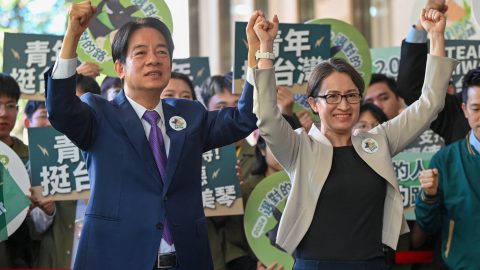
In the afternoon, the Summit was addressed by Taiwanese President Lai Ching-te (賴清德)
Lai pointed out that “whenever Taiwan faces threats from China, IPAC stands with us, speaks up for us, and gives us its full support,” Lai said. “On behalf of the people of Taiwan, I extend sincere gratitude to you all.” He also said that the IPAC Summit sends a message to the world that democracy requires “unity and protection.”
Lai also emphasized that Taiwan is willing to take “dialogue instead of confrontation” with China, and take exchanges instead of containment based on the principle of mutual respect and dignity, to reduce conflicts and achieve peace and stability.”
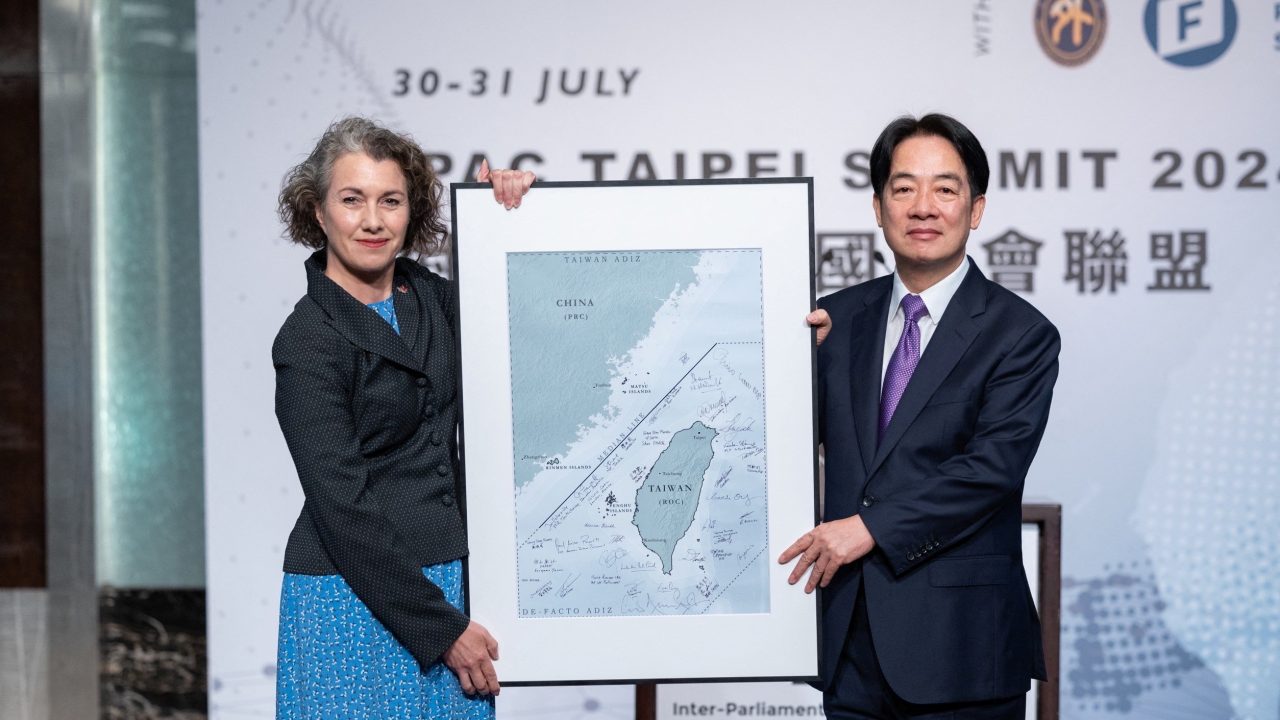
After Lai’s speech, British Member of Parliament (M.P.) Sarah Champion presented him with a map of Taiwan. In a piece of heavy symbolism, the map had been signed by all the parliamentarians attending their summit, their signatures surrounding Taiwan.
The summit passed the “IPAC Model Resolution on 2758.” This resolution seeks to inform the public about the distortion of United Nations Resolution 2758, which established the People’s Republic of China as the “only legitimate representative of China to the United Nations.” Resolution 2758 does not mention Taiwan or its political status. IPAC will work to support Taiwan’s claims for meaningful participation in U.N. Agencies and beyond. A step includes trying to pass this model resolution on 2758 in their own parliaments. However, it remains unknown how effective this action actually is, as the U.N., or rather, China, is continuously influencing countries via economy, trade, and technology.
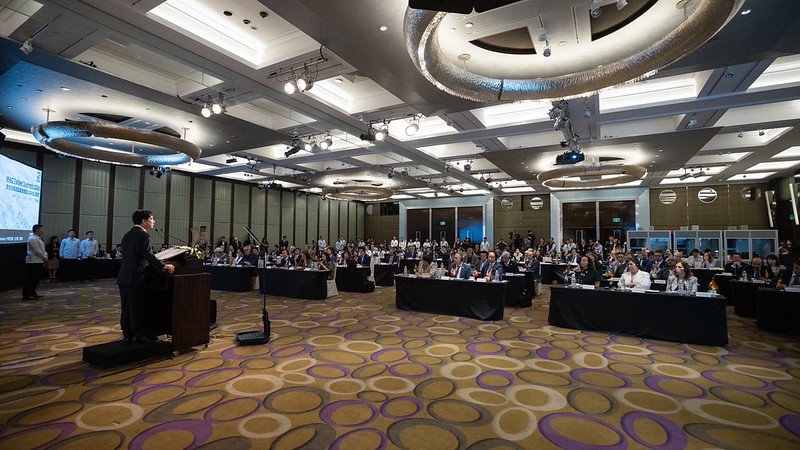
“Peace and stability in the Taiwan Strait is a global public good.” These striking words were uttered by Joris Teer, analyst at the European Union Institute for Security Studies. In a detailed presentation, he told delegates about the economic risks associated with a Taiwan Strait contingency. Interestingly, he sketched out a scenario where a Chinese invasion faltered but open warfare continued for six to nine months. Not only would the world be cut off from Taiwan’s semiconductors, but trade with China would also plummet as well as with other East Asian countries.
The knock-on effects are where this scenario really bites. Teer talked about the “skeleton of the world economy,” the supply of raw minerals, especially rare minerals. Many of these resources are largely controlled by China. With trade reduced, supply chains start to fracture. Teer said that Bloomberg has estimated a war in the strait could wipe out ten percent of global GDP, and he emphasized that this would impact developing countries most as they would have to compete for reduced supplies, a similar effect to the Russian invasion of Ukraine on a much larger scale.
Teer finished with a warning. He doesn’t see any way out of that spiral of events once it has started. He said deterrence is the only solution, bringing the problem right back to the feet of the delegates.
Following Teer’s presentation delegates held an open floor session to share thoughts on Taiwan. Sir Iain Duncan Smith from the U.K. raised the question of rare earths, saying because they are “dirty” to produce the West doesn’t want to do so and this is one reason China is ahead (another is obviously that China has large rare earth deposits). Canadian M.P. Kevin Vuong pointed out that because China’s mines are state-owned they are also able to undercut Western production on price. He suggested Western countries need to support their mining industries more.
Senator Cecilia Requena from Bolivia cited an extremely recent example of troubling Chinese behavior. She said that after the presidential election in Venezuela, China had recognized Maduro’s victory even though there are widespread concerns about the fairness of the result. In this, she said, China is acting in alignment with Russia and her own government in Bolivia. A useful reminder that many delegates face different challenges.
M.P. Sanela Klaric from Bosnia-Herzegovina said that for her the memories of war are still fresh. She urged the delegates to focus on the human cost of suffering, a point that Czech M.P. Hayato Okamura harked back when he talked about the suffering of Ukrainians.
Senator David Fawcett from Australia contrasted this with a different point. He said that “We need to bring people with us. We need to make sure the younger generation understands what totalitarian regimes mean, so they will support our actions which may come at a cost to deter them.”
At the press conference to finish the day Taiwanese Vice President Hsiao Bi-Khim (蕭美琴) addressed the legislators once again. “Thank you for demonstrating Taiwan is not alone,” she said. Reinhard Butikofer from Germany wasn’t directly responding but he might as well have been when he said: “Taiwan can’t pursue its democracy alone.” He also clarified an important point: “No one did not attend because of Chinese pressure.”

Solomon Islands M.P. Peter Kenilorea revealed the names of the delegates from the six new countries already announced as joining IPAC. Then, a big surprise: IPAC Executive Director Luke de Pulford came to the stage and announced that Taiwan would be joining as a seventh new member, with delegates from the Democratic Progressive Party (DPP) and Taiwan People’s Party (TPP). This answered a question Domino Theory had posed before the event. After the press conference the summit event closed and many delegates broke off into private conversations with the media.
Reinhard Butikofer told Domino Theory that IPAC highly welcomes Taiwan as a new addition. He said that IPAC membership depends on two conditions. One is that there is agreement with the principles of IPAC. Another is that it is not a partisan affair, this brings together people within their own parliament who may not share common views, but can agree on working together in the pursuit of their common goals.
When being asked about joining IPAC and becoming a co-chair, Taiwan People’s Party (TPP) legislator Chen Gau-tzu (陳昭姿) told Domino Theory she only learned today that she and the DPP’s legislator Fan Yun (范雲) are joining IPAC as the Taiwan representatives. She said “I’m here representing the Taiwan People’s Party, which is why we had the opportunity to become a member. Frankly, I wasn’t very familiar with this organization before.”
In terms of the dynamic in the Taiwan Strait, Chen Gau-tzu added that the TPP’s policy has always been striving for peace across the strait, harmony in Taiwanese society, and harmony across all political parties. Although the TPP’s Chair Ko Wen-je (柯文哲) does not often talk about political stances, Chen thinks their stance aligns with what President Lai talks about: mutual non-subordination and mutual respect.
Japanese Member of the House of Representatives Nakatani Gen said with Taiwan joining IPAC, since it’s an alliance of parliamentarians from different parties, the focus is on protecting democracy, human rights around the world, and stability in the Taiwan Strait.
As for the relationship with Taiwan and the idea of “a Taiwan Contingency is a Japan contingency,” Nakatani said Japan will respond to any situation, but only if it affects Japan’s defense and security. Japan is taking precautions and making preparations to prevent such situations from occurring. China’s military pressure has intensified, but they are prepared to protect Japan under any circumstances. In the case of Taiwan, if it affects Japan’s national security, they might support the U.S. as an “important influence situation” or provide logistical support. However, they can’t foresee exactly what kind of situation might arise until it happens. They are prepared for such contingencies.



Leave a Reply