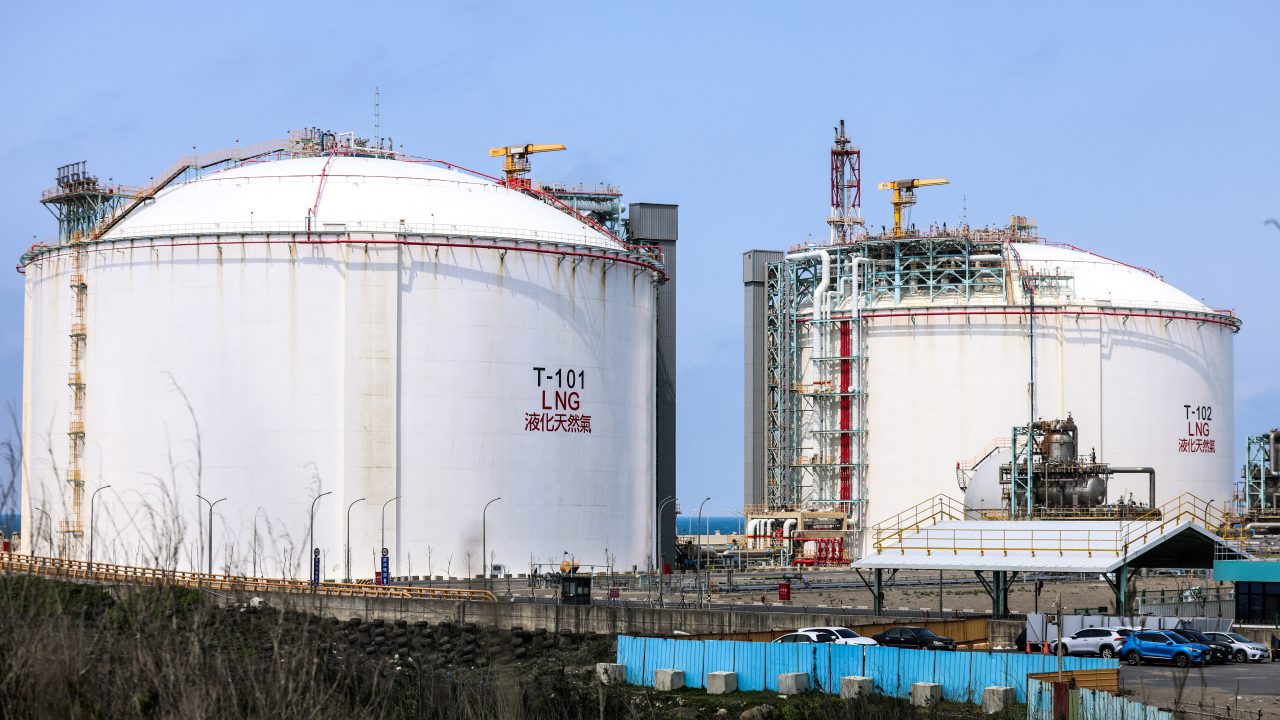
The supply shock from the Iran conflict could lead to a dramatic spike in electricity generation costs in Taiwan, according to a tabletop exercise taking place in Taipei this week.
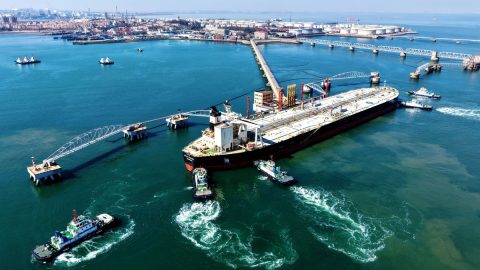
Before the Iran conflict caused the effective closure of the Strait of Hormuz, Taiwan relied on Qatar for one third of its liquefied natural gas, or LNG, imports — this amounted to about 17% of Taiwan’s electricity generation. The government said it has secured alternative LNG supplies through May and half of June, and that energy rationing will not be necessary.
But as experts told Domino Theory in March, Taiwan’s ability to absorb the financial shock of LNG price volatility remains a major concern. Around 70% to 80% of Taiwan’s LNG is purchased via long-term contracts, but LNG can also be more quickly (and expensively) procured on the spot market. The spot market is where Taiwan’s main LNG importer, CPC, is competing for LNG cargoes with other buyers to source replacement supply following the Qatar disruption. The JKM, the benchmark price for LNG in Asia, has spiked about 80% since February 28 when the war began, said Chi-yuan Liang (梁啟源), a professor at National Central University.
Following a presentation about Taiwan’s energy security at yesterday’s tabletop exercise organized by National Chengchi University’s Institute of International Relations and Chinese Nationalist Party (KMT) officials, Liang said that the JKM spike could increase electricity prices in Taiwan by 20% if the crisis persists. He got this number by multiplying 80% by the share of fuel costs in Taipower’s electricity generation costs and the share of gas-fired electricity generation. Taipower is the national electric utility.
But as of April, the LNG price for Taipower has increased about 41%. Applying the same formula, Taipower’s current total electricity generation cost has increased about 10%, Liang said.
Chia-Wei Chao (趙家緯), research director of the Taiwan Climate Action Network, thinks the 20% figure that Liang projected is unlikely to materialize. If the ceasefire continues, the JKM price will come down around August. Additionally, according to data provided by Taipower about projected fuel costs through the end of this year, which was updated following the Qatar LNG disruption, total electricity generation costs will increase around 10% this year, Chao estimates.
Still, even a 10% hike will exacerbate the financial losses that Taipower is already facing, said Chao. The electricity price review committee, which meets biannually to determine electricity prices in Taiwan — as in, the cost that is passed to the consumer — said that the price of electricity will stay the same until their September meeting because there is not enough evidence about the impact of the war to make a change right now. “So that means that until September, Taipower will have to subsidize dramatically,” said Chao, adding that prices will still likely not be increased in September due to the upcoming local elections.
By 2025, Taipower had accumulated financial losses amounting to 350 billion New Taiwan dollars (roughly $11 billion). Taipower and CPC will accumulate an additional NTD 120 billion in debt by the end of the year if prices remain below cost, said Chao. This will limit Taipower’s ability to spend on grid enhancement, including safety checks and upgrading transmission lines.
Liang told Domino Theory that the debt asset ratios of Taipower and CPC are 92% and 93%, respectively. This means that their assets — including physical infrastructure and energy resources — are almost entirely financed by debt. CPC is in a particularly dire position, according to Liang, because it recently revalued its assets. Even after the upward adjustment to account for inflation, its debt-asset ratio is still very high.
Liang also noted that Taiwan’s utilization rate of its LNG terminals is unusually high at about 120.7% as of 2023 — much higher than Japan, South Korea and China. This prevents regular maintenance and creates risk of malfunction.
As losses accumulate, the government has to provide capital injections and subsidies each year to prevent Taipower from going bankrupt. Even if the government does not hike electricity prices for now, these costs will eventually be shifted to the public. “That will be the burden of the taxpayer,” Liang said.


Leave a Reply