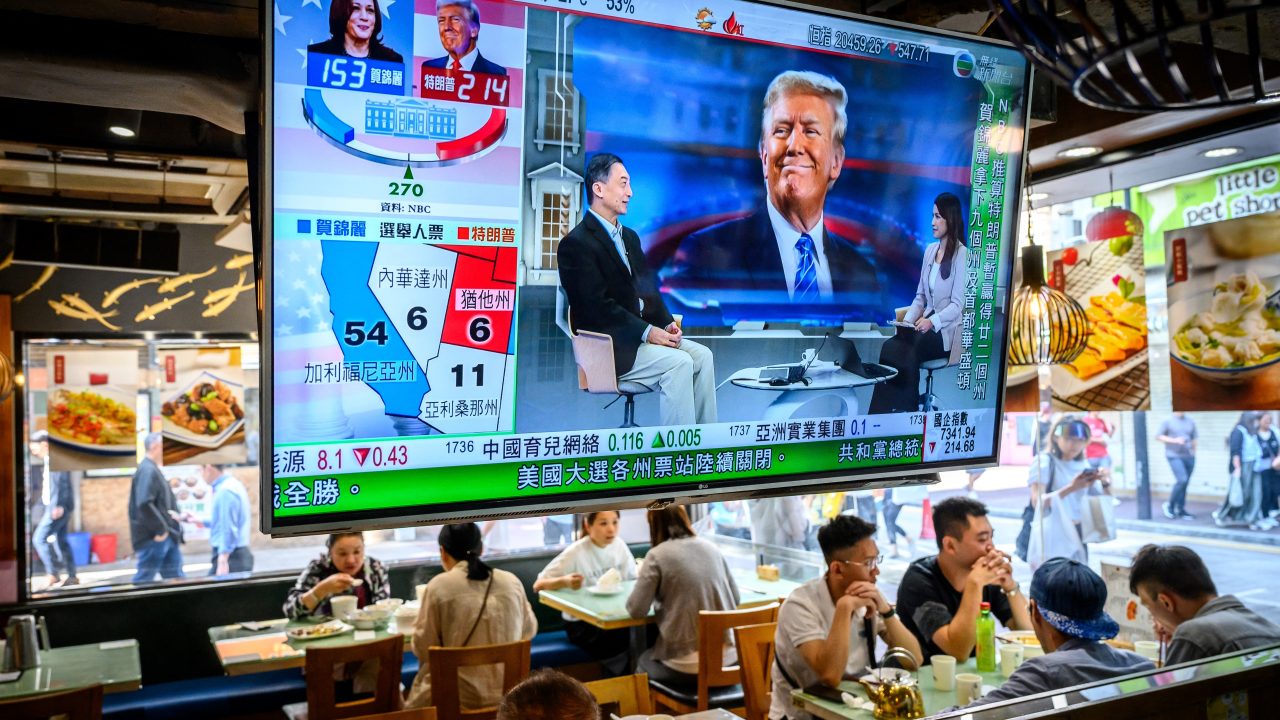
As the national security trial of Jimmy Lai (黎智英) continues, much of the focus has been on whether the 76-year-old founder of pro-democracy newspaper Apple Daily encouraged the U.S. to sanction Hong Kong. However, Lai has maintained he could not have had serious influence on U.S. policy. Here is the context.
Lai’s charges include two counts of “conspiracy to collude with foreign countries” and one of “collusion with foreign forces,” and the prosecution has made sanctions a central focus of its questioning.
On Tuesday, Lai said it was his “honest belief” that sanctions from the West would encourage Chinese officials not to enact the 2020 National Security Law. But he said the basis for believing that the Trump administration would go beyond revoking Hong Kong’s special trade status to direct sanction of officials was “wishful thinking” on his part.
Prior to that, Lai has been asked specifically about meetings with former U.S. secretary of state Mike Pompeo, former vice president Mike Pence and former national security adviser John Bolton before the introduction of the National Security Law. He said last week that he “must have discussed” sanctions with Pompeo, but denied asking U.S. officials directly for sanctions and has also denied telling Apple Daily staff and other activists he hoped for “hostile actions on China, including sanctions.”
This back and forth relates to sanctions on Hong Kong that the U.S. issued on August 7, 2020, following an Executive Order from sitting President Donald Trump, issued on July 14, 2020. Those sanctions blocked access to U.S.-based assets owned by 11 Hong Kong and Chinese government officials, including sitting Hong Kong Chief Executive Carrie Lam (林鄭月娥), and the Executive Order was issued a week after Lai visited the White House for meetings, on July 8, 2020.
However, a key argument made by Lai in court is that it is unrealistic that he could have had serious influence on U.S. decision making.
“I would not dare to ask the vice president to do anything, I just relayed to him what happened in Hong Kong when he asked me. I asked him to voice up for Hong Kong and support us, but there was never anything particularly that I asked for,” Lai said on his first day of giving evidence after the trial’s restart.
“I didn’t think about anything in particular. Because, you know, the [U.S.] government, they know what they would do. That’s not my portion to think anything particular for them,” Lai said a week later, when asked about the claim from a former editorial writer that he wanted the English Apple Daily to push the U.S. government to adopt a “stronger stance” against China.
Evidence provided by the U.S. officials who met Lai supports this account. Lai’s friend and the former chief speechwriter for President George W. Bush, William McGurn, writing on X, has published three direct denials that Lai asked the U.S. to pursue sanctions.
Former vice president Mike Pence told McGurn: “During our meeting at the White House in July of 2019, Jimmy Lai and I discussed his stand for democracy and his hope that we would continue to speak out on behalf of the rights and autonomy promised to the people of Hong Kong. Jimmy Lai did not ask for U.S. sanctions or any action against Hong Kong or China …”
Former national security advisor John Bolton told McGurn: “I’ve known Jimmy for many years, and I was glad to visit with him about what was actually going on in Hong Kong. He wanted us to know the truth, which we were not getting from the Chinese leaders.”
And former secretary of state Mike Pompeo told McGurn: “I met with Jimmy Lai and spoke with him at length. He never lobbied for, suggested, or so much as mentioned that the United States should impose sanctions on the [Chinese Communist Party] or China. Never …”
These accounts correlate with the broader context of the U.S. sanction regime.
The justification for sanctions set out by the Office of Foreign Assets Control of the U.S. Department of the Treasury, and the text of the Executive Order, both say sanctions are based on “U.S. foreign policy” and “national security” goals — pointing to a longer term trajectory that they formed one part of.
Major U.S. sanctions on China began in May 2019, when tech firm Huawei was added to the Department of Commerce’s trade restriction list, and have continued since Lai’s imprisonment. Last week, the U.S. government said it was looking at further visa restrictions on Hong Kong officials following the convictions of 45 pro-democracy campaigners under the National Security Law.
The timing of Hong Kong sanctions in question also appears to fit a trajectory that goes beyond Lai’s intervention. The Hong Kong sanctions were already in motion when Lai met with Pompeo, Pence and Bolton: The Executive Order relied on a bill passing through the U.S. Congress for its legitimacy and that bill, known as the Hong Kong Autonomy Act, passed unanimously on July 2, 2020.
The trial continues.




Leave a Reply