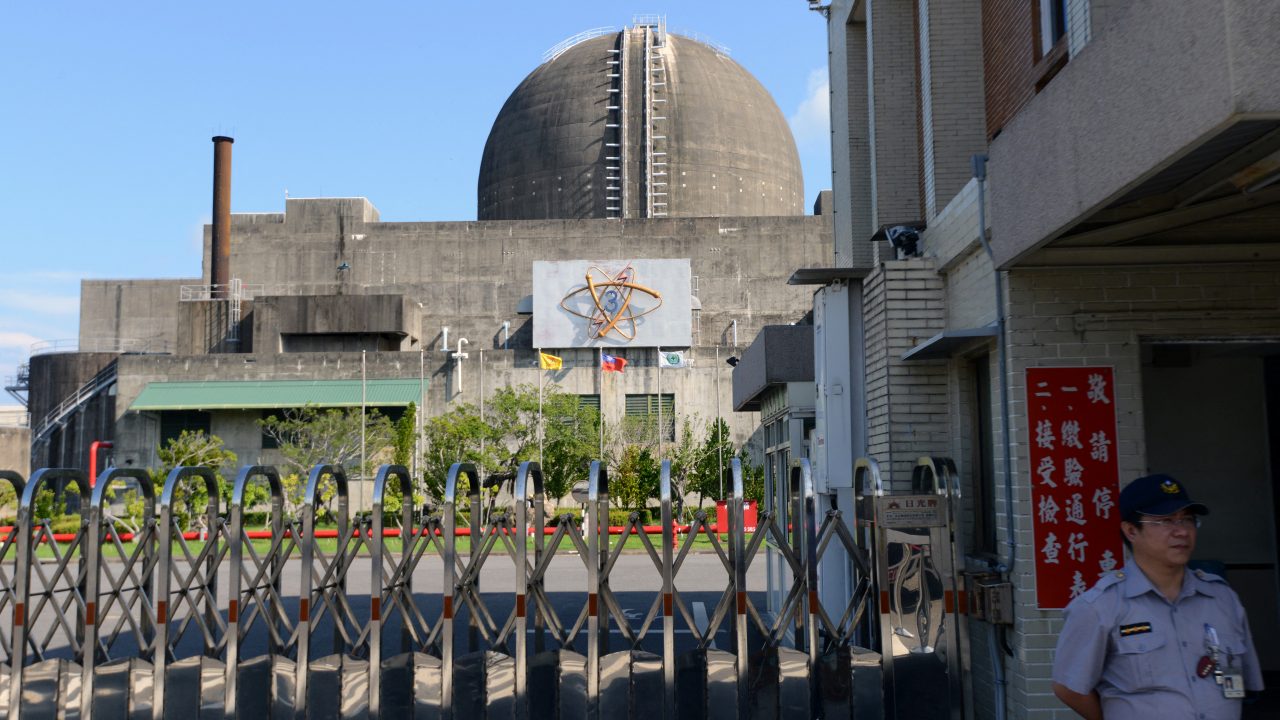
Last spring Taiwan shut down its last remaining nuclear reactor at the Maanshan power plant, finally achieving the “nuclear-free homeland” that the ruling Democratic Progressive Party (DPP) has been chasing since 2016.
Now nuclear power might be coming back. Just before the license for Maanshan’s second reactor expired in May, the Legislative Yuan amended the Nuclear Reactor Facilities Regulation Act to allow plants to extend their lifetimes 20 years beyond the previous 40-year limit, paving the way for Taiwan’s decommissioned reactors to restart. The Chinese Nationalist Party (KMT) and the Taiwan People’s Party (TPP), which hold a coalition majority, promote bringing back nuclear power to support a stable power supply.
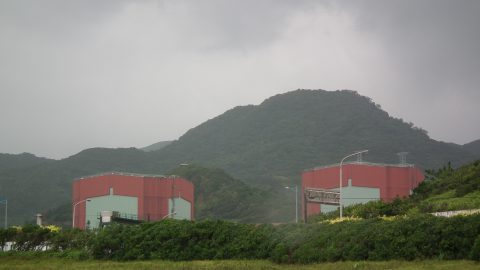
The Ministry of Economic Affairs recently approved a report submitted by Taipower, the national electric utility and the operator of Taiwan’s nuclear plants, which said that two of Taiwan’s four nuclear power plants could feasibly restart. One of those plants is Maanshan, whose two reactor units were decommissioned in July 2024 and May 2025. The other is Kuosheng, which was decommissioned by March 2023. Taipower is expected to submit restart plans to Taiwan’s nuclear regulator, the Nuclear Safety Commission, in March of next year.
Taiwan needs more energy and needs it fast. The country is almost totally reliant on imported fuel, a vulnerability that is exacerbated by the expanding energy demand of the tech sector and the geopolitical pressure of a potential Chinese blockade or invasion. Taiwan is preparing for blockade scenarios that could occur as early as 2027. In a full maritime blockade, Taiwan would need to subsist on its energy reserves and renewable energy. Taiwan could last a year in the most optimistic scenario, but this would require cutting energy consumption by one third, something that Taiwan is not yet prepared to do.
Now that there exists a legal pathway for Maanshan and Kuosheng to restart, Taiwan’s installed capacity could theoretically be bolstered by nearly four gigawatts. In 2020, when both Maanshan and Kuosheng were still operational, nuclear power contributed 31 terawatt hours of electricity. That’s roughly 12.4% of Taiwan’s current electricity consumption.
A key question is how long a possible restart would take. If a safe nuclear restart is not feasible within scenario projections for blockade windows, then perhaps Taiwan’s energy planning should focus on bolstering its coal reserves or installing more renewable capacity.
To be sure, restarting nuclear power would be a major political battle. A referendum this summer on whether to restart Maanshan failed. Although a majority supported its restart, not enough people voted for the referendum to pass. Assuming there is sufficient public and political consensus on restarting nuclear power, how quickly could Taiwan’s plants resume commercial operation?
The best bet for a quick restart is Maanshan. Neither Maanshan nor Kuosheng have been disassembled. But Kuosheng has been sitting idle for longer and has spent fuel that still needs to be removed. Taipower says that it would take one-and-a-half to two years to restart Maanshan. It would then take an additional year-and-a-half at least for government approvals, according to the Ministry of Economic Affairs. This puts the earliest possible date for its restart at the end of 2028 “in the most favorable scenario.”
Experts Domino Theory spoke to gave different numbers for how long restarting Maanshan would take, ranging from 18 months to five years. This difference matters because one estimate puts Taiwan in a situation in which it has nuclear power to rely on during a potential blockade in 2027, while the other does not.
“If the government is sincere about restarting these things, and Taipower is sincere about restarting these things, it can be done,” said Jacopo Buongiorno, a professor of nuclear science and engineering at the Massachusetts Institute of Technology. “The time scale is in the order of a couple of years, based on U.S. experience.”
The timeline-driving tasks for nuclear restart are ordering new fuel, reconstituting the workforce and obtaining a license renewal from the regulator. Each step could take two years or less for Maanshan and could happen concurrently, according to Buongiorno. As for nuclear waste, “if there is the political will to restart these plans, the fact that spent fuel pools are becoming pretty full in Taiwan is not a real impediment, because you can move that spent fuel to dry casks, as we’ve been doing for 40 years in the United States,” he said.
Tsung-Kuang Yeh (葉宗洸), dean of the College of Nuclear Science at National Tsing Hua University, thinks the restart process could happen twice as fast as the estimate given by the government and Taipower, concluding as early as mid-2027. The timeline is compressed because Maanshan underwent routine safety evaluations leading up to its shutdown, during which major components like the pressure vessels and steam generators were evaluated. This happened each time its two reactors were refueled, which was as recently as the end of 2023 and the end of 2024, respectively. Yeh does not expect that any major replacements for Maanshan will be needed. Since Taipower has an existing contract with Westinghouse Electric Company, ordering new, custom fuel rods for the reactors would take 18 months, leaving the timeline unchanged, according to Yeh.
Jan Haverkamp, a nuclear energy specialist for Greenpeace, agrees that Maanshan’s reactors are in a “relatively operational position” but thinks that restarting it would take around five years. Haverkamp participated in nuclear safety discussions that occurred in Taiwan around 2013 in response to the earthquake that triggered a Level 7 nuclear disaster in Fukushima, Japan. Following stress tests to assess the plants’ disaster resilience, Haverkamp says some safety recommendations were deemed not worth the investment because their licenses were set to expire in the next decade.
Yeh clarified that in response to these stress tests, the Nuclear Safety Commission requested that Taipower build anti-tsunami walls and construct seismically reinforced buildings to house the emergency backup main control systems for both Maanshan and Kuosheng but that these requests have not yet been fulfilled by Taipower. The updates would take longer than 18 months, Yeh said, but they could be completed after the plants resume commercial operation.
Haverkamp also thinks that Maanshan and Kuosheng would need to be upgraded to the latest standard of technology, which would extend restart timelines. This is not a requirement per international law, Haverkamp said, but it is “normal practice.” “Taiwan considers itself bound to the Convention on Nuclear Safety, and under those principles, there is an obligation to reduce the chance of accidents as much as possible.”
Buongiorno and Yeh disagree. “The plant was built 40 years ago. So clearly, it is not the latest and greatest design. But that should not suggest it’s not safe, because these plants have been updated and upgraded, particularly for safety features throughout their lifetime,” said Buongiorno. “Every time there is either a new event or a new lesson from some kind of experience anywhere worldwide, there is very efficient sharing of information among all the nuclear operators, and the individual national regulatory authorities mandate changes for the existing plant.”
If the political winds shift in favor of nuclear power, the restart timeline would come down to the conversation that happens between the Nuclear Safety Commission and Taipower about what updates, including those that were proposed ten years ago, are really necessary. In any case, decision-makers should be acquainted with this debate, as the difference between 18 months and five years could be critical for Taiwan.


Leave a Reply